



In a digital world increasingly dominated by AI, understanding how to approach marketing with both strategic intelligence and ethical integrity has never been more crucial. This special episode features a conversation originally hosted by Gert Mellak on his SEO Leverage podcast.
Our discussion explores the power of intentionality in marketing and how it creates energy that attracts the right opportunities. We examine the challenges of working with billion-dollar brands versus nimble startups, and why I prefer collaborating with hungry companies open to innovation.
Our discussion explores cross-channel strategies that boost search rankings through social media. I explain how Google’s approach to link penalties has evolved over time, and we dive into ethical concerns around AI-generated content and its implications. I share my thoughts on the “Dead Internet Theory” where originality fades away and online discourse is mostly bots. You’ll also learn about writing for three distinct audiences to maximize your content’s impact.
You’ll discover how intentional marketing creates a powerful edge in this new era. Now, without further ado, on with the show!
In This Episode
- [04:10] – Stephan Spencer emphasizes the importance of intentionality in achieving great things and shares his personal journey of spiritual awakening.
- [07:43] – Stephan explains the frustrations of working with billion-dollar brands that have strict visual guidelines, making it difficult to optimize for SEO.
- [14:47] – Stephan shares an example of Justin Bieber’s strategic social media campaign and how it could be optimized to benefit SEO.
- [20:36] – Stephan believes that AI will make it easier for Google to spot unnatural patterns and penalize sketchy practices.
- [34:18] – Stephan advises writing for three audiences: the linkerati, the core audience, and search engines.
- [39:05] – Stephan emphasizes the importance of quality over quantity in content creation, advocating for remarkable content that resonates with the audience.
- [40:32] – Stephan believes that readers will become better at identifying content with soul and originality, leading to a more authentic online experience.
Welcome back to seoleverage.com. My name is Gert Mellak. This is episode 106, and today I’m very pleased and really appreciate that you took the time to be a real SEO expert, one of the greatest SEO we look up to in this industry, and have been for a while. Stephan Spencer, welcome to the show.
Thank you, Gert. It’s great to be here, and thank you for the kind words, absolutely.
If you’re an SEO and you haven’t been living under a rock, you probably have heard of your books, like the art of SEO, or social e-commerce, or like you heard you speak at some point. We got introduced a few years ago by our common business coach, my mentor, Tim Franco, whom I definitely appreciate, had some touch points there as well. But you have been on my radar for quite a while, even earlier, with your books, obviously, with the speaking arrangements and something I definitely want to try to extract some information out of you around cross-channel. SEO is not something many people speak about, but I know you have had quite some experience, and you definitely have this perspective a little bit beyond what is the narrow focus of SEO, and really look a little bit above the fence and see how else we leverage other channels, and see that it is a little bit more global.
I want to mention that I had the pleasure to speak in your marketing speak podcast, which came out recently. You’re also the host to get yourself optimized. You’re very much in personal development. In academics, you’re surrounded by really big names like Jay Abraham and Tony Robbins, so reading your history, my first question probably would be, how are you able to bring so many things in such a short life? I mean, your about page really reads like you probably don’t sleep much more than four hours. Do you?
No, I slept last night. I think I got a full eight. But so let’s just see we’re actually working while we’re sleeping. I don’t know if you knew that, but we all work while we’re sleeping. We’re in the astral realm or doing studies or whatever. Our soul leaves the body and then goes and does stuff. We don’t actually take a break. Our body might take a break.
Definitely, definitely impressive about pageants.
But in answer to your question about how I get all this stuff done? It’s really about intentionality. If I bring a strong intention, let’s just say I show up for a family reunion. There’s one every year in Michigan that I go to most years, if I just showed up, let’s say it’s a speaking gig or a podcast interview.
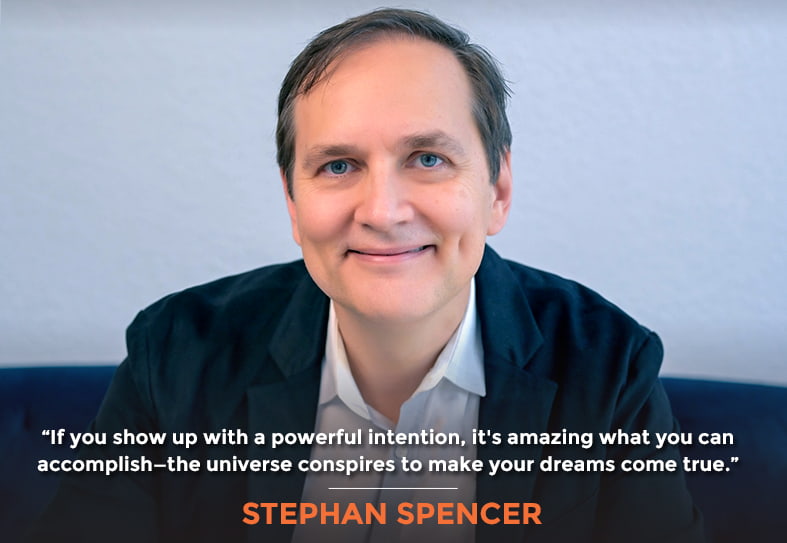
You accomplish great things by just realizing and surrendering to the co‑creation, the collaboration that you have with your Creator. Share on XIf I just show up without intention, then maybe some good things happen. But if I show up with a powerful intention, let’s say to reconnect with somebody in my family at the family reunion that I haven’t really spoken to for a while, or maybe somebody I hadn’t ever said I love you to because it’s just so awkward, because they never say I love you to anybody.
If I overcome that discomfort and do the uncomfortable thing, get outside my comfort zone. That’s my intention. It’s amazing what you can accomplish. It’s like the universe conspires to make your dreams come true. You don’t have to do all the hard slog, all the Gary Vee sort of hustling. You can get kind of carried down the river instead of having to swim it. That’s how you accomplish great things, by just realizing and surrendering to the co-creation, the collaboration that you have with your Creator.
Very interesting. Have you always had this intentionality around the things you do?
No, I had to learn some hard lessons. I used to be agnostic, and things were very hard back then. There’s this quote from Carl Jung that life really begins at the age of 42, up until then, it’s just research, and it was age 42 in fact, where I had my spiritual awakening in India, getting touched on the head by a monk. I know this has nothing to do with SEO, but it does answer your question about intentionality, getting touched on the head by a monk, getting a oneness blessing put me into a psychedelic state. I’d never done drugs.
I have still never done any drugs. But from my understanding of what a psychedelic state is, everything is kind of like in technical or super bright, like a cartoon. That was what happened. I felt this deep sense of peace, connection to the Creator. Remember, I was agnostic, didn’t believe in anything other than science. Had a master’s in biochemistry, real nerd, and then, boom, I get plugged into the fabric of creation, and I feel so useful and connected and deeply loved. Then all the miracles started happening. It’s just been one after another after another. It’s quite magnificent.
It definitely sounds like a life-changing event. I do want to get us a little bit back to our main topic today, SEO, but it’s definitely nice to have some personal background. I don’t know, you have been doing quite some personal development as well, obviously, with some of Tony Robbins and the like. Definitely all fits together. One of the things I want to point out is that it’s really interesting. You have been working with a lot of big brands.
In our case, we’re mostly with six- or seven-figure businesses, mostly e-commerce sites, online courses, and coaches. This is probably where we have a little bit more of our focus. I know you’ve been working with a lot of international, multinational brands, eight, 910, figures. Probably, what is the difference in challenges for the big companies when it comes to SEO, when compared to a six or seven-figure company? Is there anything in particular that is very different there?
It’s big. Let’s say with a six or seven or even potentially an eight-figure brand or organization, there’s nimbleness that you don’t have with a billion-dollar brand. A billion-dollar brand can be incredibly frustrating to deal with. We even had one that we fired; it was so untenable. But let’s just take an example where let’s say that it’s a very visual, high-end, stylish brand, and they’re very particular about what goes on the website, so it’s very visual, not much text.

Let’s say that the most important pages of the site, things like category pages, homepage, of course, were required to be all visual with no text, and that was a guideline from on high, you can’t change that. Here comes an SEO company, my team is trying to optimize a website where the most important pages we can add any copy to are incredibly frustrating.
I loved being able to have on my portfolio, on my client list, big brands, but I realized that was ego, and so I’ve stopped trying to focus on the big household names, and instead focus on companies and organizations that are more nimble, flexible, able to implement the changes that are required, and they have an incredible mission that are changing the world, making it a better place, not just providing yet another beautiful thing to wear that’s interesting.
I have my own experience with one of those companies, which I think was more of a technical nature. I think I asked them to create a subdomain, or change a subdomain, or something like this, something where you would usually, my usual client was probably the owner of this domain. I talked to them, and they would open up their domain panel, and they would walk them through the steps to make this change, and in two minutes, we would be finished. I was like, on this call, I said, “If you could just open, or if you have permissions, can you just open this panel, and we do this really quickly.“
Focus on companies and organizations that are more nimble, flexible, able to implement the required changes, and have an incredible mission to change the world. Share on XI remember the CMOS saying, “No, no, this is, this is not going to headquarters, and they’re going to respond in a couple of months.” They probably. Is going to send this to our country’s headquarters, and they also take a couple of months, and probably around six months or so, we could create this subdomain, but there is a chance that in five months, they tell us they don’t want to do this. It was like the moment where, say, okay, probably we this is not going to be our best case study, just because it’s just such a rigid system just for Google Ads landing page, I think we did on top of some SEO optimizations, but it’s just such a rigid system. There was no way to move anything. It feels like pushing the Titanic as a small agency, even with 30 people, we can’t do this, and it was really frustrating.
I absolutely see this point. Another thing we have come up with was really that we would just randomly add or remove stuff we were working I remember, I think it was Regis years ago, and we had two countries, then suddenly you get five countries, and suddenly they take this away, then centralized, they move things around, like in a spreadsheet. Whenever they move something on a spreadsheet, you get a notice on what needs to change. Hard to maintain, like a long-term strategy.

Circle back to and correlate to this question, a question you asked a few minutes ago about cross-channel and integrating different departments or functions channels together, so with a big company, inevitably, it’s like pulling teeth to try to get that cooperation to happen. There are silos in the organization. Social media is run by a completely different team. They don’t talk to each other, they don’t coordinate anything, and they probably don’t even like each other. That’s very frustrating. On the flip side, if you’re working with a small, nimble, hungry company. I love Les Brown’s adage, you got to be hungry. I don’t know if you know who Les Brown is, but he’s a super-inspiring, motivational speaker and personal development guru.
I want to work with companies that are hungry, and if they see there’s potential to integrate these two different areas together and gain some leverage. Because if you have, let’s say, a campaign for a book launch that is pretty much focused on social media, and you’re not taking into account SEO, what if you merge those two initiatives together and you coordinate and so now you you didn’t have a knowledge panel on Google, and now you do, because maybe you’re not in Wikipedia, but you’re in Google Books search.
And what is the description that’s displayed in your knowledge panel was thought about ahead of time by the team that coordinated the book launch, and it was a multi functional team that included SEO and social media expertise, and then you put out videos that aren’t, let’s say, just on Tiktok, but are on YouTube as well, and YouTube being the number two search engine and a much more important property from an SEO perspective than Tiktok, then you’re kind of leveraging the opportunity to its fullest potential, but also bearing in mind that a lot of these social pushes that you’re going to do aren’t going to have any real tangible effect on SEO because of the links being no followed from all the social platforms and so forth. You’ve got to kind of think outside the box, and it’s really fun. It’s a puzzle trying to figure out how to leverage social platforms that actually yield an SEO benefit.
Google is going to get incredibly good at spotting AI-generated content.
Absolutely, and it comes down to this intentionality you mentioned in the beginning. Again, I remember client calls, where, usually, one of the first things I ask is how they get clients, and then they would mention their channels. We do some social media, we do some Google ads, we do this, we do that, and usually then I try to get the contact details of the people working on the team, just to reach out and say, “How do we do SEO?” You’re doing Google ads. Is there a chance to exchange some information?
We have found some things that convert really well, which might be interesting for you. Maybe you can give us some keywords that are converting well, and we can add this to our research, into our process, and then you just see the real difference, where you say it is one company that also wants this SEO project, but they only got Google ads, so they’re kind of trying not hear too much.
You have other projects where it’s like a dream working on this. You get together on a Zoom call. Every have a good time. Everybody has the intention to get the best results for this client. It’s really a dream working on those projects. I love those projects where you just say, “Okay, hey, I found something that converts really well. Don’t you want to do something on social media about the same angle, because it seems to be resonating?” The YouTube person comes back and says, “Hey, we just had a video go viral. Let’s take some keywords.” It could be interesting, and everybody just trying to get the best results is really amazing. What would be a use case where you would say social media could benefit SEO, for example?

Let’s go back to the case of a book launch. I’m going to take a page out of Justin Bieber’s playbook. It’s kind of funny. He’s actually a very smart marketer. What he did back in. Day to promote the launch of a song called, What do you mean? I don’t know if that song, but it was quite popular. It broke some records, in fact, those that hadn’t been broken since the Beatles. What he did was he coordinated with a bunch of influencers, a bunch of his friends who are famous celebrities, people like Ellen DeGeneres, famous singers, Ed Sheeran, so amazing, amazing celebrities.
Each day for 30 days, he had at least one major celebrity do a countdown, put a post on social with them, holding a piece of paper that said day 30 or day 28 or day 26 or day 15, or whatever, all the way to day one and day zero, then, which was the launch date of the song, with the hashtag of what do you mean? So it actually said on the piece of paper, day 30. Hashtag, what do you mean? Let’s say Ed Sheeran actually did a little bit of a song that sounded like, What do you mean? It actually didn’t sound anything like the actual song, but he used a little bit of the lyrics or something.

That was intriguing to people. Let’s say it was Jimmy Kimmel or Jimmy Fallon, or somebody would do some funny-looking photo, so just a still image, holding the piece of paper or something, and it created quite a stir. How does that spill over to SEO? Well, what if you got these folks to have such huge followings on social media, many of whom probably have a pretty authoritative website, give them something that makes it enticing for them to post it to their blog as well?
Not just an embed of whatever they came up with for Instagram or YouTube or whatever, but gamify so that maybe it’s a fun puzzle or trivia question or interactive game or something that they can then post to give him a reason. Justin Bieber did not do this. He only did the social media portion, which was phenomenal. I mean, literally, he broke records doing this. But if he were to have put something together that addressed people’s desire to look magnanimous or just awesome to their fan base on the website as well. Well, then that would link back to Justin Bieber’s site, because whatever you put together would also link back, and then he’d get all this authority for Google.
That’s just something kind of off the top of my head that you got to really think strategically and outside the box, because that’s where all the juice is. Tactics are great. They’re very helpful. I use tactics all the time, but strategy can leapfrog those tactics. A great quote from The Art of War by Sun Tzu: “Tactics without strategy is the noise before defeat.” Trying to figure out some tactical way to link up social media and SEO, I think that’s kind of a waste of time. Might move the needle a little bit, but to figure out a strategy like the one I just outlined that could be a game-changer.
If you’re very intuitive and creative, you’re tuned into the fabric of creation.
Absolutely, it’s just big leverage as well. For a long time, even afterwards, people talking about this campaign might still, might still link to this, might still give this a little bit of a boost months or even years afterwards, very often in these kinds of things. I really like the strategic thinking behind it. Also, I’ve heard guys using social ads, for example, for link building purposes, where I just, like, give a lot of visibility to certain post or certain tip or something like this, and then tie this together with actually the end outcome nobody talks about is that they’re going to be a lot of links happening because, like you do say they have some sort of strategy where then everybody puts this on their blog, or even normal, smaller influencer campaigns, where there’s a blog component, where influencers might charge you a little bit more to also put this on their blog. But ultimately, this can actually be much more beneficial long-term than the actual campaign, with some stories, isn’t it?
The thing that I don’t love is when it’s like this kind of circular linking pattern that looks totally engineered. It doesn’t look like it was earned by merit, whereas in the hypothetical scenario I gave with Justin Bieber, it would be very viral-looking and natural for all those big celebrities to link to. Justin, but if it’s like, “Okay, I’m going to link to this person who’s also in my in this little wheel of promotion or whatever, and then they’re going to link to the next person, they’re going to link to the next person, and it’s all going to circle back, and we’re all going to link out and give each other some juice.” Well, Google can easily see the pattern in that.
Do you remember The Soup Nazi from Seinfeld? Remember that skit? Okay, so there’s a famous skit, and soup Nazi was famous for saying to Seinfeld or to anybody that he didn’t. Like, “No soup for you,” and then he’d make them leave his restaurant. That’s like Google saying no link for you or no juice for you. You got the links, and you think it’s working, but Google’s quietly saying to themselves and the algorithms, no juice for you. Absolutely.
It’s interesting how Google these days doesn’t even care about penalizing too much anymore. It’s been a while. Not sure about you, but it’s been a while since I have seen something that was obviously penalized by Google. I got a manual penalty issued. It seems like Google just demolished, just completely ignores, I can say, “Okay, they can do their thing, they can do their scheme.” I just don’t take it into account. That’s it.
Well, I think there’s more to it than that. Personally, I would guess that it’s not so obvious, but it’s essentially a penalty. When you have such sophisticated AI-based algorithms that the programmers don’t even know what the criteria are that the algorithm is using to base its decisions on. How do they even know when a penalty or algorithmic adjustments are even happening? It’s like the EEAT two Es. If you’re trying to build that expertise and authoritativeness and all that, and convince Google of that, it’s not in convincing the human reviewers, those manual raters anymore.
That was just training data. Now there’s enough training data for the AI to take it from there and make all these humans who are using those guidelines try to rate your site irrelevant. I don’t even know if they bother to spend much time or money with that team of human reviewers anymore, because there’s plenty of training data now that they’ve accumulated over the years from having that army of manual Raiders.
ChatGPT is a thief because it gets away with writing, maybe even coming up with article ideas.
We had just had episode 96, and I was speaking to Jonathan Gilliam from Originality.ai, so they have an AI detection tool. It was really fascinating for me, because I knew some detection tools like that, always the next word is this, like, the most likely word coming from a language model perspective. He was like, “The tool pretty much was trained with natural text and trained with AI text, and at some point, the tool figures it out.” They really don’t know how it does it, but it’s like, really, the tool just does its job, and it does a good job.
Apparently, get to 94 95% accuracy, which is really impressive, but it’s like this world now, apparently, where there’s a lot of stuff happening. Nobody has an idea what is happening, but then ultimately those algorithms make life-changing, or really impact business changing decisions for us. In this industry, obviously, for a while, I have lost count of how often people talked about link building going away, and links are not going to matter. Google, obviously, was trying really hard to figure it out without links. My feeling is that the more AI comes to the front line, the more important. What do you think about that?
I would agree. The reason why I think that makes sense is that the origins of links as votes is citation analysis, which happens in academic journals. The more prestigious articles, the ones that are the most milestones or leaps and advances in science, have mentions and other prestigious articles and journals about them, and they also mention in their references very prestigious articles. There’s no cruft making it into their references. Conversely, you find another article that references this one. Usually, there’s no cruft in that either.
Now, this is within peer-reviewed journal articles, back in the day before Google, and that’s a very brilliant innovation that came into the search engine world. Nowadays, you can find that there’s some gaming going on where, “Oh, let’s list all these prestigious things, and we’ll put some cruft in there too. That’s paying us.” Google has to up its game in terms of spotting the stuff and finding unnatural patterns and so forth. But as the AI gets more and more advanced, it can detect those unnatural patterns, not just in links and not just in content, too, in just pretty much anything and everything, there’s correlation.

Let’s say that you’re doing some sketchy link building, but you think that you’re going to get away with it, because you could just say, “Well, that was my competitor, but then you did some sketchy stuff a few years ago on page? Well, that on-page stuff will come back to bite you now, even though you got away with it back then because it painted a picture.” Now, with the AI, as this is a sketchy guy or gal doing unnatural stuff, the Link building is probably their thing too, because of the on-page stuff they clearly did. Get hacked to do this sketchy on-page stuff. Now they’re doing sketchy off-page stuff, and it’s them. It’s almost certainly them, and the algorithm is going to be right.
Absolutely. Makes a lot of sense. Where do you think AI is going to go? We now have, in the middle of when we record this, the end of January 2023, we have a big boom in ChatGPT. Even people who have never been really technical are starting to play with it, starting to write posts about it, with it, articles, etc. What’s your view? I mean, this is moving really fast. I was just reading an OpenAI article about GPT-4. There are going to be lots of expectations around it to talk about video being AI-generated very soon as well. How do you think Google is going to react when content creation is so commoditized that it really doesn’t take skill anymore to put together a 500-word article page about whatever industry you want?
I think the AI at Google is going to get incredibly good at spotting AI-generated content, because what’s missing from an AI-generated article is soul; there’s fact-checking, and there’s stuff that’s not relevant. I was using ChatGPT just as a test to create a bunch of article titles and descriptions, and there was stuff in there about Penguin and like, what the heck, you have to stay current on SEO algorithms like Penguin, and no, that’s pretty terrible. Somebody needs to fact-check all this content if they’re going to have ChatGPT generate their articles for them.
But further from that, imagine, if you’re very intuitive and you’re very creative, you’re tapped in, you’re tuned in, you’re turned on to the magic, you’re plugged into the matrix, and a good way into the fabric of creation. You’re like this dumb terminal plugged into the supercomputer. It’s like universal Google, but it’s universal intelligence, and imagine what you can create from that. Do you know that Paulo Coelho’s The Alchemist was written in 12 days? Amazing book, 12 days. He just downloaded it from the Universal Intelligence, the bigger, better cloud, and it sold 150 million copies. I’m sure you can find plenty of other kinds of examples like that.
Most of the internet is fake, written by bots, and we are getting fooled.
How is an AI going to achieve that? Can’t, because what it does is, it doesn’t stand on the shoulders of giants. It steals from the shoulders of giants or from the Giants, so there’s no credit to all the originators that the AI model is based on. You see, ask it for this artwork, an impressionist style, blah, blah, blah, blah. It does the thing, and it looks amazing. Amazing. Where’s the credit to Matisse or to whoever the originators are that the algorithm is based on?
Would you expect some regulation there? Or would you expect just for the platforms to be smart enough not give it visibility?
I would expect that ChatGPT and similar tools will get away with this, but it has karmic repercussions. When you steal without giving credit, Karma comes to bite you in the butt. I’m contemplating maybe starting a campaign, like a hashtag, ChatGPT is theft, because it gets away with writing, maybe having it come up with article ideas, but once you have it, writing the article titles and then the articles themselves, like, “What’s a slippery slope? Where does the inspiration end and the theft begin?”
I remember I had a discussion with Dixon Jones here from InLinks, and I think he said something that we are dumbing down the internet because it’s going to be AI copying from AI at some point. There’s no innovation, more, nothing new. Nobody is really thinking through and or presenting a different angle, which obviously has its point there. Then others say, “Obviously, it’s an efficiency tool.” It can, rather than sitting down and creating 100 article titles to pick the best one, you can read the 100 article titles and pick the best one. I’m really curious what Google is going to do. What I expect, what I tell people I expect, is some sort of integration in Google Search Console.
Probably, maybe they show some warnings, as they do with core web vitals and with links and everything that has come up that was like altering the overall scheme a little bit. Google eventually had some sort of warning. Issued and demurring and things like that. I am interested because it’s really, I guess, they need to define some sort of threshold. I mean, it’s going to be the AI defining the threshold. They’re not going to say it’s kind of 30% is okay. 31 is not okay. But there must be some sort of threshold, I guess, where they still allow some efficiency and say, “Okay, it’s more efficient to do it this way, but we still need to balance it out a little bit.”
The things you’re meant to experience and to be in your life are going to happen. They’re waiting in the wings like a supporting actor. It’s not random chance. You had to miss the train. That’s the only answer. If you live life like… Share on XI think you’re still thinking like a computer program that someone would have written, rather than a generative AI figuring this out, like take one very sophisticated AI that we can’t figure out what its attributes are and what the thresholds are that if we cross, we get the big red X. We’re not going to know. We’re going to try to reverse engineer it. But will we succeed in it? I don’t know, and I don’t think it’s in Google’s best interest to share that threshold with anyone in Google Search Console or anyone else, anywhere else. Have you heard of dead internet theory?
No. If you Google it, you’ll find that there’s a lot of information about it online. The concept is this, that it’s credited to conspiracy theorists, but there’s a lot of truth in this. If it’s not true now, I have a feeling it will be true later, and that is that most of the internet is fake, written by bots, for bots, all these social media posts and so forth, that they’re clamoring for change. There’s a lot of it that’s fake, and we are getting fooled. We’re getting swayed by it.
Popular opinion is swayed by fake content, fake outrage, fake travesty and tragedy and so forth. Much is fake, and we don’t know to what degree.
Popular opinion is swayed by fake content, fake outrage, fake travesty and tragedy and so forth. It’s all fake. Much is fake, and we don’t know what or to what degree, but I have this sneaking suspicion. It’s going to get a lot worse as tools like ChatGPT really hit the mainstream, and more and more people realize that I don’t have to toil for six months or six years writing a book, I can create it in five minutes. Give ChatGPT a storyline as a prompt, and let it write 50,000 words for me.
This gets even, even worse, I think, especially when you think, okay, most of what we see is probably skewed somehow. When you then see the movements in social media networks in the last couple of years, where they actually feed you more of what you already think, anyway and already like and already engage with. It just feeds you more, and to get more confirmation about whatever you think is probably wrong anyway and not based on facts. It’s going to be an interesting scenario. I do believe there are platforms that are definitely going to figure it out.
I guess Facebook at some point, but probably, for example, base it on whatever they want to push, what they allow, what they don’t allow, reminds me of another theory that I’ve heard, that people, as we don’t read anymore, we’re just guided by headlines. Not sure where this comes from. I would love to credit this to someone where they say, “Okay, read all the news. Everything we think we know is based on headlines, because we have never read the entire article.”
You just base your emotions on the headlines you get, based on headlines, you have certain emotions that affect your values, your beliefs, and this is pretty much what you think you know, and nobody actually cares enough to read the entire thing. It’s definitely, it’s another rabbit hole. I want to just wrap this up a little bit, a really interesting discussion here. I want to wrap this up a little bit and really talk about some strategies our listeners could take away from your experience, really coming back a little bit to content creation.
A six- seven figure company online course creates a piece of content. What would you say? Should they take into account, in order to make this article really resonate with the users, first of all, obviously resonate with the users, ultimately, pretty much everybody we talk to wants to drive conversions, but also stand a good chance to rank on Google and actually get the links necessary to be backed up and stand there as a good piece of content.

Great question. This is a little bit of a complex answer, I think simple, but there are a lot of kinds of parts to this. The first part is that you’re writing for three audiences. You’re writing for the link, karate, those influencers who have a lot of authority, trust, and importance in the eyes of Google. You’re writing for your core audience, that ideal client avatar, and you’re writing for search, you’re writing for Google, you’re writing for rankings.
These can compete with each other, like, “Oh, I want to have a keyword-rich headline for that third audience, but that’s probably going to take away from the curiosity gap that I’m trying to create for the link karate, I’m trying to bait the linkerati.” “Oh, I gotta click, it’s kind of clickbait, but it’s link bait.” By putting all these keyword-rich phrases in there, it waters down that ability to be really punchy and create that curiosity gap. A curiosity gap is where somebody looks at the headline or the title of the article, let’s say, in a Google search or in a social media feed, and they just can’t help themselves. They have to click on it.
You don’t give away the punch line straight away. You kind of give it to them bit by bit. You don’t want to show your cards too quickly. That’s a style of writing that is not easy to accomplish. You have to do that with intentionality.
Have some provocative adjectives or adverbs to further sex up the topic and the main keyword you’re targeting.
On the other hand, that audience that you’re trying to reach of the algorithm at Google with, let’s lead with the most important keyword in the title, and then let’s make sure we mention that keyword in the first paragraph, and maybe a couple times in the first paragraph, at least one other time in the next two three or four paragraphs, these two strategies do not normally intersect, and somebody writing for SEO copy is usually not trained on how to write link bait or stuff that’s going to appeal to the linker, Adi and vice versa.
You’ve got that audience, the second one that’s the most crucial to the business, and that’s the ideal client avatar. Because if you’re posting something to your blog and it’s just a link, baby, and it’s not really talking to their core audience, then it’s a big mess. It looks like you’re talking to your ideal client and not to them. How do you accomplish all that? Well, you probably can’t accomplish all of it in one article. You probably need to have a plethora of articles, some of which have some overlap and targeting between those three audiences.
Sometimes you can target all three very effectively, but in most cases, it’s just one or two. You can’t just say, “I’m going to post two times a week, because what’s that to post? Threshold addressing? Who is it addressing, and what problem is it trying to solve? This is difficult stuff.” One thing I recommend as a process is think of this as a funnel, or a multi-phase process where you’re starting with the topic, and then you’re going to the headline, the title of the article.
Maybe you’re going to have some provocative adjectives or adverbs to further sexy up the topic, the main keyword you’re targeting. Now that you’ve got the title, you can come up with some bullets, like an outline for the article, and maybe you’ll also come up with a few viral-type images, memes or things like that. Let’s say the topic is the kitchen sink. Well, then you’re going to do a Google Image Search for funny kitchen sink and Google image search or kitchen sink meme in Google image search, and see which ones you can use.
From a copyright standpoint, fair use and all that in Creative Commons, you’ve got to take all that into account. Which ones can you use, and which ones can’t you? Now you’ve got a really good brief, a writer’s brief, that you can give to a writer. Where’s the AI fit into all this? Maybe in the first part, where you’re trying to figure out the topic.
You can definitely ask ChatGPT to sexy up the article. Let’s get additional variations here.
Yes, but then again, I feel that that’s a slippery slope. Once you get the article titles from ChatGPT. What’s stopping you from getting subheadlines and what about captions to go under the images that you found on Pixabay or Unsplash? It’s a slippery slope, and it’s all theft, in my view, it’s all theft.
What is, in your opinion, the quantity and quality comes in when it comes to content creation? Imagine a new site starts out, and they want to do SEO. How do you balance quantity versus quality in blog articles?
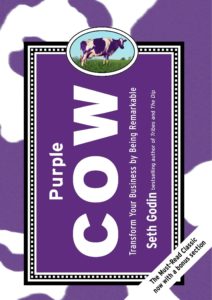
It really is all quality. Quantity, I think, is a mirage, like in the desert. If you’re trying to hit three articles a week, and you’re not really going for the quality, and what is quality, it’s something that’s remarkable. I’m going to use Seth Godin’s definition of remarkable: worthy of remark. That’s from his book, Purple Cow. If it’s not worthy of remark, it doesn’t matter if it’s two articles or 200 articles a week; you’re going to get trampled. ChatGPT will eat your lunch.
If it’s not worthy of remark, it doesn’t matter if it’s two articles or 200 articles a week; you’re going to get trampled.
How are you going to tap into that Universal Intelligence, the universal Google up there, to come up with such incredible, insightful, helpful, thought-provoking, maybe controversial, maybe hilarious article ideas and topics and headlines and so forth, that you can then really serve an audience. With and remember that the audience isn’t just your core audience. It’s the linkerati, too, and that’s the audience that’s usually forgotten with all this article writing.
I also wonder, with all this, if we as readers are going to get better at identifying what this soul that you mentioned initially has? I say AI, content doesn’t have a soul. Maybe we get a little bit better as well. Based on our signals, we give Google what we like and what we don’t like; this also helps feed this back a little bit to have an additional layer of a filter.
I do believe that. I think I’m experiencing that myself personally. I don’t spend a lot of time on Facebook, but when I’m on Facebook, the stuff that I get in my feed talks about a positive filter bubble. I get the most awesome content in my Facebook feed. The danger for me is I get sucked into love and light, awesome, amazing stuff that’s very inspiring and beautiful, and then I blow my day away.
I had big plans for today, and I just spent two hours on Facebook. What did I even do? That’s why I deleted Facebook from my phone. Basically, have an unspoken, unwritten rule for myself that I’m not gonna go on Facebook on my laptop either, except maybe a few times a week. It’s so good for me, it’s great for my productivity. I could buy into the myth of FOMO. What FOMO stands for. Fear of missing out. But you know what? On a spiritual level, I learned this from one of my Kabbalah teachers. FOMO is assigned to turn and run the other direction, because that’s part of the illusion.
Something is off. If you think that every minute you’re not doing X, Y, Z, you’re missing out on something, something’s probably off.
The audience isn’t just your core audience. It’s the linkerati, too, and that’s the audience that’s usually forgotten with all this article writing.
FOMO is like the things that you’re meant to experience and to be in your life, like you’re meant to meet your soul mate, you’re meant to meet your next business partner, and so forth. Those things happen. They’re waiting in the wings like a supporting actor at the edge of the screen on the stage, waiting to make his or her entrance. It’s not random chance. It’s not like, “Oh, I just happened to miss the train, and now I met my soul mate.” Wow, imagine what would have happened if I hadn’t missed the train. That wasn’t going to happen. You had to miss the train. That’s the only answer. If you live life like that, everything becomes magic. Absolutely.
Very inspiring. Talk today with Stephan Spencer, who is very different from the usual episodes. I appreciate it. I want to be respectful of your time. Appreciate that you’re you gave us a message about your busy day here. Where can people go if they want to find out more about you?
Well, my main site is StephanSpencer.com. I have the two podcasts that you mentioned already, Marketing Speak, which is at marketingspeak.com and Get Yourself Optimized, which sounds like an SEO podcast, but it’s not about personal development, spirituality, biohacking, all that.
Definitely a good one for a run, my experience.
Yes, and for a workout or for a long drive, and that’s getyourselfoptimized.com.
Awesome, perfect. Thank you so much. Stephan Spencer, ladies and gentlemen, here we are in episode 106, we’re going to have a written summary and all links over at SEOleverage.com, forward slash. Podcast 106, thank you so much. Stephan, it’s been a pleasure to catch up again, and I hope we can do something like this again. Thank you so much. Thank you.
Important Links
Connect with Gert Mellak
Apps and Tools
Books
Businesses/Organizations
Film
People
Previous Marketing Speak Episodes
YouTube Videos
Your Checklist of Actions to Take
- Bring powerful intention to every interaction. Before showing up to any meeting, speaking engagement, or podcast interview, I set a specific, meaningful intention. This intentionality creates energy that makes the universe conspire to help me achieve great things without endless hustling.
- Focus on nimble, mission-driven companies over big brands. I’ve stopped chasing billion-dollar household names for my portfolio because they’re often too rigid to implement necessary changes. Instead, I work with flexible, six-, seven-, or eight-figure organizations that can move quickly, are hungry for results, and have missions focused on making the world better rather than just selling another beautiful product.
- Coordinate cross-channel campaigns that create SEO leverage. I take inspiration from Justin Bieber’s 30-day countdown campaign, where celebrities held signs on social media—but I’d add a strategic layer by giving those influencers interactive content (puzzles, trivia, games) to post on their authoritative websites too, creating valuable backlinks alongside the social buzz.
- Avoid circular linking patterns that Google can detect. I never create engineered linking schemes where a group of sites all link to each other in predictable patterns. Google’s AI easily spots these unnatural structures and quietly says, “No juice for you.”
- Recognize that links are becoming MORE important as AI proliferates. As AI-generated content floods the internet, I understand that links based on citation analysis (like academic journals) are harder to game and more valuable than ever.
- Understand that AI-generated content lacks soul and will be detected. I know that content created by ChatGPT or similar tools is missing the creative spark, intuition, and connection to universal intelligence that I can access as a human.
- Write content for three distinct audiences simultaneously. I plan my content calendar knowing each piece serves: (a) the linkerati—influencers with high authority who might link to me, (b) my ideal client avatar who will convert, and (c) search engines for rankings.
- Create curiosity gaps for linkerati instead of keyword-stuffed headlines. When targeting influencers for backlinks, I craft punchy headlines that make them unable to resist clicking—even though this competes with keyword-rich titles for search engines.
- Pursue remarkable quality over any quantity threshold. I use Seth Godin’s definition from Purple Cow: content must be “worthy of remark.” I don’t chase arbitrary publishing schedules like three articles per week because if content isn’t truly remarkable enough to make people actually talk about it, quantity is irrelevant, and ChatGPT will eat my lunch.
- Connect with Stephan Spencer for SEO expertise and personal development resources. Visit netconcepts.com to work with his SEO team, or check out his two podcasts: Marketing Speak at marketingspeak.com for marketing and SEO insights, and Get Yourself Optimized at getyourselfoptimized.com for personal development, spirituality, and biohacking content. Email Stephan directly at [email protected] or visit his personal website at stephanspencer.com for screencasts, webinars, white papers, and online courses.






Leave a Reply