



Marketing gets weird when it forgets there’s a person on the other side of the screen. The internet makes it easy to chase clicks, triggers, and tactics—and just as easy to lose the plot: real persuasion isn’t a hack, it’s a clear, defensible case.
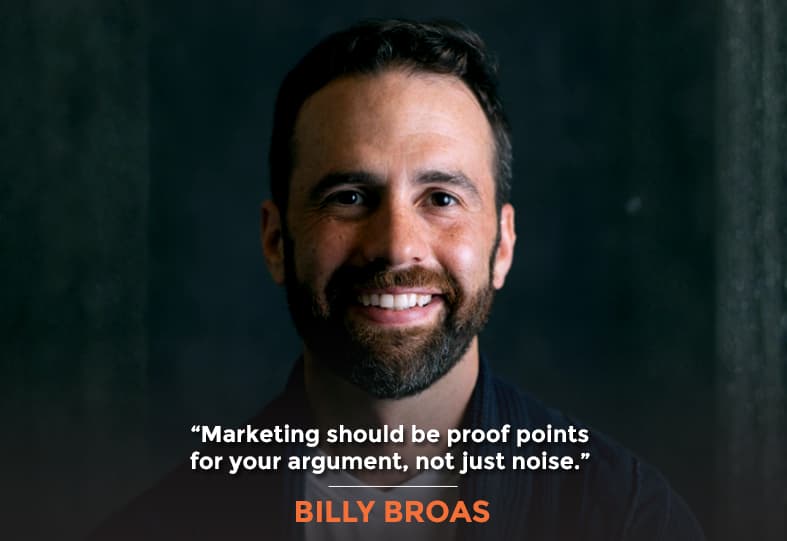
My guest on today’s show is Billy Broas, author of Simple Marketing for Smart People and creator of The Five Lightbulbs framework. He helps technical founders turn complex products into clear, persuasive arguments, and his new manifesto, Marketing Is an Argument, challenges the psychology-first playbook in favor of belief-building that actually holds up.
In our conversation, we define what a manifesto is and why Billy wrote one. We contrast “what works” marketing with marketing built on human dignity. He explains what it means to “re-enchant the transaction.” We also break down the upstream/downstream approach to messaging. Billy walks through the Five Lightbulbs as a practical framework and a belief-building system. And we talk about why content works best as proof, not noise. You’ll also hear how syllogisms reveal weak logic, sharpen claims, and align teams around one clear message.
If you want marketing that earns trust, sharpens conviction, and converts without the cringe, this conversation gives you the blueprint. So, without any further ado, on with the show!
In This Episode
- [05:20] – Billy Broas shares that many clients cannot be named due to NDAs, but provides examples like Tiago Forte and Ryan Deiss.
- [07:15] – Billy explains the gap in marketing advice, which often relies on psychology rather than philosophy.
- [13:03] – Billy discusses the “Great Human Flattening” and its impact on marketing, where people are reduced to data points.
- [15:59] – Billy outlines the three layers of the manifesto: moral, ethical, and practical.
- [21:10] – Billy criticizes the common definition of content marketing as circular and vague.
- [32:13] – Billy introduces the concept of syllogisms in marketing, using premises and deductive reasoning to build arguments.
- [37:42] – Billy emphasizes the need for a clear argument and proof points in marketing content.
- [50:00] – Billy encourages listeners to start with the manifesto and the book “Simple Marketing for Smart People.”
Billy, it’s so great to have you on the show.
Hey, Stephan, yeah, it has been a little while, so I’m excited to be back and continue this discussion with you.
Yeah. So first of all, let’s do a little bit of a recap about The Five Lightbulbs and why our listener should care what value it provides them, since they may not have listened to our episode way back in.
Yeah. Absolutely. So when I got into marketing and learned it really out of necessity. I became a T-shaped marketer, with a broad set of skills, but I really decided to go deep in one field: messaging. I saw that that was the big thing. I was using a lot of the tactics available. I was using all these different marketing channels, but what I saw, both for myself and for the clients I began to help as a marketing consultant, was that it really wasn’t a problem of which channel to be on? It really wasn’t a problem of which tactic to use. It’s a question of the messaging. What are we saying over these channels, and when do we use these tactics?
The Five Lightbulbs isn’t fluff or hype. It’s a durable messaging framework built to defend complex ideas.
So that’s when I went deep on messaging and then said, “Well, let me develop a framework here to help.” It was again, really out of necessity. I was running a group program at the time, and had to teach this messaging thing to 30 or so people without turning them into professional copywriters. And then, kind of a very meta moment, I had a light bulb moment about these light bulbs, and that’s when The Five Lightbulbs was born.
Awesome. And so what would be an application of The Five Lightbulbs, perhaps for your marketing, perhaps for a client’s marketing, or just somebody that you’ve used as a case study?
Yeah, so we use it both upstream and downstream. And by that, I mean we use it upstream, kind of like a brand manual to set, just like a brand manual, you set your internal guidelines for your logo and your fonts and everything. We use The Five Lightbulbs to create what we call a core marketing message. So we literally put it in a document. We call it a messaging map, and that is, and we talk about this more later, what that looks like, that it takes the shape of an argument, not like a conflict time and argument, but putting forth a thesis.
So once we have that, then the sky’s the limit, and then we use it downstream to create whatever marketing assets we need. So we can use The Five Lightbulbs to construct a sales letter. We can use it to outline a webinar or just a single email. And so we use it across every kind of industry you can think of, everything from E commerce, more low ticket physical products to most of my clients these days, are bigger companies, very science focused companies, very complex products that are hard to understand, where you really need to defend your product or defend the decision that you’re making if you’re buying these products. And that’s where The Five Lightbulbs are extremely handy. It’s a very durable messaging framework. It’s not fluff, not hype, that’s for sure.
So, can you share one of your clients who has used this framework, and maybe point to a couple of examples online of sales letters, lead magnets, or whatever items were guided by the five light bulbs?
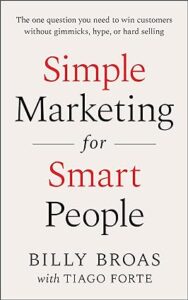
Most of them I can’t speak about because I have NDAs with them. But a very well-known one is Tiago Forte. So there’s a co-author around my book, Simple Marketing for Smart People, you’re very familiar with Tiago’s work.
Yes. So he was a guest on the podcast.
Yeah. He’s awesome, absolutely. So, he is writing his sales material. So we used it for his sales page. We used it for his email launches for his cohort. Another one who you definitely know your listeners probably know is Ryan Deiss, and he used it for his business.
Also a past guest on the show,
Exactly, yeah. Ryan is awesome. He actually helped guide me in the early days of The Five Lightbulbs. Ryan is an expert in creating marketing frameworks. We know that he’s the president of digitalmarketer.com and also runs a business growth company called Scalable for bigger companies. And we used it in the early days of Scalable to launch one of their very high-ticket programs. And did over half a million dollars in the first launch of that, using The Five Lightbulbs.
Awesome. And do you have case studies on your website that go through examples and use cases, and how this whole process is applied across different industries?
Some, I mean, the really detailed stuff, we have programs for that. So, I mean, if you go to billybroas.com, you’ll see examples, go to the top there, and you’ll see there’s a series I did called Behind the Message, and you’ll see some of the use cases of it.
Okay, awesome. Now, if we can talk about some of the more recent things that you’ve been up to the manifesto and the Simple Marketing for Smart People book, what was the impetus for creating another marketing book when there are so many out there?
We assume people are intelligent, rational human beings. If you assume that, you don't try to hack their psychology—you make an argument. Share on XYeah, absolutely, yeah. I really saw a big gap out there. You know, when I really got into this message thing, I realized that a lot of the copywriting and marketing advice out there, and your listeners know this, and you know this, marketing has a bad reputation, doesn’t it? It feels weird in a way. And a lot of the advice out there, you listen to it, you say, “Okay, that might work, but I don’t know.” It just makes me feel a little bit off, a little bit strange. Once I developed The Five Lightbulbs and started to do so, it was really, like I said, born out of necessity. But once I unpacked what it was, I really saw that it was a philosophical framework.
And by that, I mean it uses the tools of the field of philosophy, which is something that I did not have any exposure to. I’m a science guy. That’s my background. And once I dove into this and really explored this field of philosophy, I realized that so much of the marketing advice, nearly all of it that we get these days, does not come from that field. Still, it comes from the field of psychology, mainly behavioral psychology and neuroscience.
So I said, “Well, this is interesting, because we’re tapping into these tools of philosophy.” You know, you’ll hear copywriters say things like, ” Watch out for the claims that you’re making. Well, what does it claim? A claim comes from the field of argumentation. That’s not psychology, that’s argumentation, that’s philosophy. So I said, “Well, what else is really here?” And so that’s where I start to draw this distinction that really started to resonate with people, and why I wanted to share with you and with your listeners, this distinction between philosophy and psychology.
And really, my thesis, and what I talked about in this manifesto, is not that psychology is bad. I think it is extremely useful, and especially when it comes to using it online, with things like, you know, things that you have focused a lot of your career on, which is making websites very easily understandable, discoverable, usable, I think, is extremely valuable for that. However, when it gets into things like packing psychology, pressing emotional hot buttons, leveraging cognitive biases, all the stuff that I was super into, by the way.
I mean, you know, I still have on my bookshelf Robert Cialdini‘s Influence and books like The Illusion of Choice. But I started to think about what these books assume. And it really assumes that a person is really nothing more than a machine to be programmed. I mean, the book compares humans to turkeys, because of how we’re so predictable in our reactions. I really discovered that a lot of the unease in marketing stems from the fact that much of the marketing advice assumes we are really just lab rats to be hacked. And so I wanted to present an alternative that still gets the results we’re looking for, of course, but has. A stronger ethical and moral foundation for it, and frankly, it works better in the long term.
Yeah. So I think it’d be helpful for our listeners to understand what a manifesto is if they’re not really familiar with the term, so that you can then kind of set the stage for why you put this manifesto out there, right? It’s kind of like a call to arms of sorts. It’s a rallying cry about something that may be broken in society or the world, that you’re here to help fix, and that you want to galvanize people to be part of your movement. That’s kind of my take, or my understanding, of a manifesto.
I always prefer to clarify Jerry Maguire when he writes that one and walks into the office, never restricted. I didn’t get the cheers. But then again, I work alone, so maybe they were just invisible to me.
But yeah, as you said, it’s a vision. It’s definitely not. And again, this is a very meta lesson, and it’s funny because some people have said this. They’re like, “What’s the how-to behind it? What’s the practical application?” And it’s in there. But that’s not the focus of a manifesto. It’s not meant to be: do this, then do this, then do this. And that’s kind of the whole point. Because what I’m setting forth in this, this vision of, like, seeing a way we could perhaps redeem the marketing world, is that question, how does it work? What are the uses of this? It’s an important question to ask, but it’s a utility-based question, and we have to recognize it as such.
When we talk about a marketing tactic, we say, “Yeah, well, it might feel a little bit weird, maybe manipulative, but it works.” That phrase, it works, comes from a utility frame. And we have to ask, “Okay, are there other frames, perhaps frames that take priority and that?” And then I’m noodling on this, and again, studying this ancient field that we’ve forgotten about philosophy, and I’m seeing how useful it is to marketing and thinking, why have we not dug into this before?
In philosophy, you have this subfield of ontology, which is a, yeah, it’s an expensive word, but it’s pretty easy to understand. It’s just asking, what’s real? And so I drew this distinction between these two frames: one is the utility-based approach, and the thing that guides you is the question, ‘what works?’ And if it works and it gets results, then it’s okay. The ontology-based approach is what I was saying earlier: we’re really asking, “Well, what do we assume about the person reading on the other end?” What do we assume about human being?
A manifesto isn’t a how to. It’s a vision meant to change how people see the world.
And if we assume not that they are lab rats or machines to be programmed or hacked, but if we assume that they are human beings that are born with inherent dignity that doesn’t need to be earned and can’t be taken away, well then we treat people very differently, then we’re not hacking their psychology.
So I mean, clearly, you want this idea to be spread. What does the world look like once this idea has taken root and kind of spread throughout the world, and you have a whole tribe of people who are espousing your idea?
I love that question. Yeah, at the start of the manifesto, I talk about a problem I see called the Great Human Flattening, which is not just a marketing problem but a larger societal one. And I’m sure you’ve seen that your listeners have seen it too, and it’s this idea that everything that is complex, mysterious, and sacred has become flattened and commercialized, where love, for example, is now flattened into dating apps and grief is flattened into wellness products. Everything sacred, you can pretty much buy on the market now.
And then the same thing has happened with marketing, too. We don’t see people as people anymore, the people we’re selling to. We see them as data points, clicks, or conversions. So that’s really the problem. And then I see the solution to that once we start to change how we approach this. And the first question we ask isn’t, ” How does this lead to results, or how does it work? But what are human beings? And we start, and this is a key part. Yeah, I said earlier. Well, okay, we assume people are human, sacred, and dignified. That’s great, Billy, but then what does that? How does that change what we do? Well, that’s where the five light bulbs come into play.
If you assume that people are intelligent, rational human beings, because we certainly can be. I mean, we’ve gone to the moon. We’ve painted the Mona Lisa. If you assume people are like that and not like turkeys, then what do you do? You don’t try to hack their psychology. You make an argument. Because when you make an argument to someone, you assume they are intelligent and can understand it. They can think it over and make the right decision for themselves.
So, to answer your question, what does that look like? Well, I call that re-enchanting the transaction. So we’re no longer flattening the consumer into a data point, and on the flip side, too, the consumer, because it does go both ways. The consumer flattens the seller often as well. And you see this when there’s no customer loyalty, when customers walk into a store. Or they leave it a mess, with the clothes they were trying on scattered everywhere. They don’t have respect for it, right? So it does go both ways.
So if we treat each other with respect and treat each other as human beings that have inherent dignity, we re-enchant the transaction, which then, over the course of the millions of transactions that take place every day, we re-enchant the market and stop this problem of flattening and everything just losing what makes it really special and what gives it meaning.
Cool. So let’s walk through your manifesto framework. You’ve got this beautiful illustration that is really adorable, the way it’s illustrated.
Absolutely. Yeah.
So, of course, give credit to you and the illustrator, but I’d love for you to kind of just walk us through what the visual is. For someone who’s not watching the video, they’re listening to the audio. What’s the framework look like? Let’s start walking through it.
Then sure, so it’s got three layers to it. And the idea is really to connect our promises to our practices. So we’re taking these actions every day in our business. We’re taking marketing actions. We want to ask, “Okay, well, what is that grounded in? What’s guiding my actions?” So it starts with the moral layer. So that’s what you’ll see in the visual: you see a bear, yeah, that we returned, we brought back the bear from the five light poles for this other graphic, this marketing worldview graphic, is one you’re referring to.
When everything sacred gets flattened into a transaction, marketing loses its meaning.
So the first tree, the first layer, is the moral layer, and that’s that moral axiom that I stated earlier. We start by assuming that humans are sacred and have inherent dignity, and that this dignity cannot be taken away. And we can then ask also, “Well, well, how do we know that? Because that’s not obvious, but there are different paths to that.” I mean, for me, being Catholic, it comes from my Catholic faith. It stems from the idea of Imago Dei, that humans are born in the image of God and therefore have inherent dignity.
But the great thing about this is that there are other paths to that as well. There are secular paths to that. Immanuel Kant had a path to that. But not everyone agrees with that, by the way, like some people don’t think that there’s anything really special about human beings. If you see human beings as just advanced animals, as just skin and bones and chemicals, well then you are justified in the manipulation, in the psychological hacks and all that. So that’s why it’s important to get agreement upstream on that layer one, on that fundamental, fundamental axiom, because that dictates the approach that you use downstream.
So then, if we assume that, so again, this is the ontological side of this. So, asking what is real, what is true? And if it is true that humans have inherent dignity. Well, then, how do we speak to them? Well, it’s not those psychological hacks. It’s not leveraging the cognitive biases and all that. It’s not assuming the worst about someone, not speaking to their baser instincts, but to their higher nature, to their better nature. So that’s the second tree, the second layer, which is the ethic that we follow. And that’s this idea of making an argument, making an argument, again, not like I throw a phone against the wall, kind of an argument, but an Aristotelian kind of an argument, which, you know, I’ll just say, a common objection I get here as well.
But Billy, that sounds like you’re telling me to be Spock from Star Trek. And everything is very logical and cold, maybe even boring. And people don’t respond to that. People respond to that. People respond to emotion, to that. I’ll say, “First, that is not true, that phrase, that cliche that’s so common, and I write about this manifesto, or we can explore more if you want.” Stephan, this idea, this cliche that people buy on emotion and justify with logic, is not true. It’s partially true, but it gets a lot of things backwards.
The future of marketing isn’t psychology driven hacks. It’s argument driven clarity.
And second, it is totally possible to make an argument and weave an emotion, and you should do that. I mean, you think about a lawyer in a courtroom making a case to a jury in a very sensitive trial. I mean, those lawyers often use stories in their argumentation, but you can bet that they have a logical argument underpinning that story. So I don’t see the two as opposed. I don’t see logic and emotion as opposed.
I say you got to have that logical underpinning, because otherwise, we’re just in bizarro land, and your argument doesn’t make any sense. And as we know, confused customers don’t buy. But the way you make that argument, the way you make your points, should absolutely weave in stories and emotion, but also data as well, and facts bring it all to the table when you’re making your argument. So that’s the second idea: making an argument appealing to someone’s better nature, because that’s what you do when you assume a human has inherent dignity and can understand an argument.
Okay, so that’s the two pillars so far, the moral and the philosophical pillars or trees or whatever, and then the third one.
Now we arrive at The Five Lightbulbs, yeah, now we arrive at the practical. So this is really where the rubber meets the road. And this is where I started again, because I’m, you know, I’m not in an ivory tower theorizing this stuff all day. I’m actually working with businesses to create marketing campaigns, run launches, and do other things.
But what I want to do is connect it again, connect it back to okay, what’s the foundation? What’s behind this? And so on the first pass. And the way I still introduce The Five Lightbulbs. I don’t go into any of this. I keep it very simple: I call it the stages mode for The Five Lightbulbs. If you go to fivelightbulbs.com, that’s what you’ll see. You’ll see the stages of the five light bulbs.
So Lightbulb 1, where is that customer? Where is that bear? What stage is he in? It’s his status quo. It’s his problem area.
Light Bulb 2: Other things he’s tried before, that the customer has tried before.
Light Bulb 3, now we’re on the business, the business’s unique approach.
Light Bulb 4 is the offer, which includes the product,
and Light Bulb 5 is the customer’s desired outcome, the customer’s new life.
So that’s a quick version, and just from that alone, and that gives people Aha, is just right there, just thinking, Okay, well, am I hitting on all these light bulbs? But then, in the more advanced mode, I call it belief mode, which really leverages this idea of argumentation, and we see the five light poles not as stages, but as beliefs to be built.
Okay, so what would be an example of a belief to be built?
The way you make your argument should weave in stories and emotion, but it also has to bring data and facts to the table.
Well, the belief to be built for a light pole, one for example, is the belief that if you’re on the part of the customer, this business gets me, so if it’s me, for example, so Billy gets me, or Stephan gets me, or Apple, whoever it is, the company gets me. So we flip that lightbulb around. It’s still the same lightbulb, but we look at it differently. And so now we say, “Okay, well, if that’s the belief that I need to build, I’m a business, I need to build that belief that I really understand you, customer, I have empathy for you”, because you’ve heard this phrase before, and marketing that if you can describe the problem as well as the customer can, or even better, they will naturally assume that you have the solution to it. That’s the belief that you need to build. I understand it.
So that then brings in the argumentation. We turn that into a claim. The claim is: I get you, customer; I understand you. And then what does every claim need? It needs proof. So then we prove that through our content. In my view, mentioning the word ‘content’ brings up the idea of content marketing. I can go on a long rant about that. Still, I think this is a far better and more defendable approach to content marketing, where your content should really be the proof points for your argument, versus what most people say about content marketing, which is provide value reciprocity, again, one of the psychological terms, all these things that are just very vague and circular.
So what is your rant about content marketing?
Well, it’s really that. And I wrote an article about this, where I threw rocks at HubSpot, which I’m okay doing because they’re a billion-dollar company, and I’m just me here. Still, if you read their official training on content marketing, like their certification, they define content marketing. I can’t even repeat it to think the thing is so bloated and circular, but it is circular. You can even plug it in. It’s fun. If you take it and copy and paste it into ChatGPT, and ask, “Is this circular?” It will go, “Yep, this is circular logic.” It essentially says content marketing. Content marketing, at the end of the day, is what it says.
So, you know, they’re encouraging people to invest a lot in companies. You know better than anyone how much companies invest in content marketing. It’s like, okay, “well, if I’m investing this much, what do I do with content marketing, what should my content be?” And then the answer you get, “well, content marketing is content marketing, provide value reciprocity.” It’s like, “What now, like? We need something more defensible than that.” If we’re going to tell me I’ve got to invest more in content marketing for this, I saw that and said, “That’s a pretty lame definition of content marketing and guidance.”
When your content becomes proof for your argument, every piece advances the sale.
And so I think that this argument-driven marketing approach, whether you use The Five Lightbulbs or not, right? I mean, my Five Lightbulbs are my proprietary framework, and that’s why I structure it this way: the second layer, upstream of that, is argumentation. I think that’s actually the bigger idea here. I would love to see the field of marketing shift toward argument-driven marketing rather than psychology-driven marketing. And we’ve been doing this for a few years now.
When you do content marketing, and you take the approach that your content should be proof points that back up your claims, you get far better results. You have more confidence in what you produce, because each piece of content advances the sale. You attract more customers and clients by posting about your topic rather than just posting about your topic, which is what a lot of people do. I draw this distinction: topic-based marketing, argument-based marketing, topic-based content. They can attract a large following and get you a bunch of likes and followers. It does not, by any means, guarantee that it will lead to customers or clients.
So what are some of the actions next, actions that our listeners should take now that you’ve explained your premise and your framework, your manifesto, philosophy and so forth? What’s their next step?
Have your antennas up first. I’m drawing a lot of distinctions here, but a couple of primary ones. The main one is this distinction between a psychology-based approach, which you’re going to notice everywhere now. I mean, we are the fish born into the water that don’t know that we’re in water. We’re just born into a post-enlightenment world where reductionism is king. We reduce everything down to its constituent parts, like I say in the manifesto, marriage is just a piece of paper. Humans are just flesh and bone, and that word is very sneaky because it strips the meaning away from things.
And so since I started talking about this, and for your listeners, this is what I would look for: I have people forwarding me emails from, like, marketing gurus that they follow, and they’re like, “Look, Billy, look, look at the psychology hacking going on.” And the whole email is just straight out of the CLD playbook. And, you know, just all these hacks leveraging all these cognitive biases and zero arguments, zero claims, zero proof, zero reasoning.

I wonder if you’d notice the two Stephan, like the I kind of like B level C level copywriters, like, really leverage the psychological hacks. But when you get to the A-level copywriters, like the Gary Bencivenga, I mean, he’s famous for saying, “I always advise my clients to base their campaigns on their strongest proof elements.” I mean, those guys and gals like they make arguments so that I’m pushing for is now first notice this distinction.
Notice all the psychology-hacking advice that’s out there. Ask yourself, are they really making an argument here? And then for your own material, start to ask yourself, well, what is my argument? What do I stand for now? What is the thesis that I’m putting forward? What do I believe is important, and how does that compare to what my market believes is important? And then, how can I bridge that gap? Because we’ve all been in a situation where the thing that we know is important in our field, our customer, our client, our prospect, doesn’t think is important, and that’s going to cause problems, especially when it comes to us making an offer to them.
And we can discount all we want, but if the thing we know is important isn’t important to them, that coupon is gonna bounce right off. And the way we bridge that gap is to get them to realize, “hey, this thing really matters,” not through hacks but through argumentation. “
If you can describe the problem as well as the customer can, they will naturally assume you have the solution. Share on XYep. For the book, Simple Marketing for Smart People, does it go into the manifesto? Or is that something you came up with afterwards, after you published the book?
Good question. Yeah, the sequence, the manifesto came out afterwards. Yeah. The book was published in 2024, the manifesto just came out here at the beginning of 2026, and yeah, the book goes into argumentation. That’s kind of when I cracked open the vault on this idea of making an argument. It doesn’t delve into the moral layer, and some of the other parts focus on the difference between logic and emotion.
So you can think about the sequencing as the manifesto. I would start with the manifesto. It’s about a 10/15 minute read. And then the book, Simple Marketing for Smart People, which, again, is pretty compact. A lot of people knock it out in one or two sittings. And we also have an audiobook. And then after that, we have the five-light-bulb framework itself. And I’m even working on the book The Five Light Bulbs right now, and that’ll be out in 2027.
So, why did you partner with Tiago on this book instead of just solo-authoring it?
Topic based content gets attention. Argument based content earns trust.
It really goes back to our story. I mean, The Five Lightbulbs were born. I mentioned that the program that I did, which was really out of necessity, I had these 30 or 35 people. The reason I had so many people in this group program, I mean, most of my work is one-on-one consulting, or was until that point. And then people were asking Tiago, we had a lot. I had a lot of success helping Tiago out. And people were asking him, “Hey, can you help me with marketing? He has a lot of business owners in his audience.” And he said, “Well, that’s not really my thing. I’m a productivity guy, but here’s my behind-the-scenes marketing strategist, this guy, Billy Broas, and he asked me if I’d be up for launching a program to his audience.”
Tiago has a huge audience, so, of course, I said, “Yes.” It’d be silly to turn that down. At the same time, I was super worried, because it was a big stage for me, being behind the scenes. So Tiago was part of the story from the beginning, because we did that program, we spoke so much about marketing. We addressed so many of the problems people had and the reservations around it, especially this idea of just feeling weird about it, feeling weird about selling.
So at one point, you know, we had spoken so much about it, I said to Tiago, you know, we got a book here, and I said, “I tell you what. I’ll lead the project. And I think it’d be really cool if we had me speaking. But then we also brought in a case study of a business owner, an entrepreneur, a creator.” And of course, Tiago was a natural fit for that. So I really like how it turned out, just from an aesthetic perspective, with the kind of bouncing back and forth between ‘I teach a lesson’ and then we show how it’s implemented through Tiago’s Business.
Gotcha. And did Tiago write a lot of that case study material? Or did you mostly write it? And he kind of gave you his bullet points or his notes,
A lot of it we had already written. You’ve written books. So you probably know this. That’s the benefit of, like, writing constantly over the years: you have all these building blocks you can then put together into finished products. So we had a lot of it written. I mean, he definitely did some long writing sessions. He came out to say that his portion is about 20% of the book he wrote, maybe. And then what was really cool was we got to record the. Studio book together in a studio in Long Beach over a couple of days. And that was a good memory.

Awesome. Very cool. Yeah, well, I think highly of Tiago. I love his Building a Second Brain framework. I’ve had him talk about that on my other podcast on Get Yourself Optimized. And, yeah, he’s a really smart guy, so congrats on doing that project with him.
Thank you. Yeah, great guy.
So let’s walk through a little bit of the actual takeaways from Simple Marketing for Smart People. Like, what would be some of the highlights?
Yeah, well, the idea of the key phrase is belief-building. I actually want to back up. So like, probably the thing I’ve heard most about in regards to the book, the feedback, the thing that really landed most is this metaphor that I used in the beginning, called the upstream, downstream metaphor. I’ve used that a little bit. So I want to highlight that, because everything I’m talking about, the argumentation, the five light bulbs, fits into that metaphor.
And so the idea, again, like the brand manual, is to have a core message upstream, then distribute it downstream across all your marketing channels, and then that’s where you even the tactics. There are different ways to create an upstream message. Donald Miller has his StoryBrand. So he takes the same approach. He says, “Hey, create your story brand up front. I think the seven steps in Story Brand are steps in that journey, and then that becomes your funnels, your website, etc.
I think that’s brilliant. I think the idea of creating something for your core messaging up front and distributing it across your marketing assets is brilliant. I just think it’s a better approach to take an argument-based approach, because I see marketing as an argument. So that’s the perspective for this whole thing. Is it that you want the upstream and downstream in place? Your core message is upstream. Or different ways to create a core message in our world, that core message takes the shape of an argument, right?
I never do a marketing project now without first creating the syllogism behind it.
And as you said earlier, it’s not a fight or a disagreement. It is kind of like a friendly debate or just building a premise, yeah?
And that’s what I love about this: I’m a process guy. I come from the energy industry, where things are very concrete, and like you, I focus a lot on the process of creating energy, creating steam, creating a car. And so I took that approach to marketing as well. And what I love about that argument is that it provides a blueprint for creating one. There’s this funny little word called a syllogism. Have you ever heard of that one?
I have, yeah.
Yeah. I vaguely heard about it. I never thought I would actually use it, but I’m telling you, Stephan, I never do a project now without creating a syllogism. And I don’t think this is completely novel to the world.
Is that painful?
No, I mean, I’m a nurse. I think it’s fun, but it’s funny, because now again, I have people responding to my emails with their own syllogisms. So I’m like, I cannot believe that I’m talking about marketing. I actually have people creating syllogisms. It makes me very happy. Makes me very happy. But you know this idea of distilling, and so what is it? All right? So let me give you an example that will resonate with your listeners. So this is a very philosophical example. We can apply it to marketing.

So, a syllogism typically has the form of a premise, a premise, and a conclusion. So one might premise that all men are mortal. Premise B: Socrates is a man. Therefore, the conclusion is that Socrates is mortal. So it’s a structure that uses premises and deductive reasoning to reach a conclusion. Every piece of marketing has the same thing. Every marketing campaign has the same thing.
So if we distill it down, what we found is going to distill it down. And I asked myself, “what’s the syllogism? What’s the argument?” And in my head, that’s what the syllogism is behind this content piece, but one, it’s fun to do. By the way, you can do this easily now with LLMs. You can copy and paste the sales letter into ChatGPT and say, “Turn this into a syllogism.”
And often, the logic behind it is invalid. The wires don’t connect. It’s like one thing doesn’t lead to another. So that’s a sign, right? So what we find is that when you distill it down, and you get it right, it’s kind of like, I think about myself as like a plumber, like I’m hammering with one hand and I’m like, tweaking, I’m using a wrench with the other hand, trying to get everything to line up. When we get it right at the syllogism level, we nail our argument there.
Every marketing campaign has premises and a conclusion, whether you’ve thought them through or not.
Now, when you expand it into all this content, because you don’t publish your syllogism, it sounds more like legal language than marketing language, but that’s because it’s internal. When you do make it external, you publish it in sales pages and emails and Facebook ads and everything, because you got the syllogism right and the logic correct when it was so distilled, you know that it’s going to all line up when you expand it into these marketing pieces, and that’s how you have a consistent marketing message that doesn’t confuse people.
And you’re making the same argument across all your marketing and sales channels, which is rare for most companies, especially as they get bigger and have different departments. They’re making one argument over here, another argument over here. So I found, especially, I’m working a lot more now with teams. This argument-based approach, working with teams, really helps align the teams on the message.
Okay, so let’s apply the syllogism approach to Tiago’s business and his marketing.
Yeah. One of the things Tiago argues for is note-taking. That was a big thing for him: Building a Second Brain, but it was all about the features of his course and everything. Course and everything, and what do people need to believe to buy, that’s the question we ask in the book. Well, because it’s all based on note-taking, if they don’t believe in note-taking, then obviously that’s a problem.
So I don’t remember the exact syllogism for him, but that was the argument we were making. Is that, you know, you start with what you want in a marketing syllogism, which is customer transformation? So what his people were struggling with was this idea of information overwhelm. I listen to these podcasts, I read these blogs, but I don’t take any action from them. And then his courses provide the solution to that, but it’s based on a certain approach to note-taking.
Essentially, you’re struggling with this. And the big problem is that everything is just scattered. You don’t have a system for managing it. You want this. You want to act on your notes. You want to create creative projects and note-taking, which he can argue for. That’s been done for centuries. Da Vinci, we use that example in the book. He was famous for his journal, which stated that note-taking is the key to getting there. So we put that into a syllogistic form.
Consistent marketing comes from making the same argument everywhere, not different claims in every department.
We make these claims around note-taking and then all the objections that pop up around it, because you’re going to have objections around it. Well, Tiago takes too much time. I read this long blog. I don’t have any extra time to go take notes on it. Right? He has to make claims to address those objections. A claim like this doesn’t take much time, and overall, it will save you time in the long run. So we unpack this argument into all these claims, sub-claims, and proof points, and then that goes into his emails, sales pages, launches, and things.
Okay, cool. So I just used ChatGPT just now to create a syllogism about note-taking, and here’s what I came up with. So the major premise, premise A, is that if a practice improves retention and clarifies thinking, it strengthens learning. Minor premise, premise B is that note-taking improves retention and clarifies thinking. Conclusion, therefore, note-taking strengthens learning. I don’t know what the takeaway or the application of that syllogism would be. With Tiago is marketing, though, read it again once through. If a practice improves retention and clarifies thinking, it strengthens learning. Note-taking improves retention and clarifies thinking; note-taking strengthens learning.
There we go. So that phrase note-taking clarifies.
It strengthens learning. So it strengthens learning, yeah, because it improves retention and clarifies thinking.
You can see how you can take all these things apart into their own claims. So just that that improves retention, that it improves learning, that it clarifies thinking, those are all claims that Tiago is making, and he should not take those things for granted, that his audience knows those things for one or believes those things too.
The first question in marketing isn't 'What works?' It's 'What are human beings?' That's the ontological approach. Share on XSo this is what I was saying earlier about content marketing. What should you do with your content? Well, it should be proof points that support your argument, that support your claim, so that the claim that note-taking improves learning doesn’t just rest on Tiago’s assumption that he needs to prove it. And you can dedicate a lot of material to do that, and you can use a lot of different angles to do that, a lot of different types of proof. He could bring in authoritative figures who vouch for the idea that note-taking improves learning.
He can appeal to authority, which is that Da Vinci approach. He can use data, studies, and everything, right? So that’s, again, this idea, this cumulative case that he’s making, kind of like that lawyer in the courtroom, and asks just for one of those claims. I mean, I would totally work on that syllogism. I was thinking, that’s not terrible, but it’s not surprising for ChatGPT, just right out of the box, there, but all those little claims need to be backed up. And then that’s the goal of marketing. And then, you know, you do that all the way to the point of the transaction, the point of the purchase.

One kind of tip for prompt optimization or prompt engineering with ChatGPT is to upload some sort of document that provides additional context, such as your book, or at least a chapter that talks about syllogisms, and apply that to your marketing, which would be very helpful in producing much better output through your ChatGPT prompts.
So I tried another example with ChatGPT, this time about improving retention, and I got: “Premise A: all practices that increase spaced retrieval improve retention.” The minor premise, spaced repetition, is a practice that increases spaced retrieval. Conclusion, therefore, spaced repetition improves retention. So that concept of spaced repetition and writing content around it, providing substantiation and proof. And the value of spaced repetition in learning and retention. And creating a systems approach with spaced repetition so you’re not just relying on willpower or random acts of learning would be a really helpful content marketing strategy for Tiago.
Absolutely. Yeah. And like, this stuff takes time. I mean, this takes hours, and I’m on calls with clients, so this takes hours and hours to unpack all of this. I do these very in-depth interviews because I find that my clients know this stuff, but it’s all tangled, and they often run into contradictions in their arguments. It’s like, “Okay, well, we need to sort this out. It’s kind of like you have a ball of string that’s all knotted up. You’ve got to find the thread and pull it and untangle that thing.”
So you have to work with this. It’s not going to be a one-shot with ChatGPT, but again, that’s why I say the first thing is just being aware of this and noticing how different this approach is from the psychology-hacking approach, and start deconstructing arguments like you’re doing. Stephan, I mean, I love the way you’re doing it.
Valid logic isn’t enough. Marketing only works when the argument is also sound.
Another way you can do it is to take existing sales material that’s out there, put on your X-ray glasses, and say, ‘turn this argument’ or ‘turn this content piece into a syllogism.’ And that’s a lot of fun as well. And then I’ll give you a fun follow-up that you can do with that. There are two boxes you want to check in the syllogism: two things it needs to do. One, it needs to be valid. The logic needs to be valid. And what that means is one thing leads to another.
The second thing it needs to do is to be sound. So, soundness refers to the fact that you can have a valid argument whose logic makes sense, but it might not be sound. What soundness means, and this really is where content marketing comes into play. It means that you’re proving your premises. So it’s like, okay, well, this argument makes sense, but this premise, premise A and premise B, you’re making claims that I just don’t buy. You’re going to have to prove those claims. And if you do prove those claims, you have a sound argument. And then if you have both, you have a valid and sound argument. So, something you could do is you could ask that syllogism that you just typed, or if you put in a sales page, is this argument valid? Is it sound?
Great? All right, I was just curious to see if I could apply it to my own business, because, you know, I have an SEO agency. So I asked ChatGPT to create a syllogism about SEO that I can use in my marketing. And I came up with the major premise: any marketing channel that compounds over time creates a durable competitive advantage. Minor. Premise: SEO is a marketing channel that compounds over time. Conclusion, therefore, SEO creates a durable competitive advantage.
I don’t hear many SEOs, SEO practitioners or agency owners talking about SEO being a durable competitive advantage. That terminology comes from Warren Buffett and Rule One investing. Rule number one, of course, is don’t lose money. Rule number one for investing: Don’t lose money. I mean, how obvious that should be. But common sense isn’t that common, right? So I’ve lost plenty of money in my investments because I didn’t follow rule number one.
Anyway, I know this terminology: durable competitive advantage from Rule #1 Investing, or rule one. Phil Town is the author of that book, so credit to him. And he’s also a past guest on my other podcast. And Get Yourself Optimized. Great episode, by the way. So I love this framing of SEO being something that creates a durable competitive advantage. I talk about it being an asset. I talk about it being something that adds to your balance sheet in the section of goodwill, the link equity that you’ve acquired, and all the AI overviews and all that sort of stuff is something that the acquirer of your company would find valuable, and that increases the sale price. So anyways, yeah, what do you think about that?
I love that. That’s an interesting example. I love that example. And you can see how The Five Lightbulbs are embedded in this because we might ask, “okay, well, what’s the outcome that they are looking for with that syllogism?” Well, it’s exactly what you honed in on. It’s a durable competitive advantage. So, in that case, the lightbulb is Lightbulb 5. So you imagine that the bear crossing the bridge gets to the Lightbulb 5 in the SEO world. That’s that durable competitive advantage.
So, what you would do, and if you were going to run with that stuff, what you would need to do, in that case, is argue for a durable competitive advantage. So argue: “Here’s why the thing to aim for with SEO is having a durable competitive advantage, and here’s why a durable competitive advantage is important.” So notice that claim that I’m making, so you can see how these start to stack on top of each other. Because before you argue for the way to achieve a durable competitive advantage, you need to argue that for that thing in the first place, which is its own argument, really its own syllogism.
Yeah. And that reminded me, too, when I was thinking about Rule #1 and Warren Buffett and all that, of the idea of a moat. So a durable competitive advantage is. It can be framed as a moat. And there are different kinds of Moats. I think there are five of them. According to Rule #1 in business, there’s the brand moat, the secrets moat, right? So if you have, like, Kentucky Fried Chicken or a KFC secret recipe, a toll bridge moat, everybody has to pass through that toll bridge. There’s essentially a monopoly.
There is a switching mode where the switching costs are really high, people don’t want to switch, right? So going from, let’s say, Windows to Mac is that painful switch. So there’s a switching mode there, and the price mode. So applying these modes to the syllogism concept, I think that’d be an interesting idea. Let’s see what ChatGPT says about that.
Yeah, I want to see that. I mean, the thing you said to Phil Town, who wrote that? Yeah, he wrote Rule #1, which is a big, best-selling book on investing, right? So Gotcha. So for your listeners, you can think about it again. Try to look at it through this lens of argumentation. And these syllogisms. If Phil is giving a how-to or describing and defining these different moats, what does his reader need to believe is important?
Well, they need to believe that moats are important.
And a durable competitive advantage. I mean, that’s another way of framing it.
And that can’t just be a throwaway line. That needs to be. It takes a copy to make that argument, and examples need to be brought in. You might try to falsify it, like, where would it not matter to have a durable competitive advantage? Maybe if you’re in a market that’s just not competitive, maybe if it’s a blue ocean. So he’s going to want to make that argument first. Here are the reasons why moats are important. Here are some different examples. Here are studies, here are case studies, here’s data, here’s what smart people say about it. And because only once people believe that moats are important, are they going to care about the five moats, right?
So once you care about moats in general, you’ll then be more likely to care about the five Moats. So don’t set up the content piece to start with the five moats, assuming they have bought into the concept of moats. Once they’ve bought into the concept of moats and the five moats, you can apply it to, in my case, SEO.
So here’s the ChatGPT major premise: applying the five moats, any company that builds at least one defensible moat, brand secrets, toll bridge, switching or price, can sustain an advantage. Minor premise SEO can build defensible moats, brand visibility and trust secrets, proprietary content data, toll bridges owned, high-intent rankings, switching, content, systems and integration, lock-in and price, which lower CAC and enable better pricing.
Conclusion, therefore, investing in SEO can create a sustained competitive advantage through one or more of the five modes. Needs work, but there are some interesting ideas in there about how you can set a premise around, let’s say, creating a secrets moat using SEO, or just the value of secrets moats, kind of the KFC secret recipe, sort of concept applied to your business, and that SEO should be part of that kind of secrets moat. Could you do the same thing with having a toll bridge or having switching costs? Yeah, I like it. Thanks for sharing all that.
I love that. Yeah, no, you did an awesome job with that. I would tweak it a little bit. So that’s a really interesting example, because you can see the progression. And so first, they need to believe that having this durable competitive advantage is important. Then they need to believe in this idea of moats, which is really a metaphor, right? So it’s kind of the same thing. But now put into this metaphor form, argue for the idea of having a moat, argue for the idea of having these five Moats. And then the key thing, and I love this, this is where you fit in. What you would be arguing for is SEO as the best way to implement those five Moats. And it sounds like something you obviously picked up on, because you know SEO so well. I didn’t know this, but it sounds like you’re saying that you’re able to implement the five moats alone via SEO?
Well, I think to differing degrees, SEO can support the five Moats.
So that’s your claim.
Then, yeah. Anyway, so yeah, I don’t want to go down this rabbit hole too far, but the idea of applying syllogisms to kind of pull apart the things that you consider to be just basic premises. And really, you can’t assume that your constituent, your consumer customer, is going to feel the same way and see things with the same worldview as you. So this is really good stuff. So I know we’re out of time here. So if our listener/viewer wants to dig deeper into all this, they should obviously pick up your book. Get it from Amazon. What else should they do to learn more? Perhaps even work with you.
Yeah. So start with the manifesto in the book. That’s the best place to start. So start with the manifesto again. It’s a 10 Minute read, marketingisanargument.com, and then go from there into the book. Simple Marketing for Smart People.
Right. And fivelightbulbs.com.
Yeah, fivelightbulbs.com. The number or the word.
Awesome. Thank you so much, Billy, and thank you. Listener, do something with this. This isn’t just for edutainment. You’re supposed to apply what you learned from this show. So we’ll catch you in the next episode. I’m your host. Stephan Spencer, signing off.
Important Links
Connect with Billy Broas
Apps/Tools
Books
Businesses/Organizations
People
Previous Get Yourself Optimized Episodes
Previous Marketing Speak Episodes
YouTube Videos
Your Checklist of Actions to Take
- Implement the Upstream/Downstream Messaging framework. Create my core marketing message upstream first—like a brand manual for my messaging—then distribute it downstream across all my marketing channels.
- Apply the Five Light Bulbs framework in two modes. Start with the “stages mode” to map my customer journey: Light Bulb 1 (customer’s status quo/problem), Light Bulb 2 (things they’ve tried before), Light Bulb 3 (my unique approach), Light Bulb 4 (my offer/product), and Light Bulb 5 (customer’s desired outcome/new life). Then shift to “belief mode,” where I treat each light bulb as a belief to be built.
- Distill my marketing campaigns into syllogisms to check if my argument is logically valid. Copy and paste existing sales letters or content into ChatGPT with the prompt “turn this into a syllogism” to reveal weak logic where one thing doesn’t lead to another. When the syllogism is correct at the distilled level, I know my expanded marketing content will align properly.
- Check that my marketing syllogisms meet two criteria: validity (the logic connects properly) and soundness (my premises are actually proven). Validity means one thing leads to another logically; soundness means I’ve proven my premises through content marketing.
- Stop creating content just to “provide value” or trigger “reciprocity”—instead, make my content serve as proof points that back up the claims in my argument. Ask myself what beliefs people need to hold to buy from me, turn those into claims, and then create content that proves each claim. This approach gives me more confidence because each piece advances the sale.
- Before launching any marketing campaign, ask “what do people need to believe in order to buy?” I can’t skip that foundational belief and jump to course features. Build arguments to establish each necessary belief layer by layer.
- Instead of leading with “what works?” (the utility frame), start with “what do we assume about the human being?” (the ontology frame). Assume people have inherent dignity that can’t be earned or taken away, and that they’re intelligent, rational beings capable of understanding arguments—not lab rats to be hacked or machines to be programmed.
- Develop awareness of the difference between psychology-driven marketing (pressing emotional hot buttons, leveraging cognitive biases, manipulation) and argument-driven marketing (making defendable claims with proof).
- Combat “The Great Human Flattening,” where everything sacred becomes commercialized, and people become data points. Treat each transaction as an exchange between human beings with inherent dignity—this creates customer loyalty and mutual respect.
- Begin with Billy Broas’ manifesto at marketingisanargument.com—it’s a 10-minute read that lays out the philosophical foundation. Then read Simple Marketing for Smart People, which introduces the argumentation approach and the Five Light Bulbs. After that, explore fivelightbulbs.com for the framework itself. Visit billybroas.com to work with Billy and his team.

About the Host
STEPHAN SPENCER
Since coming into his own power and having a life-changing spiritual awakening, Stephan is on a mission. He is devoted to curiosity, reason, wonder, and most importantly, a connection with God and the unseen world. He has one agenda: revealing light in everything he does. A self-proclaimed geek who went on to pioneer the world of SEO and make a name for himself in the top echelons of marketing circles, Stephan’s journey has taken him from one of career ambition to soul searching and spiritual awakening.
Stephan has created and sold businesses, gone on spiritual quests, and explored the world with Tony Robbins as a part of Tony’s “Platinum Partnership.” He went through a radical personal transformation – from an introverted outlier to a leader in business and personal development.

About the Guest
Billy Broas
Billy Broas is the author of Simple Marketing for Smart People and creator of the Five Lightbulbs framework. He helps technical founders turn complex products into clear, persuasive arguments. His new manifesto, Marketing Is an Argument, makes the case for building beliefs—not hacking psychology.







Leave a Reply