



Search is changing fast, but that doesn’t mean everything marketers know about SEO belongs in the trash. The challenge is figuring out what’s genuinely new, what still works, and where brands need to show up now.
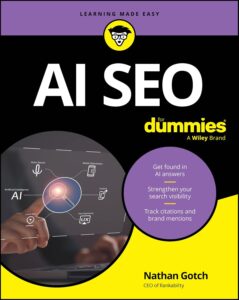
My guest on today’s show is Nathan Gotch, an SEO entrepreneur, educator, and founder of Rankability. He’s also the author of AI SEO for Dummies, a new book published by Wiley that’s written around principles he believes will endure as AI platforms and search behavior change.
In our conversation, Nathan and I explore how AI actually changes SEO, where AEO or answer engine optimization, fits into SEO, and why chasing every new tactic can be a distraction. We discuss how brands can earn visibility across Google AI Mode, ChatGPT, Claude, and other answer engines, and why citations and third-party mentions matter more than ever. We also unpack AEO myths, from schema markup to LLMs.txt, and look at why traditional SEO remains the foundation for AI visibility.
Nathan also shares how he uses AI agents to run marketing campaigns and automate work that once required hours of hands-on execution.
If you want to know where search is headed without getting distracted by every shiny new acronym, this episode will help you focus on what actually moves the needle. So without any further ado, on with the show!
In This Episode
- [00:00] – Nathan explains the need for a repeatable AI SEO process, while Stephan frames the broader challenge of keeping up with rapidly changing AI search tools and tactics.
- [03:18] – Stephan and Nathan discuss Nathan’s early SEO experiments, aggressive link-building tactics, Google penalties, and the lessons that ultimately shaped his approach to SEO.
- [10:38] – Stephan asks why Nathan created the book in an era when AI can answer almost anything, leading to a discussion about evergreen principles, repeatable processes, and the need for structured guidance.
- [16:19] – Stephan and Nathan explore how search behavior is spreading across ChatGPT, Claude, Grok, and other AI platforms, creating new visibility challenges for businesses.
- [19:46] – Nathan explains how Rankability tracks prompts, brand mentions, and AI citations, while Stephan explores how these signals can reveal opportunities for improving visibility.
- [26:39] – Stephan and Nathan discuss using YouTube and owned content to build awareness, followed by Nathan’s example of using AI agents to automate much of his advertising campaign.
- [31:42] – Stephan asks about Nathan’s AI workflow, leading to a discussion of Codex, AI subagents, GitHub, and why keeping projects in a central repository makes it easier to switch between AI platforms.
- [35:43] – Stephan raises questions about public GitHub skills and Markdown, while Nathan discusses Markdown versus HTML and challenges claims surrounding LLMs.txt, schema markup, and AEO.
- [43:06] – Stephan presents a research-content scenario, and Nathan explains why making the research crawlable, building supporting content, and earning third-party mentions can improve its chances of being discovered and cited by AI.
- [48:42] – Stephan and Nathan examine how local SEO connects with Google AI Mode and why businesses may also need visibility across third-party platforms that AI systems use for local recommendations.
Nathan, it’s so great to have you on the show.
Thank you so much for having me. Really appreciate it. I’m excited to talk with you because I’ve been following your work for a long time, so it’s going to be fun.
Awesome. Yeah, yeah. So, do you have a copy of the SEO book?
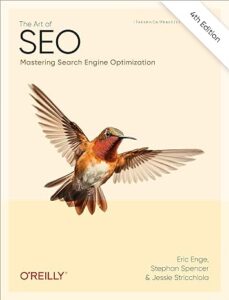
I do. That’s the thick one. That’s the big one. Yeah. So yeah, that’s what I would say, like, out of all the books I’ve actually read, I did a funny little case study where I purchased every single SEO book. So I ended up purchasing like 30 books on Amazon. So I spent like a whole week reading all of them, and that was like the one where I’m like, “okay, I really got to sit down and really digest this one because it was so intense.”
So yeah, I actually use it as a textbook in universities.
Yeah, it’s like any of the ones that I recommend. That’s always like the best foundational one for pretty much anyone getting started. Yeah,
Awesome. Well, yeah, you’re kind of a legend too in this space. You’ve been around for a long time, and I guess you might have a bit of a gray-hat or even black-hat reputation from the early days. Maybe you could kind of give us your hero’s journey, superhero origin story.
Yeah, I mean, I know a lot of SEOs. It seems like at least a lot of the ones that I know did start more on, let’s say, gray hat, black hat-ish in many ways. Not everyone, but a lot of people I talk to, and I think it’s just because generally it feels easier when you’re doing it right. And so when I actually started, this was when I started SEO in 2011, which is just crazy to even think about. I was still in college when I started SEO. I was trying to grow a little baseball pitching blog, and I’m like, “How do I get traffic to this thing? I started looking into things. I discovered SEO, and back then the tactics were, by today’s standards, pretty nasty.
And so, like, you know, I was buying bot traffic and creating Web 2.0s and building private blog networks, as I did it all. Unfortunately, it worked, and that was the problem, so it worked a little too well, and then, so you know, I did that for a long time, and I got really obsessed with private blog networks, and I had a whole network, and I had different web hosts, and I did the whole thing. Right, I blocked Ahrefs and Semrush from getting to my websites, and it was like this whole huge operation. But then, in 2015, I had started to grow a pretty successful agency, and I had a good client roster. Still, I was using the same tactics with my clients, and I made a couple of mistakes with my private blog networks: I linked to a lot of the same clients on a lot of the same websites.
And what ended up happening is I woke up one morning, and it was manual action, manual action, manual action, manual action. My whole inbox was just manual actions, and I’m like, “Yeah, this is not going to be a great day.” Like, I was pretty concerned at that point. But fortunately, that was a really good turning point for me, where I was like, “Okay, this is not the right thing to be doing.” If this is the risk that I’m playing with, especially with, like, it’s one thing if it’s my own projects, but, like, when I’m working with a client, it’s not right that I’m, like, jeopardizing their website over, using, crazy tactics.
So fortunately, I ended up getting all of those manual actions removed, and so that was, you know, super good. And I had a lot of problems. I had to go back, remove all the links, submit a reconsideration request, and go through that whole process, but I fortunately got it all resolved. But it was more like that was the turning point for me, where I’m like, all right, no more. I’m not. I’m not playing this game anymore. And like I said, “I haven’t played that game since 2015.”
Getting businesses to build review-generation systems is like pulling teeth. Share on XYeah. It’s the difficult challenges where we learn the most, and you can’t outsmart Google, at least not for a long time.
True, yeah, yeah. It’ll eventually get you. That’s why it’s funny. You see, even now, there are still people playing these games, and they’ll brag about how much growth they’ve gotten in such a short time. Still, then they disappear in like a year from now, and you don’t hear about it anymore because, you know, you can play the game for a short amount of time, but the longevity is really the problem with those strategies.
Right. So now there’s AI-generated content that is flooding the internet and might work for a time with Google or with ChatGPT or whatever, but then you pay the piper; eventually, it might last for a few months. Yeah,
And I mean, I always noted, I always know too, when I’m looking at someone who doesn’t have any battle scars, and they haven’t experienced what it’s like to get hit by Google, and so on. Like, I not only have gotten manual actions, but at the time I had a lot of niche websites that would just get algorithmic actions, right? Just getting hit by the algorithms. So like once you’ve taken a lot of hits like that, you become a lot more careful with what you’re doing because it’s not fun.

Yeah, I remember being pulled aside by Matt Cutts, you know. I mean, he’s no longer at Google, but he was the Google guy, and I was speaking at SMX Advanced, and I kind of got in trouble with Google because one time I shared all sorts of ninja hacks that maybe weren’t their preferred strategies. Yeah, I mean, they’re above board. They were maybe cutting close to the line at the time, but not into gray-hat territory.
But I remember Miley Oye came up to me at some point and said, “You know, we were thinking of inviting you to be our, you know, MC or whatever, our speaker for a whole bunch of trainings on SEO for, you know, the world, and no longer because of, you know, what you shared at this conference”, I’m like, “what?” And then Matt Cutts comes up to me at some point at the same conference as like,” you know, your client Zappos looks like you’re doing some sort of cloaking thing, and we don’t like it.”
And I had to explain exactly what we’re doing and be totally forthright and everything. We used a technology platform to create a search-friendly version of the content because the CMS was a train wreck. Their e-commerce platform at the time was a train wreck in terms of SEO, and yeah, so we narrowly escaped, like, with just a finger waving.
That sounds kind of like that. I was gonna say that sounds like the current equivalent to that is having Markdown files as a secondary option for your web pages, which a lot of people are playing with right now to, you know, play with agents. So yeah, that’s interesting. Yeah, I know a lot of people are very careful with the tactics they share because they want to maintain a relationship with Google and the people who work there. So there are definitely two different, you know, groups of people in this industry where, like, there’s the group where it’s like they don’t care about Google at all. Others try to be a little more diplomatic. I don’t know, but yeah, that’s interesting.
Yeah, the one thing that stuck with me a long time ago was probably 15 years ago. I heard this, or maybe 18 or something. Google’s not your friend.
Yeah.
I remember different people I respected at the time who, when they went up to Matt and asked questions, would turn their badge around so you couldn’t see the name because they didn’t want it written down in his little book. You know, it’s like, “Oh, we should look into this guy and/or this website.” So yeah, they have a lot of power. A lot of power.
Oh yeah.
Anyways, let’s talk about your book because this is a big milestone for you. I’d say for the industry too, because there aren’t a lot of quality AEO or GEO or AI SEO, whatever you want to call it, books out there. I don’t know that people are really as motivated to write books as they were a few years ago, because things are moving so fast. Like, “Why a book? Why a physical printed book with a traditional publisher? Why now? And why you?”
Yeah. Well, very good questions. As for why I wrote the book, I was approached, so that was it. So they were just reaching out, I guess, because it was funny. Actually, I’ll rewind this story. I created a YouTube video called AI SEO for Dummies. So, I actually created a YouTube video, and I was ranking for everything related to AI SEO, like on YouTube and stuff, so I think I was just in the mix when the research process happened.
Oh, that’s awesome! Yeah, talk about fortuitous.
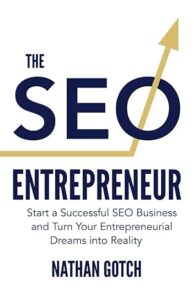
Yeah. And it was just a funny title. Like, I wasn’t even thinking about the book, and it’s just weird how that happened. But anyway, yeah. So we ended up agreeing, and it ended up being like a full year of writing this thing, and it was intense. I wrote another self-published book called The SEO Entrepreneur, and that was intense too. Writing that book, but not at this level.
I mean, and I know I’m preaching to the choir here, but it was very, very challenging because, like, the way that dummies, the way they do it, I don’t know how the publisher that you worked with, but the way they do it is you have to write the entire manuscript up front. Hence, you write the whole manuscript without any edits then you submit the full manuscript then they give you the edits for the whole book, so as you can imagine, you know, getting all those edits back is like whoa! This is, yeah, super intense, very intense. And funny enough, though, yeah,
It seems like AI mode will be the default experience on Google. That seems like the direction that things are going, more than likely. Share on XThey don’t do that at O’Reilly. Like, yeah, doing a chapter at a time, and they give plenty of time with the deadlines. You’re not stressed out, although it is a lot of work. I mean, each edition we’ve done four editions now. Two years is the whole process for each edition. It’s not. It’s not for the faint of heart, and it probably pays minimum wage.
Yeah, I’m definitely not doing it for the financial side of it. Yeah, yeah. But yeah, so that’s how it kind of came about. Now the second part, which is why a book at this time, which is a very valid question, is that you can just go into ChatGPT or any other platform and just kind of, you know, give you a course on basically anything. You know, it’s funny. I talk to agency owners every single day. I talk to SEO professionals every single day in my training programs and communities and so on, and obviously people use my software.
And it’s, ChatGPT’s been here since November 2022, right? I think that’s when it launched, and so, like, AI is not new, and people have had AI to play with for many, many years at this point, and still some people are not seeing better results. And despite having all the information in the world, literally at our fingertips, you can ask the AI literally anything. Yet the people that I talk to, including agencies that actually do this work for clients, they’re all over the place. They are all over the place.
I’m using Claude here. I’m using this, and it’s like they’ve unlocked all this capability, but they haven’t really harnessed it in any type of repeatable process that can actually produce results. And so I personally felt like there needed to be kind of a process that could be followed from end to end, knowing that this is all going to change basically all the time. So, with that in mind, when I was working through, like, how can I make this book not be out of date in a week from now, I was really thinking, like, what are the evergreen principles that likely will change in this process,
So that’s really what I focused on heavily in the book. It was more about thinking about that, not so much like, “Here’s a little tactic that is working right now but won’t work a year from now.” So, and of course, naturally, there’s going to be things that are going to just go out. Like, a small little detail is that right now, ChatGPT, based on the last benchmark, has like 50% of the AI search market, right? Just by total usage and so on; that could change, right? ChatGPT could maybe be overtaken by Claude, or maybe Google comes back roaring and, all of a sudden, takes it over again with Gemini in AI mode. Who knows, right? So things like that, platform changes-I don’t know where that’s going to go. But as far as the general principles of doing this work, there are some evergreen things. So that was kind of the basis for it.
Yeah, I’m waiting for the other shoe to drop with regards to ChatGPT or with OpenAI specifically because, you know, they pulled out of their IPO, and that wasn’t for altruistic reasons. I mean, they could see the writing on the wall.
Yeah, there’s weird stuff happening right now with those companies.
So if they keep postponing it, they’ll eventually run out of cash.
Yeah.
If they go public and it goes poorly, then the AI bubble is over, and ChatGPT or OpenAI will be the first to go. And who knows who else will take it? Who else will they take down with them? Oracle probably, and who knows who else? But regardless, I mean, you don’t operate out of fear. You just diversify, and you use multiple platforms, and you work with open source and all that, so that you can manage the potential downside.
I just try to go wherever the attention is. I don’t care what platform it is. I’m going to try to win the visibility.
So yeah, I mean, my thing is I just try to go wherever the attention is. I don’t care what platform it is, right? Like, I don’t become romantic. Like, you know how some people are hardcore, just Google or hardcore. I’m wherever the attention is; that’s where I’m going to go to try to win the visibility.
But it is interesting. It is definitely interesting right now because ChatGPT and Claude and Grok, even though they are not. It’s not like a one-size-fits-all strategy works across every platform now. It’s even getting to the point where you have to think about each individual AI platform. Even, like, for example, Amazon. You know, Amazon has its own AI platform as well, and that’s a whole separate game. So, you know, SEO has just become so wide, you know, wide-ranging at this point. Where, you know, a part of me kind of misses the old days with Google, where it was a lot simpler. You know, like it was a pretty simple process. You know, you just rank and get traffic and make sales. But yeah, that’s not really the way it is anymore.
Yeah. So let’s talk about what the strategies are and where your software’s rankability comes into play in these strategies and these tactics.
Yeah, I mean, this is always the great debate of how much has actually changed, right, compared to, like, SEO versus this new environment. And I would say that there are a few areas that are definitely different. The one area is tracking and attribution, which I think is dramatically different. You know, when we were just doing SEO, at least the way I was doing it, it was like, you know, you had your bucket of tracking tools. You know, Google Search Console, Google Analytics. You’d probably have some sort of rank tracker.
If you’re doing local, you’d maybe do some grid tracking, and then you know you’d probably put that into Looker Studio or some sort of dashboard, and then maybe throw in Bing Webmaster Tools if you want to be fancy, right? But like there wasn’t a whole lot to do there, and it was pretty easy to track for the most part. But now you know the tracking is very different, and traffic is.
Like, I’ll give you an example. I just finished an audit for a media website, and they are in a very weird situation. They lost 46% of their traffic between 2020 & 2023, and the weirdest part is that when I did the audit, they were ranking number one for everything- every single one of their keywords that they cared about. They’re ranking number one on Google. Traffic just keeps plummeting, and now it’s like there are websites that are doing all the right stuff technically but still getting destroyed because AI is eating up all those clicks.
Zero click, right? Yep. Yeah. Rand Fishkin talks a lot.
Yeah, and it’s definitely a reality when you’re going after topics that have informational intent, which they were; like, a lot of the stuff they were going after was very top of the funnel, very informational intent, and unfortunately, the AI just destroys those types of queries. So you know that the first element of this is that traffic is becoming a difficult metric to ultimately determine success in this new environment. It’s kind of hard to report to clients like, “Hey, your traffic’s dropped by 40% over the last two years, so do you still want to work with us?” You know, it’s kind of a hard thing in that regard.
But the counterexample to this is HubSpot, which, you know, very famously recently lost a lot of their traffic, organic traffic, but their revenue went up. So, and that’s because, you know, they had a bunch of content on their blog that was basically just designed to juice their traffic numbers, but not really designed to drive any conversions. So when they lost all that traffic, it didn’t do anything to their bottom line, like at all.
So this is like, and this is even before AI. I was telling a lot of companies, like, you don’t need to create that top-of-the-funnel informational content. It is actually a massive waste of time. But the problem is, they like seeing the little graph go up. That matters more than, like, “oh, well, why don’t we just focus on the bottom of the funnel where the actual money is made?” And so that’s kind of like we’re seeing the effects of all of that now. And so that’s kind of the first part.
The way I’m approaching it, I’m not even looking at it from the perspective of, “We need to show up for this specific prompt.”
The second part is the new thing we have to track: brand mentions for commercial queries across these AI platforms. And so the way that we do it is like we’ll take a standard seed. So, like, if it was a plastic surgeon in New York City, okay, that would be the seed that we would build our prompts based on, and a lot of people. There’s a lot of debate on prompt tracking and prompts in general because obviously a lot of these prompts don’t have any quantifiable data. There’s just no data. Like, we just don’t know if people search that exact query inside these platforms.
Yeah, so Ahrefs is tracking 300- 400 million prompts and their outputs every month across six or seven different LLMs, and they’re all synthetic. They’re all synthetic prompts. No humans are coming up with those prompts. So who knows if a single human is actually prompting for what they’re tracking and reporting on.
Yeah, and the thing is, for me, the way that I’m approaching it is like I’m not even looking at it from the perspective of, like, we need to show up for this specific prompt. I’m approaching it by running the prompts to see where we have gaps in a particular category. So that’s the way that I’m approaching. It’s not necessarily like, “oh, I want to make sure we have visibility for this one synthetic prompt that we made up.” It’s more like, “I want to see what our total brand visibility is across this whole category.”
So, as an example, I just did an audit for a plastic surgeon. That’s why I’m bringing it up in New York City, and I picked one category they wanted to do well in: liposuction. So I created a bunch of prompts related to liposuction in New York City, all these different, really granular types of liposuction. Like, there’s something called a banana roll; I don’t even know what a banana roll is, right? But there’s like all kinds of weird stuff, and so I built a bucket of like 25 prompts within the liposuction category, ran those all through, and then looked at like, “okay, what is his overall coverage in this category across all the AI platforms?” And it was useful because you can start to see like, okay, he does really well in banana roll, but really bad in this type of liposuction, and and you know, and you can start to see those gaps.
And if you run enough of these, you really start to see there are some trends. You’ll start to see like, “okay, the same plastic surgeon shows up every single time and is always recommended number one across every single prompt. I’m gonna go and see what they’re up to,” and that’s the way that I try to approach. I’m looking at the prompt tracking more as intelligence, not so much like I like keyword tracking, as we did for traditional SEO.
So, that’s the way that I approach it on that front. Then I’m also looking at citations, and I’m not looking at them from the perspective that we need to win a citation with our website. I’ll take that, obviously. That’s a good thing. But what I’m really looking at is our brand being covered in those citations, excluding competitors, right? So that’s what I’m looking for. We’ve actually found, you know, rankability. We analyzed thousands and thousands of AI answers and citations, and we found a direct correlation between whether the brand is mentioned in those AI citations and its visibility in the actual answers.
We found a direct correlation between whether the brand is mentioned in those AI citations and its visibility in the actual answers.
So we spend a lot of our time on those citations. Like, that’s what I call the work, because that’s what we do. We extract those citations and start working on them. And simple, like for example, for my book launch, build a whole list of citations. Just start sending outreach emails. That’s it. Nothing complicated. So that’s kind of the first part. And then obviously we can talk. There’s a lot more to this that’s different than traditional SEO. But that’s kind of the first piece: tracking.
Yeah. So by the time this episode airs, the book will be out. September 22nd is the launch date for the book, and yeah. So how many of you are doing a whole podcast tour? How many podcasts are you doing, and what other media activities? What kind of launch activities are you doing to get this book out into the world?
Quite a few. I have a launch event on the 22nd. So it’s going to be a webinar. I’m going to be going kind of like the full process that’s kind of in the book, but I’ve kind of brought it to a little higher level. It’s got almost 500 slides, so it’s going to be really intense. So, I’ve got almost 500 people registered for that, so I’m hoping to get to like 1000 before the launch.
So that’s the big thing. Aside from that, I’ve been doing a lot of other things, like using YouTube. So, using my channel, I use something. So one of my favorite techniques for content creation is using the five stages of customer awareness. And so when I think about trying to promote something, I think about, okay, what are the pieces of content I need to build at each stage of the awareness process?
So are you using the acronym UPSA? I think that’s from Eugene Schwartz?
Yep. Yeah.
But anyways, he was on this podcast a couple of years ago. Unaware, problem aware, solution aware, product aware, and then most aware/decision.
Correct. Yep. Exactly. So basically, what I do is I start at the very bottom, and the reason why you have to do this on YouTube, what you want to do is create a string of videos across that whole cycle. So you actually have to start with the last video first, so that way, in the next video, you can say, “Go and watch my AI SEO for Dummies summary. It’s going to be right here. Click on that, right?
So you have to basically do it in reverse for it to work on YouTube to create that chain. So that’s what I’m doing right now. I’ve already published an AI SEO for Dummies review and summary. That’s the first one. The second one is, I think, like the top eight best AI SEO books for 2026. So I’m going further up the funnel, and then the next one’s going to be something like, you know, my complete AI SEO system for 2026, and then go further up the funnel. It’d be like if I was starting today, here’s how I would learn AI SEO, right?
So, like, just keep going further and further up that funnel, and that’s the way I like to approach it, and it works pretty well for many reasons. Number one, for YouTube specifically, it increases watch time, which is a big ranking factor on YouTube. And then secondly, YouTube is a very, very common source of retrieval for AI. So we’ve actually been able to influence a lot of answers just using YouTube.
So I always really like to double down there. So focusing on the owned assets. So obviously our website, YouTube, and LinkedIn. LinkedIn’s another one. We’re already creating the same type of content on LinkedIn as well because it gets picked up a lot by AI systems on X. So a lot of organic content on the owned assets. The one part before we started recording, I was telling you about how we’re really heavily using agents in a lot of the work that we’re doing, and man, I have a really good example of this.
A one-size-fits-all strategy no longer works across every platform. You have to think about each individual AI platform. Share on XSo, we’re running Meta ads, okay? So we’re running Meta Ads for the webinar. Basically, we’re running ads directly to a webinar landing page, and it’s a Zoom webinar. That’s it. Simple as that. But the part that’s really funny about it is I haven’t even logged into Meta, so I have run this entire campaign, and we’re getting about $4 per registrant, which is really good, and it’s all U.S. based traffic too. So $4 per registrant. I have not left my Codex chat for that entire thing. I’ve just been in my Codex chat the whole time, letting Codex just run, opening up my browser, creating the ads like it.
It did everything from strategy literally, developing the strategy for the campaign, to fixing all attribution to make sure that we can actually track it well, and then actually creating the ads, the copy, the ad creative, the visuals, everything. Then going into Meta and actually building out the ads, and then launching the ad set, and then I have a scheduled task where every morning it goes and reviews the ads, sees if there’s anything that needs to be optimized, does that, and then just sends me a quick little report to tell me what’s going down.
That’s impressive.
Yeah, it’s pretty insane. Like, it’s really disturbing when I walk because I have, like, my laptop over here for, like, a lot of advertising stuff. I’ll just look over my laptop. There’s just windows opening up on my laptop, and I’m like, “This is really something else.” It is.
Oh, there’s my bank account.
I’m really way too trusting of the agents. I just let them loose, and now they’re running everything from strategy to launching and optimizing my ads.
Yeah, exactly. Yeah, there’s my Social Security number. There we go. Yeah. So I like, and that’s why I tell people, like, I’m really way too trusting of the agents, like way too much, right? Like I let them loose. I really let them loose. I have a separate Mac Mini too. So like when I first started really getting into this, when OpenClaw first came out, I got a separate Mac Mini, and I was super concerned about security. So I was like, I’m gonna isolate this thing on just the Mac Mini, and then now I’m just like it’s all over my computers. I don’t even know what’s going on. They’re just, yeah. So not recommended personally for security reasons, but yeah, it’s interesting how I’ve loosened that a lot in my behavior. So, for better or worse. So
Hopefully not for the worse.
Yeah, I guess we’ll find out.
Yeah. So, are you still using OpenClaw? Have you switched to Hermes or Grokbot? What are you using?
I’m, you know, I’m 100% Codex. I just use the Codex subagents. So, okay. And I just, I just love Codex. I mean, I really do. I was using Claude. I used Open Claw for a while, man, talk about a nightmare. I mean, OpenClaw is capable as it was. The amount of time I spent debugging everything, I was like, okay, this is just not. This just isn’t. This isn’t it yet, right?
Yeah, that’s a lot to maintain.
It is, and so then I started experimenting with using Claude, and then eventually, you know, Codex has really strong subagent systems. They’re actually really easy to spawn. You literally just ask it. Like, I’ll just ask Codex. I’ll be like, “Do you think this is a good task for subagents? It’ll be like, “Yeah, I think it’s a pretty good one. And then you’ll watch it spawn the subagents for whatever that thing is you’re doing. So yeah, I think it’s a matter of preference. Just my, I just like using Codex.
yeah. But are you not concerned about putting all your eggs in one basket there? Like, as we discussed earlier, what if they run out of cash? What if the IPO doesn’t go well?
Yeah. So I’m not concerned because I’ve thought about this deeply, and I put everything in the source of truth, which is GitHub. So that way, no matter what- for example, we had to do this because I have my partner who uses Claude. So what we had to do was figure out, “Okay, how do we continue to work together if we’re using two different agentic platforms?” So what we did was basically put everything into GitHub, and then whatever agent I’m using, I can just link up GitHub and get started, right? So I’ve created independence, and so let’s say Codex, OpenAI goes out of business tomorrow, I’ll just go to Anthropic or Grokbot. I don’t really care, right? So yeah, it’s just a matter of preference at this point, nothing more than that.

Yeah, okay. So why GitHub? Why not? Let’s say I don’t know a bunch of Markdown files in an Obsidian vault.
Just because it’s easier to access in the cloud with the team that’s working on it. Obviously, I guess I’m not. I have Obsidian on my computer, but I don’t use it. I don’t use it much. I don’t know if it has that same capability of bringing in cloud-based stuff, or if you can bring your team in to actually get into that vault. I’m not. I’m not entirely familiar with that. So it’s just because I’m used to GitHub, especially because when we’re developing the app side of rankability, I’m just used to using GitHub, and I know it just works, right? So, I don’t foresee GitHub going out of business anytime soon, but of course I guess that’s certainly possible. Anything’s possible, I guess. So, but yeah, that’s just a matter of preference. Yep. Yeah,
Yeah. And how much stuff are you putting out there publicly on GitHub, and how much are you keeping private to your team?
All private.
So why not have a strategy like Eric Siu, Single Grain, where he’s putting a bunch of Claude skills for marketing and for SEO and so forth on his public GitHub, getting all these stars, getting a lot of links and mentions and notoriety for sharing all these great skills. Any plans for that?
Skills are easy to create, but it’s really hard to test them, refine them, and make them better over time.
I think maybe because he’s probably got a different objective than I do. Probably so. Like I’m, I’m. I would imagine his goal of doing that is probably to drive awareness, maybe for his agency. I would imagine that’s probably his strategy on that front. For me, I’m more focused. So, like, skills are a funny thing because I feel like it’s really easy to make skills at this point, but it’s actually really hard to test those skills, refine those skills, and make those skills better over time. And you need a lot of testing with these agents to make sure they’re doing a good job.
So, any skill that I put out, it’s been through heavy, heavy. I’ve been beating it up. Let’s just say that much. And so, for me, any skills that I share, I just share them with my community, and I like to keep it private. Because they’re paying for it, so that’s the main reason. Yeah, I see the utility of using it as a marketing play, though, for sure.
Yeah, yeah. So let’s talk more about Markdown files and why not just put everything out there as HTML. I mean, 99% of the web is HTML? Yeah. Why a new format? Why strip it down to something that the AI could get the content either way? You know, it’s like it’s smart enough. It’ll soon be smart enough to run circles around us. Why not just let it figure out the HTML?
I actually agree with that. To be honest, I think it’s at this point majoring in the minors because the agents can easily extract HTML, and I mean even traditional crawlers can easily extract HTML. So I actually don’t think there needs to be, like, let’s build a separate page just for the agents to have this markdown environment. Like maybe there’s a slight efficiency gain, like tiny, tiny efficiency gain, by just stripping out all the code and just having the raw text. Maybe, but we’re talking like tiny, tiny little probably efficiency gains that probably not even worth it.
So yeah, just my opinion. I don’t. I don’t really think what matters more is that your website is just HTML in general, which is a bigger discussion we just did a full study on. We took a whole set of citations and traditional search results, and it was overwhelmingly clear that HTML is the correct format your website needs to be in. In fact, even your rendered HTML didn’t perform as well as just straight raw HTML.
I actually don’t think we need to build a separate page just to give the agents a dedicated Markdown environment.
Yeah. So if you’re using a lot of client-side JavaScript, that’s just asking for trouble.
I’m very opposed to it for sure, dude. I just think it’s dangerous. I mean, you. Why take the risk when there’s already a proven language that works?
Yeah, and there are a lot of myths and mistaken misperceptions around AI, SEO, or AEO, like llms.txt . I still hear people talk about it, and that was never a thing. It was never a standard. LLMs never implemented it. So, what are some of the myths that you hear besides llms.txt?
That’s definitely one of the top ones. It’s funny. I know I was saying I have 500 slides in this webinar I’m doing, and I don’t even mention that once in 500 slides. So, because it just doesn’t do anything. I would say one that definitely I feel like some people have been talking about a lot is schema markup, and I don’t. I found no evidence that schema markup influences your ability to be mentioned by the AI at all. I don’t. I haven’t seen any proof of that. I don’t know if that works at all, and I mean, we’ve tested. We don’t see any uplift from it, and in fact, pages without any schema do just as well in citations and being extracted by the AI anyway.
So I just don’t think that’s the way the systems really work. There’s a lot. There’s one thing that I think is actually kind of the opposite, which is people who are trying to treat AEO as a completely separate discipline from SEO.
So basically, they’ve kind of rebranded some things that are basically the same. So, like an example is, I’ve seen some people talk about AEO content. So instead of saying SEO content, they say AEO content. But the funny thing is, it’s funny when you look at what they’re talking about. They’re like, “Okay, this is what you do. You put your keyword in the URL. You put it in the title and the meta description. You put it in the H1. You put it in the first 100 words.” And I’m like, “We’ve been talking about that for a decade.
More than a decade too.
I think. Yeah. So, but it’s just funny. It’s like a slight rebrand for stuff that’s always been the same. Another one is on technical SEO. I’ve seen technical SEO, and it’s all the same stuff. You know, use HTML, have a fast-loading website, make sure it’s mobile-friendly, like make sure it’s crawlable, make sure it’s indexable. Like, this is all stuff that is the same.
YouTube is a very, very common source of retrieval for AI. So we've actually been able to influence a lot of answers just using YouTube. Share on XHere’s another one that makes my eyes roll. Whenever I see on LinkedIn somebody post an infographic of the differences between AEO and GEO,
yeah. Oh yeah.
What what? Tell me more.
I know that. I just wish there was, like, I wish we could settle on what it really is, like what we’re gonna call it. Like, if I had my preference, I would definitely pick search everywhere optimization. I think that definitely encapsulates what we’re doing, but I just don’t think it flows well for most people.
It’s confusing. The problem is that you have this long-standing term: search engine optimization. You know that’s synonymous with SEO, and you’re trying to replace it with the same acronym and replace the words that it means. You’re just going to confuse people, especially a lot of you know kind of not savvy but kind of early entry people, like early in their learning journey, so yeah, I don’t think that one’s going to fly.
But yeah, just for the record, for our listener who isn’t aware of what we were saying about the differences between AEO and GEO, there are none. They are the same thing. They’re just different ways of referring to it. And it seems to me- correct me if I’m wrong- that AEO is kind of taking the lead here. GEO was kind of an early contender. It sounds a little, I don’t know, awkward sounding. Answer engine optimization kind of rolls off the tongue a little more than generative engine optimization.

Yeah.
So I think maybe that had something to do with the greater uptick of AEO these days, but yeah, they’re the same thing. Yeah,
Yeah, I definitely like answer engine optimization because I think it describes what we’re doing better. After all, we are trying to influence the answers. So I feel like it has better alignment. I don’t know if it will be the thing; you know, I don’t think anyone knows at this point. I think AI SEO is a good transitional, let’s call it, terminology, but I just don’t. It’s just a lot of acronyms. Yeah. So yeah,
Yeah. By the way, one of my favorite acronyms of all time is PEBCAC. Do you know what that stands for?
Oh no, I don’t know that one.
That this comes from tech support, the tech support world, where they were making fun of users calling in or whatever. Problem Exists Between Keyboard And Chair.
Yeah. Okay,
So let’s talk a little bit about a hypothetical situation. Somebody wants to show up, be visible as a recommended tool, service, or whatever in the answer engines in the LLMs, and they have research studies. So they’ve commissioned research studies, and these are published, let’s say, as PDFs. So if the PDFs are published on a site with no mentions, no links and a very poor DR domain rating score, etc. It’s very unlikely that the LLMs, let alone Google, of course, will cite and refer to these studies, right, or to the great information in those PDF reports, right? So, what do you do if that’s the case, and you want to build up your reputation with the LLMs, especially when it comes to the research, the hard data, the, you know, the scientific analysis of whatever their thing is?
Yeah. Well, I mean, you know, if your stuff has no visibility whatsoever across the internet, there’s no way the LMs are going to pick it up at all. So that’s the first part. The second part is if it’s a PDF, the first thing I do is turn it into a web page, so that’d be the second part. Let’s get that squared away. The other piece is the goal. So I’m assuming you’re talking about first-party data. I would imagine. So you know the goal here is different than a goal for, let’s say a business that’s trying to get let get their brand mentioned for a commercial query, more than likely, if you’re trying to get visibility for some sort of study or first-party data, you’re probably trying to get cited in the AI.
Ahrefs is tracking 300–400 million synthetic prompts every month across six or seven different LLMs. Share on XThat’s probably what you would want because, unfortunately, the AI will reference where that source came from in the answer. It certainly will. You know, it came from, you know, came from Rankability, right? And so there can be some awareness benefits of that, but I think the big thing would have to be thinking about how we actually get the AI to find us in retrieval, so then we can have a very good chance of being actually cited in that AI answer.
Now, as far as being, you know, found in retrieval, well, search is a good place to start because we know that the number one source of retrieval is traditional search. So you would want to work hard to just do standard SEO to get that study to get visibility in search. But your website is only one piece of that retrieval process, so then you’d want to start to expand the way I would treat it is like, “Okay, we take this study. How can we break it down into micro, little mini studies?” So then we can distribute that- you know, let’s call it the mother asset using all this micro content across all of our other owned assets and kind of build out a full strategy to attack it in that way. And then aside from that, I am looking at trying to get other people to talk about the study, right? That’s the next thing, because you know. So then I just kind of keep adding layers and layers. So basically, funny enough, I’m just doing digital marketing around this study.
Yeah, you’re doing SEO exactly, and that’s the thing. That’s what it comes down to. Most people are, you know, I think confused about where SEO stands in this process, and it’s the foundation of it all. Like if you’re doing AEO, then by definition, by default, you are doing SEO. If you are not doing SEO, or if your SEO is a train wreck, there is no AEO. There’s no possibility that you can game the system. Maybe for a little while. Yeah. Maybe a year ago, you could pay a bunch of people to add your brand to a bunch of listicles, and that might work for a short time. But those days are gone.
SEO is the foundation of it all. If you’re doing AEO, then by definition, by default, you are doing SEO.
Yeah. And I think one important distinction too is, like, going back to earlier in this conversation with what are the key differences, and I think for at least for me, for many years it was a lot of thought about the website. Like, let’s work on the website, let’s get the website right, let’s promote the website. That was what we wanted to do, with the intent of making the website appear in traditional search.
That was the whole idea, but I think when you think about ranking in general, it should be like: how do we take as many spots on the first page as we possibly can? Because the more spots we can take there, the greater the likelihood we’ll be retrieved. That’s kind of the way that I’m thinking about it these days.
Yeah. So highly cited sites like Medium.com and LinkedIn.com are great places to seed your content, not just on your company blog.
Yeah, it’s actually funny. Sometimes it’s easier to rank on a third-party website than on your own. Like even on YouTube, like I. I think I’m ranking now for best AI SEO books on the first page of Google with my YouTube video that I published yesterday. That would have taken me to rank on my website. Would I write the article? Would have had to do some link building. You know, it had been a lot. So I just think it’s important that we’re looking at it as our owned assets, and your website’s one piece of the owned asset pie. Right, and I think that’s the way to kind of think about it these days, personally.
Yeah, totally. And so in this hypothetical scenario, if you got this PDF research study, you need to get another home or an alternative home other than your own website that has no link authority, no citations. Like, for example, ResearchGate.net or whatever you know, some place that has a lot of authority, a lot of trust, a lot of history to it, and it’s credible.
Yep.
So that’s where you’d publish at least a copy of that research. So yeah, let’s move to another hypothetical scenario. Let’s talk about a local business. You know, like a plastic surgeon or cosmetic surgeon. What about, like, the local landscaper or dry cleaner or plumber? What does he or she need to do to get cited, recommended in ChatGPT and so forth? I know we briefly talked earlier about solutions like grid tracking. Local Falcon is one example that we use. It’s like, do you need to use a tool like this? What sort of tools or techniques specific to a local business would you want to use in such a hypothetical scenario?
Yeah. Well, I think the first thing is prioritizing platforms based on the vertical that you’re going after. So, like in the case of local, Google’s still king for locals right now. Yeah. And so, and, you know, the thing is, this has been pretty well known for a while: AI mode, in particular, when you’re searching for local keywords that have commercial intent- sorry, like something like Who are the best plumbers in Chesterfield, Missouri? You know, my toilet just exploded. You know, something like that.
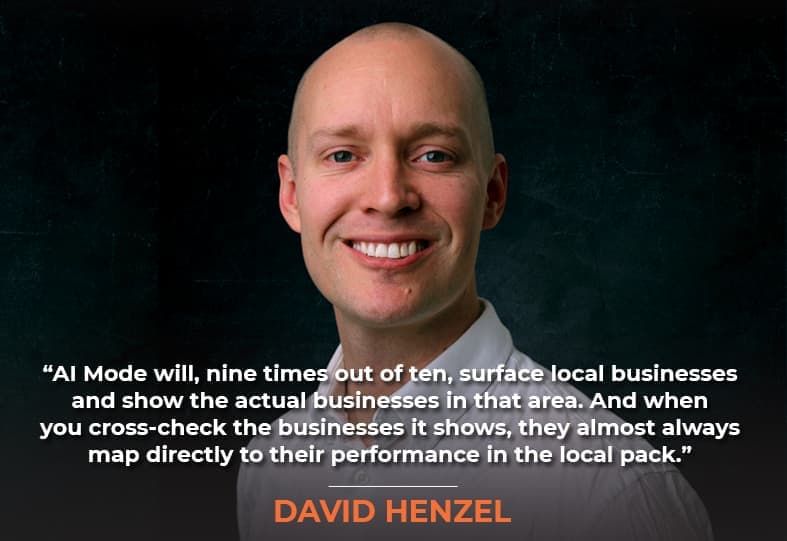
AI mode will, nine times out of 10, pull local businesses and show the actual local businesses in that area, and if you cross-check the businesses it shows, it almost always directly maps to their performance in the local pack in traditional search. So you can almost find it’s almost a one-to-one match almost every time. Like if you’re doing well in the local pack, you’re going to show up in AI mode typically.
If you want to influence Google’s AI products, the local pack is your best friend.
Yep. So, in other words, for someone who’s not familiar with that terminology, if you do a Google search, the local results section there- that’s the local pack- and it’s going to mirror the first set of results on maps.google.com.
Yep. Exactly. Yeah, and they’re pretty closely linked. And same thing, you will often. So AI overviews don’t always pop up for a lot of local queries, especially when they’re much shorter queries. They won’t always pop up, so you’ve got to kind of extend the query to force that AI overview to pop up. But even then, you’ll often see local businesses that are just popping up in AI overviews. This is totally my speculation, but just kind of based on where I feel like things are going, it seems like AI mode will be the default experience on Google.
That seems like the direction that things are going, more than likely. I think Google is just kind of slowly making that transition. But you know, the big thing is the local pack is everything, and so for local specifically, and so the way that, you know, I talk to local businesses is like I’ll give you an example. I actually talked to an agency recently, and they were having some issues with getting results for their clients. Let’s just say that much, okay? And they were like, “Our success rate’s not where it should be. We want to improve it.”
And so then I started to work through their process, and I was like, “Well, tell me about a campaign that didn’t work. Let’s focus on that. So then they start telling me, like, “Oh yeah, we brought on this HVAC company in Phoenix, a brand new HVAC company in Phoenix. And I’m like, “You brought on a brand new HVAC company that wanted to rank in the local pack in Phoenix.”
So that’s your first problem: it doesn’t matter how good you are at SEO; you will never catch up to the people who are in Phoenix right now. Like, the top guy probably has 20,000 reviews. So, you know, there are certain areas in the United States where there are moats that you can’t break. There’s an example: Four Seasons Heating and Cooling in Chicago, and I think they have, I think it’s like 30,000 reviews or something, some enormous amount of reviews. How do you, as a local business, compete with that? I mean, you’re just never going to catch up because not only would you have to try to catch up, but you’d have to actually have a surplus in review velocity to beat them,
You can do well on Google and not show up in ChatGPT. Share on XYeah, it reminds me of the analogy. You don’t show up at a gunfight with a pocket knife.
Yeah, exactly. So there are ways to chip away at a big dominant player like that, but you can’t go directly at them in a major metro, right? You’ve got to go after a suburb where they’re not paying attention and try to win over there, so you know the and the reason I’m bringing that up is because one of the biggest things obviously in local pack is is first of all the address that you have that’s the number one thing, number two is obviously the the business name itself, which still to this day it just works.
I mean, keyword-rich business names-they still work in the local pack really, really well. And then the third is reviews. That’s like 95% of the equation in the local pack. So, when you have these businesses coming in, it’s like, okay, your job is to get more reviews. And it’s crazy how many businesses are so resistant to building review-generation systems; I mean, it is like pulling teeth sometimes. Like, I get so frustrated sometimes. Like, “Am I going to have to, like, come to your office and ask people for reviews?” Like, Is that what this has come to?” So it’s just very, very difficult. So that’s like the first piece: if you want to influence Google’s AI products. The local pack is your best friend, so that’s the first one.
But aside from that, when you start going into ChatGPT or Claude, the whole game changes completely, especially in ChatGPT because ChatGPT now has a partnership with Yelp, so you know you can do well on Google and not show up in ChatGPT. That is entirely possible, and we see that happen a lot now. We have businesses doing really well on Google with a great reputation, but for whatever reason, in ChatGPT, they’re not showing up for those same queries. And it’s because oftentimes when we go and look, they don’t have visibility on Yelp, which is number one. Number two is they don’t have visibility on the third-party platforms that are being pulled in retrieval.
Every platform is a little different. Even Claude, for example, uses Brave as its core search engine.
So, like an example would be a plumber. We’ll stick with the plumber example. You might see that when you run “who’s the best plumber in Chesterfield, Missouri.” You might see Angi’s popping up, Thumbtack, these kinds of other directories that are not associated with Google, and those are what ChatGPT is pulling from to build that answer. So if you don’t have a presence there, you’re out of luck, right? Yeah. So that’s why I’m saying that these platforms are different; every platform’s a little bit different. So even Claude, for example, uses there’s a lot of evidence it uses Brave as its core search engine, so like if you’re not visible in Brave, you’re not going to have a bunch of visibility on Claude, which is a weird, really weird thing. But yeah,
yeah. Do you ever use the Brave browser?
I do just to track performance, but I don’t actually use it.
No. Yeah. Okay. Yeah. So I know we’re getting close to time. Is there a way to pay to play with the LLMs? Like, if you’re a local business, get your brand out there with some sort of local service and equivalent. Or if you have an e-commerce store, you know, putting your e-commerce shop online and pay per click or whatever. However, the business model with each LLM is that thing, right?
Well, I mean, there’s ChatGPT ads now, so there’s obviously a formal way that you can pay for visibility, but it won’t give you visibility in the actual answer itself. It just gives you a separate ad block below the answer. There are ways to pay to play, and it’s happening all the time. And I can just tell you what they are right now. Businesses are paying influencers to recommend them. People are paying right now for websites and blogs to inject them into lists. I could keep going. It’s happening all the time.
I mean, it’s pay-to-play these days. I mean, I’ll just tell you, we do a lot of outreach. We almost always lead every outreach campaign with either paid collaboration, a sponsored post, something like that, because we already know what’s going to happen as soon as they respond, like I’m sure you know this better than I do. Still, at one point you could do, like, broken link outreach, right? And you could actually score some links just by helping people, right? That used to be a thing.
WordPress posts that are really well written.
Yeah, like that used to happen. Like give value and then get a link in return. That used to work, not anymore. Unfortunately, I mean, everyone asks for money,
Especially now that we’re in this zero-click world, and publishers are not getting rewarded by Google.
Yep, yep, it is, and this is why, at least in the SaaS space, you’ll see a lot of software companies growing really fast that are venture-backed because they just pay for visibility everywhere, and you’ll see it like on LinkedIn. Like, I won’t name names, but you’ll see certain SEO tools getting promoted a lot on LinkedIn. It’s not an accident, you know. So it’s that it didn’t happen organically. That’s for sure.
Right. Yeah. All right. So I know we’re out of time. Where do we send our listener or viewer to get your amazing new book, and maybe get a replay of your webinar if you’re going to put that up later? Because you know, by the time they listen to this, that will have already aired. So yeah, yeah.
So I would just go to nathangotch.com/dummies, and depending on when this airs, you’ll be able to join the webinar, and then, you know, we’ll see what the timing is. But anyway, that will redirect you to a page that shows where you can buy the book. You can buy the book on Amazon, Target, Walmart, Barnes & Noble. So pretty much anywhere.
Awesome. Yep. And rankability, if they wanted to sign up with that software,
Yeah, just rankability.com. We do require a call, so you know we’re a different style of doing things. So you just book a call, and if it’s a good fit, we just work with agencies, so that’s our focus. But yeah, you just go there and book a call and see if there’s a good fit.
Awesome. All right, Nathan, it was a pleasure. Thanks for coming. Thank you so much. Thanks for sharing your wisdom.
I appreciate it. Thank you.
All right, and thank you, listener. Go out there in the world, make a better place through SEO, AEO, marketing, or just being you. We’ll catch you in the next episode. I’m your host, Stephan Spencer, signing off.
Important Links
Connect with Nathan Gotch
Books
Businesses/Organizations
Apps/Tools
People
Previous Marketing Speak Episode
YouTube Videos
Your Checklist of Actions to Take
- Don’t chase black-hat or gray-hat shortcuts, even if they work short-term. Nathan’s own wake-up call, an inbox full of Google manual actions in 2015, shows that unsustainable tactics eventually catch up with you.
- Stop obsessing over top-of-funnel traffic that doesn’t convert. A rising traffic graph means nothing if it’s not tied to revenue. Going after purely informational content is often a waste of resources, AI or no AI.
- Track your brand’s AI visibility by category, not by individual prompt. Run a batch of prompts around one topic and look for coverage gaps, rather than trying to “win” a single made-up query with no real search volume behind it.
- Prioritize citations as brand mentions, not competitive keyword grabs. Getting your brand mentioned in sources AI already trusts matters more than getting your own website to rank for everything.
- Diversify across AI platforms instead of betting on just one. Google’s local pack, ChatGPT’s Yelp partnership, and Claude’s use of Brave all pull from different sources, so a one-size-fits-all strategy doesn’t work anymore.
- If you commission research or data, publish it as a real webpage, not just a PDF. If your own domain doesn’t have the authority yet, seed a copy on a trusted third-party site instead.
For local business visibility, focus relentlessly on reviews, address, and business name. That combination still drives the vast majority of local pack results, and local pack performance maps almost directly to AI Mode visibility. - Build your content funnel backward, starting with the bottom-of-funnel piece. On platforms like YouTube, publish your most “decision stage” video first so you can link back to it from every broader video you publish afterward.
- Keep a source of truth outside of any single AI agent platform. Storing your work somewhere agent-agnostic protects you if the AI company or platform you’re using runs into trouble.
- Connect with Nathan Gotch. Get his new book, AI SEO for Dummies, at nathangotch.com/dummies, or learn about his SEO software at rankability.com.

About the Host
STEPHAN SPENCER
Since coming into his own power and having a life-changing spiritual awakening, Stephan is on a mission. He is devoted to curiosity, reason, wonder, and most importantly, a connection with God and the unseen world. He has one agenda: revealing light in everything he does. A self-proclaimed geek who went on to pioneer the world of SEO and make a name for himself in the top echelons of marketing circles, Stephan’s journey has taken him from one of career ambition to soul searching and spiritual awakening.
Stephan has created and sold businesses, gone on spiritual quests, and explored the world with Tony Robbins as a part of Tony’s “Platinum Partnership.” He went through a radical personal transformation – from an introverted outlier to a leader in business and personal development.

About the Guest
NATHAN GOTCH
Nathan Gotch is an SEO entrepreneur, educator, and co-founder of Rankability. He is the author of AI SEO for Dummies, published by Wiley, where he explores how businesses can adapt their SEO strategies for the rise of AI search and answer engines. Nathan is known for his practical approach to SEO and his focus on building strategies that remain effective as search technology and user behavior evolve.






Leave a Reply