



The strategies that built your company can quietly become the thing holding it back. AI is rewriting how businesses actually run, and the change is moving faster than most leaders can keep pace with.
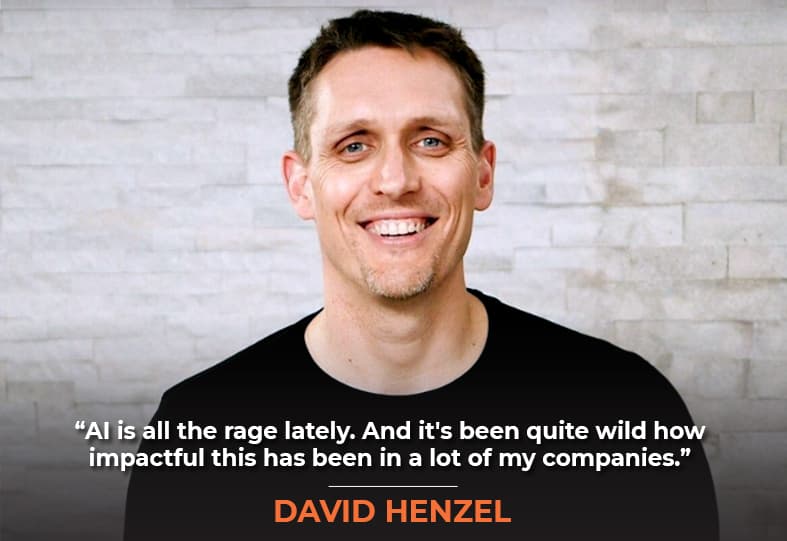
My guest on today’s show is David Henzel, a serial entrepreneur with a portfolio of companies and more than 500 team members across several industries. After selling MaxCDN, he turned his focus to making businesses AI-first and built Context Engine, a platform that facilitates this.
In our conversation, David explains what “AI first” really means, and why it starts with a company brain that holds every decision, process, and customer interaction in one place. We get into how agents now handle work that used to take whole teams, from QA to support to shipping code. We talk about why middle management is thinning out, how he feeds his own health data into a personal brain, and why he treats this whole upheaval as something to play with rather than bracing for impact.
By the end, you’ll see how far this shift has already come, and why leaning in now beats waiting for the change to force your hand.
In This Episode
- [03:15] – Peter shares his passion for building businesses, empowering teams, and spinning successful ideas into new companies.
- [05:58] – Peter explains his AI-first approach, centered on creating a centralized “company brain” that enables AI agents to handle workflows while humans focus on strategy and decision-making.
- [09:44] – Stephan questions whether employees who resist an AI-first culture will inevitably be replaced and asks Peter to compare the productivity “horsepower” of humans versus AI employees..
- [14:08] – Stephan shares Ryan Carson’s AI-first workflow and explores the idea of managing AI agents through voice while walking, including building an entire new company or product with AI on the fly.
- [18:12] – Peter explains why backlinks and SEO still matter in the AI era, while emphasizing consistent messaging, strong company knowledge, and staying aligned with the ideal customer profile.
- [22:47] – Stephan and Peter discuss the overlap between a founder’s personal AI second brain and a company’s AI brain, including how Context Engine connects the two and the role of MCPs in making company knowledge accessible to AI agents.
- [29:28] – Stephan and Peter discuss Grokbot’s advantages over other AI agents, particularly its safer cloud-based virtual computers, while highlighting how a company brain provides vendor flexibility and preserves valuable business knowledge.
- [34:58] – Peter explains that a company brain should centralize key business knowledge, including decisions, brand guidelines, customer conversations, and connected business data, so AI agents can access and act on the right context.
- [39:45] – Peter explains how to overcome the fear and overwhelm of AI adoption by helping teams understand and confidently use AI to redesign their workflows and business processes.
- [43:11] – Stephan discusses how the accelerating pace of technological change makes adapting psychologically more challenging, citing Ray Kurzweil’s predictions about how dramatically the next 12 years could transform society.
- [47:13] – Peter shares his excitement about the wealth-creation opportunities of AI, from AIifying existing businesses to embracing change, and offers three companies a free two-hour Context Engine workshop plus a one-year license to help them build a company brain and become AI-first.
David, it’s so great to have you back on the show.
Thank you for having me again. Yes. Good to be back.
Yes. You’ve been on both shows now. This is Marketing Speak, but you’ve also been on Get Yourself Optimized. We talked a bit about love, not fear, and about, yeah, you’re actually wearing the shirt. That’s right. didn’t notice it until you just pointed it out. So why don’t you give us a little background for our listener or viewer who hasn’t seen the previous episodes, either on this show or on Get Yourself Optimized? Why, why are you not fixated isn’t the right word- but why are you enamored by the concept of love, not fear and the stuff you’re into with coaching and managing happiness and all this sort of stuff? You’ve made some good money off of some nice exits. And you know, you could be sitting on a yacht somewhere, like, why are you working so hard?
I really enjoy working. After I sold MaxCDN, we moved to Turkey, and I thought I’d just chill out and do nothing. But after three months, I just couldn’t handle it anymore. I felt like working. I enjoy building cool things, which resulted in a portfolio of companies. I like to scratch my own itch when I see a need or something that isn’t there. I really enjoy building it, and I love working with good people and empowering them to grow and build cool stuff and also helping them to become financially independent. So I just really enjoy the game of business, I guess.
Yep. So MaxCDN was your biggest exit, and you have a portfolio of how many companies, like nine or ten?
You’re not going to be replaced by an AI; you’re gonna be replaced by someone using AI.
Yeah, some are around there. You know, some are not; some are spin-offs of existing companies. For example, LTVPlus is my biggest company currently. It’s a BPO (business process outsourcing) business. And we spun off Winback Engine, which is a service where we call back lapsed customers of local businesses mainly, like massage parlors, spas, waxing centers, and we get these people to come back, and it works like a charm. So I like to spin things out and then kinda always find a team of one person who’s focusing on operations and one person who’s focusing on go-to-market, team them up and let them build that. And yeah, this is how the businesses are multiplying.
Right, and where does AI come into all this? Because I know you spend a lot of time working on AI, working with AI. Are you AI-ifying traditional type SaaS businesses, or are you building AI-based businesses from the ground up? Like, where does AI fit into this equation?
Yeah, I have been really geeking out hard on this. It’s gonna also give me like a second wind. I used to be a Linux system and network engineer, like almost in a past life. I have not touched any servers or code in a very long time, but nowadays I’m really leaning in deep. We AI-transformed my portfolio companies, and in the process, we built another company: Context Engine. It’s contextengine.com, where we help people go AI-first by building, you know, the company brain and the agents that can then take care of all the processes you can optimize. So yeah, AI is all the rage lately. And it’s been quite wild how impactful this has been in a lot of my companies.
Yeah. No, you said AI first. What does that mean exactly? Because there are a lot of terms that are thrown about, and I think it’s kind of not very well defined. So AI first, AI enabled, AI-ify- there’s all these different ways of explaining how to integrate AI into an organization. Why AI first? What does that mean?
If you want to sell your company, having everything neatly packaged in a context engine could significantly increase its value. Share on XI mean, AI first mindset that you kinda always think about, like, you know, what could AI do that work? You know, versus how you do it traditionally, or kind of like thinking, how would you build that business if you would start with the technology that you currently have available, you know, kind of removing all these legacy processes. And the main thing for me is that being AI-first means having a company brain where all the information flows in, all the decisions you make, and all processes are captured in this single entity. So agents and people know what to do.
And you know, you waste less time; you don’t waste tokens, and it can serve as deep insights on what’s going right or wrong inside of your company where you should double down more. And this has been the biggest blessing for us: centralized knowledge per company. And then building workflows with agents that do tasks that can be handed off to AI, while keeping the human in the loop. So humans just like to observe and strategize. But yeah, passing off as much work as possible to the agent where the agent can do a better job than a human.
I don’t remember where I heard this, but it stuck with me. You know, there’s this adage, this old, old quote-unquote adage going around that you’re not going to be replaced by an AI; you’re gonna be replaced by someone using AI. But there’s another layer on that, and this is what I really liked, and I think it merits some discussion, and that is above even the person using AI, AI is using AI. And that’s where, actually, we all get replaced because you can’t outperform an AI using AI. What are your thoughts on that?
You can’t outperform an AI using AI.
Yeah, very true. I don’t know where this will all head, looking at what’s happening right now, and I think the most obvious thing is that middle management is completely gone. Like the Cloudflare CEO just let go of two thousand managers. He says, “the world doesn’t need managers anymore.” He could have done this more politely, but he has a point: it’s all about gathering information, presenting it and getting insights from it. Basically what middle management did, you know, the coordination piece, I think, is completely gone. Hey, I can do a much better job at this.
Are you seeing that in your organization?
Yeah, for sure. Yes, absolutely.
Have you laid off some team members because of that?
And so we’re doing our best to find other places for the people that we have on the team and make them more productive. But where it doesn’t make sense anymore, for example in LTV Plus, we have lots of QA that has to be done, and AI just does, you know, before we just kind of poked through different conversations or calls and saw like, well, how, you know, is everything okay there. But now we can just, like, AI can kinda go through all of them in a much easier fashion, you know. So before, we had like ten QA people or so, and now it’s two doing a much better job than the ten could have done, and we, as you know, are finding places for these people elsewhere in the business.

Yeah, but frankly, some people are not AI first and don’t wanna be. And you can’t kick, you can’t drag them kicking and screaming into an AI-first culture. So some people are gonna have to be let go, right?
Yeah, I think that’s inevitable. You know, you can only lead a horse to water and do your best to, you know, make them adopt stuff. But if somebody doesn’t want to play, you know, it’s a team sport, you know, and you want to support the team, and if somebody, yeah, does not, then it becomes a problem. Some people call it the antibodies, as some have, like, AI antibodies. People are really pushing back, feeding the AI wrong information, poisoning the company’s brain and stuff like this. You know, I’ve heard some stories about that. But you always have this, or with customers, sometimes we have it. We jumped on a call with a customer, and we had this just two weeks ago. And a team member was on the call who had built something, spent a lot of time building it, and we came in and replaced it and made it 10x better than what he had built. And he was like very hostile about this, you know, cause like his
The rules of the game have changed, and you know you have to adapt and sometimes also cannibalize yourself.
The things that he crafted became useless. So I think this will always be the case, but you have to change and adapt to stay relevant in that game. You know, the rules of the game have changed, and you know you have to adapt and sometimes also cannibalize yourself. Especially, you know, with LTVplus we’ve done lots of customer support. We have like five hundred people on staff doing customer support for companies. And the easy stuff like ecom support is completely gone, like I can do, you know, where’s my package? It’s like, you know, like you don’t have to; you do not need level one support in this regard. So we’ve been shifting to working with more MSPs, managed service providers, where it’s more challenging technical jobs where AI cannot do it yet. But we have to adapt.
Yeah. So what would you estimate you have in terms of headcount in human terms and then headcount in terms of AIs, like full-time AI employees?
We don’t like the idea of, like, I have, like, three hundred agents. You know, we don’t do it that way inside of a context engine. You have, like, the brain, and then you set up different workflows, and we don’t call it an agent ’cause technically it is the same agent using different skills or different SOPs. So I can’t quantify it like that.
How would you compare the horsepower from humans versus the horsepower coming from AIs? Like, if you had a I’ll just make up a number- a hundred-person company before, and now you’re down to ten human employees, but you have the equivalent of a thousand AI employees because they’re who knows how many agents are running- but essentially it’s the equivalent of ten times the number of employees in terms of productivity that you had before.
Yeah, I mean, like the QA example, it’s a hundred X, you know, ’cause now they look at every case, every ticket, et cetera. And you know, it depends on what it is, but you can say like a hundred X is easily achievable. At Upcoach, we already had like a very small team. It’s software for coaches. And now we’re running it just on the side, like the founders. We can just, you know, it’s become all the customer support is handled. So we have, like, you know, Stripe is connected, the code base is connected, and the customer support platform is connected.
If somebody writes in, like, there’s a bug, it checks the codebase, builds the fix, deploys the fix, and writes the person back like, “thank you for letting us know. We just fixed it.” Here you go. You know, or building features in there, we just talk to the agent or the chat interface about what we want to build in terms of features; it creates the feature and shows it to us. We can click around like, yeah, this looks good, please merge it into main, and then it’s built. You know, so it’s really quite wild what is possible these days.
Yeah. I watched an episode of the Startup Ideas Podcast. Are you familiar with that show?
No, I have not seen it.
Okay. It’s pretty popular. It’s very AI-focused. So the Startup Ideas podcast is Greg Isenberg‘s, and the episode is called The Most Valuable Skill of 20226: Managing AI Agents.
Found it, yeah. Well, I’ll check it out.
Yeah, so this episode is with Ryan Carson, who has, yeah, over a hundred employees. He has a very successful SaaS business called Untangle for divorce lawyers, and it handles all the stuff that the lawyer doesn’t want to handle.
And he walked through how everything is so streamlined and kind of like what you were just describing: as a bug gets reported by a customer or client, it gets handled, it gets deployed, and everything completely autonomously or almost completely. And yeah, he’s this guy, Ryan is doing most of his work on the phone talking instead of on the computer, instead of typing. And he’s able to get massive amounts done. He’s basically like a one-person software company where he would have had hundreds of employees before.
Teamwork only works when everyone is willing to play their part. When someone refuses to, it becomes a problem for the whole team.
In fact, the previous company he had- yeah, it was called Treehouse well over a hundred employees. So, anyways, I just thought this was a really cool way of thinking about how to manage a virtual team of agents that you’re talking to and just riffing while you’re hiking. It’s all getting built on, you know, on the fly, and then you’re checking back with them every, whatever, you know, if you could work nonstop if you wanted, but he checks in maybe every twenty-five minutes or so, and it’s an amazing, like different way of thinking about how the world works.
Yeah, my business partner and I, Mart, he also lives in Bodrum where I live, and we go on walks together and he just, like, you know, quote unquote codes while doing it. And it’s really crazy. I don’t know if you can see it. Here it is. There is a picture here on the wall that is also from him. He’s an amazing artist. He draws really cool stuff, and since AI became so extreme, his drawing output is way up because he starts five, six jobs in Claude Code and then he draws, and then he turns back and sees what they want, what feedback, what input they need, and continues. And so it freed him up quite a bit. We’re actually thinking about doing a podcast or recording that we’re going to walk, build stuff and talk about while we walk through nature and Bodrum. You know, we wanna see if we can pull off this format ’cause why not? Yeah. It’s possible now.
Yeah, that’s interesting. Like, especially if you come up with something totally fresh while you’re on the walk, like, hey, let’s try and invent a new company or a new, tool or something, but we don’t know what it is yet, and we’re gonna riff with AI to help us figure out what that need is to fill. Then you build it on the fly with AI and record the whole thing; that could be a really interesting episode.
Since we’re in Marketing Speak, marketing-related, one of our companies is a marketing agency. We’ve been doing SEO work and a lot of backlink building over the years. It’s called Shortlist. And since I’m so obsessed with AI lately, my idea was to help make agents sell to agents, not humans, and I was blown away by how often Claude Code recommends Vercel. You know, you want to do XYZ, like just sign up for Vercel. And I want to get it to that point that ideally all of my companies are recommended in that way, that there’s a free tier where people can sign up and you know that that the agent basically becomes the customer.
By the way, that podcast I mentioned, Startup Ideas, was on the show, and that is my favorite episode. Really, really insightful stuff.
Hmm. I’ll check it out. And for the backlink-building thing, I built placement.sh. I have not. I just built it, and I’m using it myself. The idea is that we have, like, this catalog of nine thousand sites where you can get a backlink from a paid backlink, and I don’t know how many sites where you can get a free backlink from. And so you can just, like, connect to this MCP and say, “Hey, I want to promote your website.com,” whatever it is.
And then it figures out which sites are a good fit for you and suggests them, either free or paid. And it also tells you what kind of article should be featured there, and it helps you write that article, how many outlinks you can have, kind of like all these, you know, specifics, and then it submits it to us, then we shortlist, then work with the site to get it placed, and so like fully automated. You know, it’s quite cool. I’m super excited about stuff like this.
I think people who are really leaning into AI can amass a lot of wealth quite fast. Share on XYeah, so you know, some people say that, or maybe they have the question: is backlinking still a thing, or is link building still a thing? Because stuff has changed so drastically in the last several years with LLMs and people, their search behavior and where they’re going to do their queries or their prompting. What do you say to that?
I’m not that deep into it because I’m not actively running that company. We still sell a lot of backlinks, and I’m still also building backlinks for my companies. And I start doing more press releases. You know, for some reason this works well with being picked up by the LLMs. So I think it’s still somewhat the same game. You know, SEO has been dead for I don’t know.
Yeah, over and over again, many times in decades.
So I still think it’s a thing, it’s always gonna be a thing, because this is how in my mind the web, whatever it is, LLM or it is voting, what is what is relevant, this thing pops up more and more and more. I also heard from a very smart SEO that having a consistent message everywhere becomes more important from an SEO perspective, but also, like, a context engine helps tremendously, or having a company brain.
So everything you create will always be on brand, on message and for the right ICP. It’s especially helpful when you have a new employee or an agent that writes something; it will make it much easier. Also, in the context engine, we have this, you know, like the identity document, like vision, mission, values, ICP, brand voice, etc and also like the goals that we have and/or the ICP and every time, ’cause I’m like shiny object syndrome, I suffer hard from this.

Every time a new thing comes up, the eye kind of helps me to paddle back, like, are you sure you wanna do that? You go to the market, as you know, this ICP- what are you doing here? Are you sure you wanna divert from that? So it’s always good to have a voice of reason.
Yeah. By the way, for our listener who’s not familiar with the term ICP, ’cause we love acronyms, us geeks, but “Ideal Client Profile”.
Yes, yes, ideal customer profile, yeah. Yes.So yeah, it’s been really helpful for me to do a lot more things. So my shiny object syndrome, you know, things can move faster, but it also helps me focus back on what we’re actually building here.
Yeah. So one of my past guests is Tiago Forte. He championed the concept of building a second brain. He’s got multiple books out about this, and now he’s really focused on an AI second brain. Instead of just getting everything out of your head into a trusted system, it is completely AI-ified. And I’m curious what the difference is in your mind between, let’s say, a second brain for you personally as a founder or, as you know, an executive as a business leader, versus a second brain for a company. Like, there’s just gotta be a lot of overlap. Like, how do you not replicate a bunch of stuff in two places and have to manage two different potential sources of truth?
So, how we do this in a context engine is you can chain them together. So, I have like my personal brain where only I have access and my chief of staff has access, and like everything’s in there, from my Whoop data, from my health data, from blood work, like literally everything flows into that thing. And then my companies also have context engines, and they’re connected to it. So I mainly work in mine, and it pulls from the other engines; also, if something is irrelevant to the other engine, it writes it into the other engine. So there’s no overlap.
Okay. Are you using Context Engine for your personal second brain too, or are you using Obsidian or what?
No. I mean, we built it, you know, so I’m biased, but I think it’s way more effective to have, you know, the context engine that we’ve built, with all the dream passes and, you know, the gardeners that we have built that kinda keep the information relevant and organized. So I’m, yeah, I’m a pro context engine in this regard.
So you’re using it personally for your health information and everything else. Is that something that you have other customers doing as well? Or is it pretty much exclusively all company brands?
I mean, you can also have like single-player brands that you can install. I think in a company you really get the massive benefit of, like, you know, having all the decisions flow together, you know, or, like, when one developer continues on something, it will always know, like, what decisions the other guy made beforehand. So I think this is where you get the real benefits, plus, you know, having an MCP to connect to it. If you have your Obsidian on your local computer, I think this kind of works. But yeah, I think it’s more powerful to have it connected to an MCP and/or have it have an MCP.
The most obvious shift from AI is the disappearance of middle management. Share on XYep. So model context protocol, for again, we love acronyms. So what is the purpose of an MCP for our listener who isn’t familiar?
So that an agent or a program can communicate, you can pull information from that source, and you know, re-read and write.
Yeah. And what’s the difference between an MCP and an API application programming interface?
I think an API is just more for the machines, but I can’t give you a really good answer. I thought about the same question before you asked it, like how would I put that into words?
Well, we could always Google it or Chat it. So what I get from Google’s AI overviews is that APIs are built for human developers to integrate software at design time. In contrast, MCP is an open standard built for AI models and agents to dynamically discover and use tools at runtime.
Yes.
It’s like an AI native wrapper, in other words, an MCP.
Having proper context is so powerful.
Yeah. It’s probably more for your other podcasts, but having proper context is so powerful. I went to the doctor after we had our last call, and I did my blood work, and certain values were off, and the doctor was like, ” That’s, you know, this may be concerning. And then I recorded the conversation with the doctor with my granola tool to feed it into my brain, too. And then my app told me that.
Did you tell you this conversation’s being recorded for quality assurance purposes?
It’s been recorded, yes, yeah. He’s also geeking out on the eye, so it’s fine. You know, and all my data goes into it, my Whoop data, and you know, really everything flows into that. And it’s like, it’s normal that these values are off ’cause you worked out really hard with your trainer half an hour before you went to get your blood drawn. So this is why you are probably dehydrated. So it kinda, you know, made these correlations ’cause it has proper context. Context the doctor wouldn’t have, and that I also wouldn’t think of, you know, but it helps me surface these things.
And even though it’s probably against HIPAA and all that stuff, my chief of staff and I worked together for almost 10 years. And she knows I went to the doctor, and we have like a chat and Telegram together, me, her, and the agent, you know, and she’s like, How did David’s doctor visit go and just like completely responded with like, you know, he has had to lose like ten percent body fat and blah blah. It’s, it’s like very little too private, but you know, I thought it was funny too. But anyhow.
It's always good to have a voice of reason. Share on XWow. Yeah. It’s a different world, right? So we are living in an era where personal agents are gonna be, or for some people already are, negotiating deals and making purchases, having budgets to work with and assigned sets of permissions and everything, and they can be our emissary to do all sorts of things in the digital and the physical world.
Like they could make phone calls and book restaurant reservations or doctor’s appointments with even just humans on the other end of the phone. You don’t even need an API or, you know, a website available. They can just have a voice conversation with the restaurant. It’s amazing. It’s a crazy time to be alive.
Crazy world we live in. Yeah, I actually have my twenty-first wedding anniversary this Sunday, and we were going to Istanbul with my wife and all the preparations and all that stuff, Grok Bot did it. Grok Bot did it, you know, kind of picking the restaurants, making a reservation, hotel and then all that stuff, you know. So that’s yeah. It’s a fun, fun time to be alive.
Yep, for sure. So I want to circle back to the company’s brains in just a minute, but let’s double click on Grok Bot for a minute because some people have been bullish about Grok all along, but not most people. Most people have been either all in on ChatGPT or all in on Claude. And now it seems like just recently there’s been a lot of hubbub about how amazing Grok is. So Grok Bot isn’t the same thing as Grok, but it’s owned by the same company as SpaceX. It came about in part because Elon acquired Cursor. So what makes Grok Bot so special and much better for most business leaders to deploy? Versus, say, Hermes or OpenClaw.
So the problem I have with Hermes and OpenClaw is this: we built our own agent, ’cause you can break it easily, and it can do wild things. It can install things on the server and then break the server, or it can do questionable things.
It could delete your entire world.
Technically, yeah, it could. So we built our own agents, too, because Hermes was very verbose when you brought him into a Slack conversation or in Telegram, when he’s sitting there with you. And it was just not yeah, we didn’t like the experience, so we built our own version that you can add as an agent to your conversation. By the way, I forgot to mention this. Having a company brain is important if you want to go AI-first, but AI should have context on everything that’s going on. So all the conversations that you have in your Slack when you’re on Telegram or wherever you’re communicating with your team, you know, should be fed into your company brain. So yeah, it knows where everything stands. This may make it really powerful. Also for me it’s super nice.
When my Claude credits run out, I just switch to Grok. Nothing changes because the AI already knows everything. Share on XWith all the companies that I’m having, I just like to say, “hey, give me a report on how sales and marketing is doing in all these companies where the leads are at worst,” and I don’t have to talk to anybody; it just gives it to me. So back to Grok Bot, I think the powerful thing is that they spin up their own virtual computers. So it can act; you can teach it things. Even if there’s no API, you could technically just train it on how to get to where you need to go, and then it can do it by itself. And over time, I think it is quite neat with Grok Bot. I have the problem that I’m running out of credits within like a day or two. I always like to have my weekly credits already spent. But overall, I like the experience. It’s not bad. Are you using it?
Yeah, I’m just starting, so I’m in the early learning stages. But yeah, I did a lot of research, and I was also very reluctant to use OpenClaw because it could do so much damage. And now, when you got more, I don’t wanna dedicate a bunch of Mac minis to running OpenClaw or Hermes, and this really appeals. They’re just right out of the box. They have computers in the cloud, and they all communicate seamlessly with each other, all these different agents. There’s a chat already set up, ready for you to go. You know, it’s like they all just go chime in there. There’s a lot more setup involved, a lot more complexity with OpenClaw.

So yeah, I’m bullish about it. I also like Grok as an LLM. I use it interchangeably with Claude. I know there are a lot of people who are really gung ho about Claude now, but I wouldn’t put all your eggs in one basket. You know, all it takes is one issue with, let’s say, the US government or whatever and then all your favorite capabilities just went away.
That’s one of the big reasons having a company brain, or a context engine, is important: once my Claude credits are gone on the two hundred dollar plan, I immediately switch to Grok as well. And it just seamlessly continues because it knows everything, you know. So you’re never tied to any vendor. You know, for the same reason as if the government does something or you get banned or whatever, and you know, all your eggs are in that basket, it can ruin your company. I also believe that if you wanna sell your company and you have everything neatly packaged inside of a context engine, you’re gonna get more money for it because you can, like, keep it here. It’s all the decisions that we ever made, like all customer contacts, like every detail on everything. So it’s gonna be easy for the acquirer to run that company, and maybe you don’t even have to stick around as a founder because they can see everything you did there.
Yeah. So let’s talk a bit more about what goes into a company’s brain. Context is everything. For example, if you’re going to ask Claude Design to design you a website, you feed it, like, example mood boards and brand guidelines and your tone of voice and tone guidelines and all these different things, it will produce a much better mock-up than if you just have it do its thing with very little context. I mean that so many of these AI sites look the same. And I just am sick of them. I just don’t want to launch a site that looks like that. So if I have to, you know, deliver some sort of mock-up or prototype of a tool or an app, I’m absolutely gonna feed it enough context that it’s not gonna look cookie-cutter like everything else generated by Claude Design, Claud Code, Lovable, et cetera.
Yeah, I mean, as we said before, like having all the decisions that you’ve made in there and your identity docs, you know, what’s your brand voice, what’s your brand guidelines, what’s your ideal customer profile and all that stuff, you know, will help it to make a much better focused site. And you never have to re-explain yourself if you have an MCP with all that information. Just like, I wanna try out Lovable, just like okay, go use the MCP and connect the MCP, and then it will be able to build something that’s actually really specific to your company. And in terms of what goes into the company brain,
I think in my case, it depends on what things I want to automate. You know, if I have links from Stripe, to Google Analytics, to HubSpot, to Search Console and like all these things. Like, everything is connected to it, and it pulls in the relevant information. It does not store all information. It’s not that it just knows where the information is. So if the agent has to do something, it can do it, like a summary of, for example, my Google Drive. It’s connected to my Google Drive and makes an overview of which files are in there and what the information is in those files. And then it can, you know, make the right decision. The agent can then take the right actions. I think that’s the main thing. But yeah.

So let’s say, for example, I mean, let’s get specific with this. Let’s say that you have a whole bunch of prospect calls and recordings, and they’re not in transcript format. It’s not textual; it’s just MP4s. What do you do with that? Would you recommend running the videos through Otter to create transcripts? You’d have your agent do that. You’d use something else. You wouldn’t bother with that because the agent will do it real-time when it needs to do that. But you know, how does the search work then if it does it only on an as-needed basis? Like there’s gold in those files, right? In those recordings, whether it’s prospects or if it’s clients, let’s say that you have a bunch of coaching calls, you’ve got such brilliant stuff that you’ve shared on your coaching calls, and you want to surface some of that into things like blog posts and scripts for videos for YouTube and so forth. How do you do that?
Yeah, I would definitely make my life easier and use something like Granola or any of these other agents out there that automatically create a transcript of the call that you’re having, and you know, feed all that in. I think it’s also one of the most important things, kind of similar to having the agent in your Slack so you know what your team is talking about, but then every conversation you have with a customer should be recorded and input into the context engine or in your company brain.
And having a standing MCP connection to whatever tool you’re using. So it can import these things on a regular basis. And as you said, I know having a flow set up that I like, and we call it hubs. I have a hub for social media posts, and based on like all the conversations that I’m having and calls and and whatever telegram conversations, it pulls it in and suggests what I could create in terms of posts and then say, “this is this is good, let’s do those and then it can write a blog post automatically or give me a script for for for a video that I record.”
What about stuff that’s old? Let’s say, you know, you I don’t know how many years you’ve been in business, but for me, you know, the first business I started was in 1995. And so I’ve been in this world for thirty years, which is crazy. So 1995, yeah, can you believe it? Wow. So anyways, I don’t know how many years you’ve been in business, but it’s been more than a few, right? And you haven’t had Granola set up and running as a workflow the whole time. So what do you do with that archived stuff or that legacy stuff?

Yeah. I haven’t had this issue with old video or MP3 files or whatever that I have to transcribe, but I’m sure there’s, like, one cloud search away that will give you the right tool to go through that. I think, I mean, our agent can probably do this, but I’m sure there’s more efficient ways in terms of not burning tokens, you know. And I mean, you have to only do it once for the old stuff. And then moving forward, you’re probably using- I think you’re using Fireflies, or what did you use on the last call? But yeah, you know, you probably have something current, right?
Yeah. So I use Otter, but it’s half dozen one, six the other, whatever; it’s like they’re all work, but in any event, you know, it’s like it can feel very daunting for somebody who is not like an AI native. I don’t even know if that’s a term now. I know dig digital native; you can hire some kid right out of college or out of high school, and they just totally get how technology works. That’s great. But I want somebody who’s AI native, who’s just, you know, able to just see the potential for things right out of the gate. But this is a challenge for people. Like they’re trying to figure out how I can enable my entire business and my life. How do I not sacrifice my privacy and my security in the process? And I’m sure they need some help. So how do they help them navigate that? Do you have some sort of I don’t know- course or program, maybe some one-on-one training or coaching? Like how do you help them navigate this? And yeah.
Yeah, that’s quite interesting actually. We even had one with my company. We just had the team here, the leadership team, and we AIF’d that business, and we showed them how the context engine works and how you set up these flows, and you know how the mechanics work. But then they’re like, Okay, what do I do now? And it’s like, just talk to it and, you know, describe the process and, you know, have it built. It’s like, yeah, but what if I do something wrong, you know? kind of almost felt like how my mother was working with computers, you know, like scared to break something. And you know, once I pushed my mother to like not to be scared, it became natural. But I think that’s like the big hurdle that people don’t know how to tackle: how to do it and kind of losing those fears and just leaning into it.
Yeah. It’s as much a mindset and a psychological game as anything. You know, it’s like have you heard of it or I guess it’d be a short enough book that you probably would have read it, but it’s Who Moved My Cheese? Are you familiar with that book?
Yes, I read it, yeah. Yes.
Yeah. So yeah, changing is not easy. And we’re having increasingly more change happen at a faster and faster clip, you know, at the Law of accelerating Returns. I love this kind of framework given by Ray Kurzweil, an amazing, brilliant futurist AI expert from decades ago who’s still around and adding value. He wrote Age of Intelligent Machines, The Singularity Is Near and a bunch of other books. Anyway, what he explains is that, let’s say a hundred years ago, the rate of change was much slower and at today’s rate of change it’s much faster.
So if you were to look at the last hundred years and try and figure out what that would be equivalent to today, it would not be a hundred years into the future; to go back a hundred years from today to the future, it’d be actually 20 years because everything is sped up so quickly.
But because it is continuing to accelerate, it’s what it would be if it stayed stagnant at today’s rate of change throughout the next twenty years, but it won’t. So it would actually fit in the next twelve years, a hundred years of technological advances, like a hundred years ago, they were just inventing the toaster. Like it was so seemingly prehistoric back then, but try imagining what a world is going to be like in the Star Trek kind of future for us in just twelve years’ time. If you’ve got small kids and then they’re like just finishing high school or whatever. Like, is that even a thing anymore? High school, like why would people go to school anymore? So like twelve years from now, it’s just really hard to wrap one’s head around that.
I think it’s kind of coming back to love, not fear—leaning in from a place of love, interest, and curiosity, rather than fear of protecting how things are.
I think it’s kinda coming back to love, not fear, you know, kind of just leaning in and doing things from a place of love and interest and curiosity and not from a place of fear of protecting how things are. For me, the only way forward without going crazy is to do that. You know, if you f I think yeah, it’s accelerating so fast. Like a hundred years ago, probably, I would have been born in a village somewhere, and my father was a blacksmith or whatever, a carpenter, and I would have become a carpenter, and then that’s that.
And there were like three or four women my age in that village, and I would have married one of them, and like so it was kind of very predictable and simple. And you know, it’s accelerating more and more and more and faster and faster and faster. and yeah, this is with the decision fatigue and that’s also why I’m so big on on this self-leadership program that we’ve developed with Love Not Fear to figure out your vision, mission, values and goals and so we can have like a more of a focus and not dying from the analysis paralysis, and overwhelm of like what’s what’s out there because there’s yes, so many options these days.
Yeah. A lot of people don’t realize that there are three modes of the kind of reptilian brain or the what’s called the fight or flight response. There’s a third, and that’s freeze. It’s fight, flight or freeze. And many people, me included, will go to freeze instead of fight or flight. So yeah, that’s why a deer who’s scared just doesn’t move.
You in the headlights, yeah.
Yeah, so that’s us, many of us, me for one. And if you are a deer in headlights with this AI era, you’re done.
Yes. Yeah. And if yeah, I think it’s like the wealth generation is gonna shift drastically. I think people who are really leaning in can amass a lot of wealth quite fast. Also buying up businesses that are or going into businesses or buying a business and then AI-ifying it and then running it. I think there’s a lot of potential there. Or like, you know, people being scared of SaaS these days. So nobody’s moving. But you know, companies like Bending Spoon, they figured out a model for how to really make that work. So yeah, I’m always excited by change. I always like to play and kind of see it as play, not as a fight.

Yeah. Well, this is why I think it is one of the reasons why Elon Musk is so successful, because he fervently believes this is a simulation and you might as well play the game full out. I mean, what do you have to lose? I mean, you’re just a video game character essentially.
Yeah. Interesting. Okay. So I know we’re running close on time, but I wanted to surface an offer that you made that we discussed before the recording for people who are still listening and are interested in exploring Context Engine and, you know, AI-ifying their business, building a company brain and learning how to be AI-first. So why don’t you share what we came up with? What you came up with, what you offered.
Yeah, it’s about providing value and then helping people. I always get excited about this. So I’d love to offer three companies, if they want to work with us, do like a two-hour workshop where we set you up with a context engine and help you to AI-ify a few of the processes inside of your business to get you off to a good start and then give you a context engine for a year so you can use that. So if you are interested, we’ll set up a page on contextengine.com/marketingspeak. You can register there, and then we’re gonna raffle away three winners that can do that. So if you’re interested, go to that site and let’s say I fix your business and geek out.
That’s awesome. Yeah, thank you so much. So that’s a free entire year of license of Context Engine and a two-hour workshop to help them not just learn how to use the tool, Context Engine, but actually to help them develop a company brain and to start building in some AI-first methodologies into their business.
Yes, let’s put it up for it.
Yeah, awesome. Really cool.
I always like to play and see change as play, not as a fight.
Thank you. Again, it’s contextengine.com/marketingspeak. And the deadline to submit an entry for that is what, Oct 9?
Yes
Oct 9, 2026. So if you’re listening to this in 2027, you’ve already missed out. Sorry about that.
Awesome.
Awesome. And if somebody wants to follow you, learn from you, if they want to, you know, start digging into some of your portfolio and see what kinds of tools and resources that you’ve developed are going to be applicable for them, perhaps, you know, a love not fear workshop or managing happiness or a service provider, like a short list, something like that. Where do we send them to?
So my website is davidhenzel.com. You can find all the portfolio companies on all the socials, LinkedIn, et cetera. And if you, you know, want to connect, hit me up on LinkedIn and include that you heard me on Marketing Speak, ’cause I get lots of spam as well, and then I’ll definitely accept, and I’m happy to chat and see if I can provide value. So please reach out.
You’re always providing value, David. Thank you so much. You’re awesome. And a light in the world too. So, listener, hope you will make it a great week. And we’ll be a light in the world for your people too. We’ll catch you next episode. I’m your host, Stephan Spencer, signing off.
Important Links
Connect with David Henzel
Apps &Tools
Books
Business/Organization
Film
People
Podcast
Previous Marketing Speak Episodes
Previous Get Yourself Optimized Episodes
YouTube Videos
Your Checklist of Actions to Take
- Build a “company brain” that centralizes everything. Connect your tools- Stripe, Google Analytics, HubSpot, Search Console, your Drive- into one system so decisions, customer conversations, and institutional knowledge live in a single place instead of scattered across your team’s heads.
- Adopt an AI-first mindset before defaulting to how you’ve always done it. Instead of asking how to bolt AI onto your existing process, ask what the process would look like if you built it today, from scratch, with the technology you already have.
- Record and feed every customer and team conversation into your system. Use a tool like Granola to transcribe calls automatically, and pipe your Slack and Telegram conversations into your company brain too, so nothing valuable gets lost to memory.
- Don’t put all your AI eggs in one vendor’s basket. Run on more than one model (Claude, Grok, etc.) so if credits run out, pricing changes, or access gets restricted, your business keeps running without missing a beat.
- Feed your brand voice, ICP, and guidelines into your system once, not every time. A properly documented identity, vision, mission, values and ideal customer profile keeps every AI-generated output on-brand instead of looking like generic, cookie-cutter AI output.
- When AI takes over a role, look for where to redeploy your people, not just cut them. If ten support or QA staff become two, actively find higher-value work elsewhere in the business for the rest rather than treating headcount reduction as the only outcome.
- Treat your documented decisions and context as a real asset, not just internal notes. A business with everything neatly packaged, every customer contact, every decision made, becomes easier (and more valuable) for a future acquirer to run.
- Push through the fear of “breaking something” when you start using AI tools. Like learning any new system, the discomfort fades once you stop being afraid to try; treat mistakes as part of getting fluent, not a reason to avoid starting.
- Think about how your product gets recommended to AI agents, not just to humans. As agents increasingly do research and make purchase decisions on people’s behalf, consider what it would take for an AI to recommend your product the way it might recommend a well-known tool.
- Connect with David Henzel. Visit davidhenzel.com or find him on LinkedIn; mention you heard him on Marketing Speak. He’s also offering three companies a free two-hour Context Engine workshop plus a full year’s license; register at contextengine.com/marketingspeak before October 9, 2026.

About the Host
STEPHAN SPENCER
Since coming into his own power and having a life-changing spiritual awakening, Stephan is on a mission. He is devoted to curiosity, reason, wonder, and most importantly, a connection with God and the unseen world. He has one agenda: revealing light in everything he does. A self-proclaimed geek who went on to pioneer the world of SEO and make a name for himself in the top echelons of marketing circles, Stephan’s journey has taken him from one of career ambition to soul searching and spiritual awakening.
Stephan has created and sold businesses, gone on spiritual quests, and explored the world with Tony Robbins as a part of Tony’s “Platinum Partnership.” He went through a radical personal transformation – from an introverted outlier to a leader in business and personal development.

About the Guest
David Henzel
David is a serial entrepreneur who has built a portfolio of companies with more than 500 team members across various industries. As he and his teams work to transform these businesses into AI-first companies, they built Context Engine, which is now his main focus.






Leave a Reply