



The strategies that built your business can stop working overnight, and no one warns you when that shift happens. Recognizing it and knowing what to do next is where real growth starts.
My guest on today’s show is Nick Musica, a former SEO consultant who spent over two decades helping companies rank and grow online before pivoting into executive and career coaching. After watching AI upend the content and marketing world he’d built his career on, Nick shifted his focus to helping people navigate exactly that kind of disruption.
In our conversation, we trace his path from an early corporate SEO role through building his own consultancy, and into coaching leaders and career changers through uncertainty. We talk about the habits that quietly stop serving you, the difference between passive income myths and real business ownership, and why soft skills like intuition and presence are becoming more valuable, not less.
Nick shares a personal story about grammar school choir that reframes what resonance actually means when making decisions. We also get into practical ways to stay sharp and human as AI reshapes how we work.
It’s a great discussion that will have you walking away with a clearer sense of which of your habits are worth keeping and which are quietly holding you back. So, without any further ado, on with the show!
In This Episode
- [02:20] – Nick shares his journey from discovering SEO in 2003 to building his own consultancy, and explains how the rise of AI-generated content disrupted his business and ultimately led him to pivot toward coaching and referral-driven work.
- [10:07] – Nick explains that executives turn to coaching when what once worked stops working, helping them gain clarity, find new strategies, and stay accountable.
- [15:14] – Nick explains that career transitions require clarity about what you truly want, warning that self-employment can simply become another demanding job unless you intentionally build something beyond your own labor.
- [18:02] – Stephan distinguishes self-employment from business ownership, emphasizing the importance of building a business that isn’t dependent on your own labor.
- [26:26] – Stephan shares how mindfulness, intuition, and his wife’s perspective helped him use AI more effectively to rethink his website.
- [29:51] – Nick explains that tuning into resonance and intuition can help people quiet external noise, recognize what aligns with them, and make better decisions.
- [35:22] – Stephan and Nick discuss how AI makes problem-solving faster while warning that over-reliance on machines could weaken human thinking, creativity, agency, and connection.
- [39:28] – Stephan shares how daily handwritten gratitude journaling and non-dominant handwriting help him stay creative, mentally sharp, and connected to his intuition.
- [43:33] – Nick encourages listeners to start with one meaningful action, focus on the process rather than the outcome, and trust that consistent right actions will lead to the right results.
- [45:47] – Stephan invites listeners to connect with Nick, who shares his website and founders community for people seeking clarity, motivation, and support in figuring out what’s next.
Nick, it’s so great to have you on the show.
Thank you, Stephan. Good to be here.
So you’ve been in the marketing and SEO world for many, many years. So why don’t you start by sharing your origin story, how you got into SEO marketing and how you ended up pivoting to what you’re doing now?
Yeah, yeah. So I’ve been in the digital marketing space since, I think, 2003. That’s the year that I give it minimally. And I was working for one of the babies of ATT on a little Skunk Works project. No one wanted to work on it. Then someone was working on it out on Long Island, and the parent company found out and said, “We want to bring it in-house.” And there were four of us from the parent company in New Jersey who started to work on this project. We hired an SEO firm. I forgot about this. We hired an SEO firm for a six-month contract. And it was six thousand dollars a month then for this retainer.
And the first three months- it was either two or three months; this was the deliverable. I kid you not. It was a PDF of four individual web pages. Whatever: home page, about us, whatever it was. And they edited- SEO edited the copy. And so it was minor copy changes: page one, minor, minor copy page changes, page two, page three, page four.
And that was six thousand dollars. And I brought it to my boss, and I was like, “This is six thousand dollars. This is what they’re charging us. And he goes, ” Let’s see what they give us next month. Okay. So the next month they sent over the email. I got the email, and it said interlinking or cross-linking. I forget what we called it back then. And I’m like, great, I never liked it. I never, I never liked doing the work of interlinking. It just felt tedious to me. So I thought, fantastic, they’re gonna have the recommendations, I’m just gonna go in, make the changes, good to go. And what they gave us was a page and a half of best practices of interlinking. And I copied and pasted the document into Google. And what I got back, I can’t say it was one-to-one, but you know, eighty percent the same.
Here’s what interlinking is. Here’s why it’s important. Indexation and crawling your website, blah, blah, blah. All mean all the things we know. And I said, “This is six thousand dollars.” And my boss said, “Okay, so here I’m gonna- here’s what I’m going to do. I’m gonna call them up and fire them. And here’s what you’re gonna do. You’re gonna go find someone to train us so we can figure out what we’re doing right, what we don’t know, fill in the gaps, and then we’re gonna take this work in-house.” Cool. So I found Shari Thurow. She came in for either a day or two of training.
And at the end of it, she goes, here’s what’s gonna happen to one or both of you. She says, This happens every time I train someone. One or both of you is gonna get a new job. And I’ve been through the annual layoffs of this company. I didn’t want to be there anymore. And you know, so I’m like, why do you say that? Because it happens every time. And she was right. Four months later, I had a new job. I was doing a bunch of things at this baby of ATT. I was writing the copy, designing the website, whatever marketing thing of the day needed to get done, had to get done, and I was doing it. But then I focused on SEO after that.
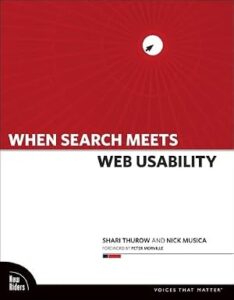
And did that for quite a while. Co-authored a book with Shari in 2009, worked at NYU and taught at NYU for a half minute in the summer of twenty ten, teaching online marketing and including SEO. And then in 2019 I started my own consultancy. I just had the itch to do my own thing, and I started it. And then about three years after that, you and I were chatting before you started to record. Three years after that, I think it was three Novembers now; if you fast-forward to November of 2026, ChatGPT became mainstream. Everyone, everyone and their mother’s using ChatGPT. And before that, we were writing a lot of content for folks.
More specifically, human-written content and blog articles. And all of a sudden, 25,000 words a month, 50,000 words a month are busy in busy months. And then all of a sudden crickets, it goes quiet. Everyone decided it was way better to write vanilla, mediocre copy with this brand-new machine. That’s gotten better doing it. But at the time it was terrible, terrible. But you could do a lot of it cheaply and quickly. And what no one ever came to me for was, “hey Nick, give me a lot of really cheap, poorly done content.” They always wanted a result from what I did, funny enough. But now, the market has shifted, and they are just better. And now we have the result of that again.
And I lost contracts, but what I also lost was interest in what I was building, which is terrible. It’s not a job. You built it, you’re responsible for it. Here’s the lovely thing about self-employment. All the freedom of the world, all the responsibility in the world, right? Like you, you are responsible for making what you’re making. And I could have spun up products and services to make up the revenue, but I lost interest, and that was the hard part. That was really the hard part.
If you have your foot halfway on the gas of self-employment, you're not gonna build anything interesting. Share on XSo I started to see what was available for myself. What was I doing? What was interesting for me? And I was dabbling in coaching for years. Before I started my own gig, I had a team of folks, and I was working with them. That’s a form of coaching, mentoring. And so I started to take a look at that more seriously. And so for the past two-ish years I’ve been doing SEO. I mean, I’ve been doing it for like, I said, since 2003. So people know who I am. I’ll get a reference here and there, and those folks close more easily because someone told you. For people who are running their own business or considering it, you can do all the marketing in the world.
I’m not saying don’t do all the marketing in the world. However, I will say, at least for my experience, the people who close are the referrals. Eighty percent of the people who knock on my door close. Someone told me to talk about a thing. Here’s my problem. Can you help? I can. Let’s go. I mean, it’s sort of that simple. Versus: What can you do? Who are you? Do you have references? If anyone ever asked you for references, say no and walk away. They do not want to work with you. That is a clear indication they are not going to sign the contract. You’re you, and you probably will never hear from them.
Yeah. Or if they’re interviewing multiple companies, that’s not a good sign either.
Yeah. They’re more interested in seeing what the work could look like, smell like, feel like than actually doing the work. If it’s urgent, just go do the work. If it’s not, then you know, maybe I’ll see you in six months. So I started to dabble in coaching more. I especially considered SEO; that was the focus.
But after ChatGPT came out, I was more interested in working as a coach in that realm. And you mentioned intuition at the beginning when we were chatting. There was one day in meditation I heard coaching, and I thought, I’m not doing that. And it kept coming up again. Okay, I’ll go check it out. And I’ve been very lucky in my career to work with folks at the top of their game.
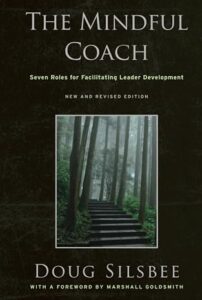
Shari Thoruw, Bruce Clay, who recently passed, Steve Krug, Peter Morville– like the folks at the top of their game. And I’m like, what do they all have in common? They’re at the top of their game, and they wrote books. Well, let me go, let me go find someone on Amazon, which may not be the best way to find someone, but I was like, let’s go on Amazon and see if they wrote a book. And I found this book called Mindful Coach, and Doug Silsbee wrote it.
And I looked him up, and Doug’s off the planet, but his training is alive and well, and it’s happening in Asheville in four weeks. And so that sort of took a lot of what I was doing and just made sense with it. Because I was dabbling with a Harrison assessment- it’s a behavioral assessment- and I was doing intuition coaching and some other various coaching along the way, story coaching, but finding Doug’s book and that program just made everything in my world make sense from a coaching perspective.
So you took this program, you then started working with executives, and what sort of pain points are they coming to you with? Things are very much in upheaval right now with the AI era and a lot of uncertainty; there’s a lot of fear and inaction because people don’t like to make decisions when things are pretty chaotic.
Totally, right. So I mean, there are a few you hit on a couple of things- but I would say the number one factor that I’m working with, the number one theme, is that the things that I’ve done stop working. However, whatever I built just sort of stopped working, and I can’t figure out why it’s not working.
So our habits, our go-to’s, the same five people that have built the company from zero to fifty million. What the number doesn’t even matter. The number is immaterial. It’s the pattern that continues to show up. What got me here is not going to get me to where I want to go. And so there’s this frustration that builds, and there’s the spinning in individual operating systems that continues until we say what we’re doing is not working. We need something different. And when you have exceeded, and we all have limitations- but when you’ve exceeded how you show up, whatever that means, that’s the part that’s different for people.
It’s really helpful to have an outside resource to help you understand what’s going on, to create a different path for yourself. And really, here’s one thing I hear repeatedly. And it’s not venting sessions; they’re coaching sessions, but people just need space to talk and to get their thoughts out. Most folks don’t have that. They’re passing from meeting to meeting, from email to email, from problem to problem, from fire to fire. And then the next day happens. So carving out time to simply process and plan, and have someone hold you accountable, is enormous for a lot of folks.
When you’ve exceeded how you show up, whatever that means, that’s the part that’s different for people.
Yeah. So how does one do that if they don’t have a coach? Do they use ChatGPT or Claude for that? Do they take an online course, read a book? Like, not everybody is able or wants to hire a coach. So what’s the do-it-yourself approach?
Yeah, so you can do it yourself. And here’s what I would say. There’s a bunch of things I’ve done by myself. Books are great, and they’re great for learning. They’re not really great for changing habits. They just don’t contribute to it. There’s their wonderful way. Online courses and books are wonderful ways to see. Am I really interested in what I’m reading? Is there something I want to go deeper on? You can read a million books, but you’re not gonna be an expert in a million things. You’re not gonna change a million different ways. Just say, from my experience, when I’ve worked with whoever it was, and I mentioned some of them when we were chatting.
Whoever I worked with one-on-one, that’s when there’s been big shifts for myself. That’s when I was able to adapt my perspective and see things differently. And then because of that, I was able to function differently and get a different result.
Yep. So I’ve had many coaches over the years, probably fifteen, maybe more. Yeah. So I’m curious if there’s a standout coach that you worked with in the past. Still, it felt like that was a season, or that was a chapter in your life. Now you’ve moved on; how would you leverage that coaching, if you had, let’s say, a year or two years’ worth of coaching with this person? You’ve got the recordings, but they’re sitting in a, you know, Dropbox or a Google Drive somewhere; it’s not like you’re revisiting them regularly. How do you bubble up the insights, the wisdom, the actionable takeaways from those kinds of coaching sessions and make it applicable right here, right now?
Yeah, so I’ve worked with a handful of folks as well, and I still do. And when I’m in the coach’s chair, typically what happens at the end of an hour is, Stephan, what makes sense to move on to the next two weeks? We don’t leave things in the Dropbox; we don’t leave things in. Now we have summaries. More summaries of meetings that we know what to do with. But if we’re not focusing on moving something forward, then we’re having very expensive, non-productive conversations. So the whole idea is to get clear on what’s going on.
What do we want as the outcome? And if that’s the outcome that we want, then what actions are we gonna take to get us closer to that outcome? And when you rinse and repeat doing that for weeks and months on end, looking backward, I had someone say, I can’t, you know, I’m really astonished that we’ve done so much in this period of time. And it was little things every two weeks that we did. It was just little things. But the clarity and the action were the consistent thing over six months.
The clarity and the action were the consistent thing over six months.
So let’s play this out just hypothetically. You don’t have to give any real names or anything, but let’s anonymize this. Like somebody that maybe you worked with for at least six months- they’re in transition, they need to maybe pivot in their career, or they’re seeing a lot of layoffs in the organization. So when they see the writing on the wall, they need to update their resume and sound really appealing ’cause the job market is brutal from what I hear. So what kind of outcomes and actions are you having them take, and what comes from it?
I mean, the actions and outcomes are very broad considering the framework. So it depends on the person. So if we’re talking about, you know, if I’m working with founders, those folks aren’t looking for a job. They’re looking to see how they can expand their company. If we’re looking at folks who are in transition, be it I got laid off or looking for a new gig, it’s a time where you can take a step back. Hopefully, your situation will support this. Where can you start to give it some consideration around what I want to do? Do I want to go back into this situation or a similar situation? Have I been holding myself back? Have I been comfortable as a marketing manager where maybe I should have been the director three years ago? So these are some of the conversations that can happen.
And some people may go, you know, I just, I don’t, I don’t want to go back into it. Also, I don’t know what I want to do. Great. That’s also a great outcome. You know, you have a path ahead of you. It’s not clear, but you know the direction you want to go, versus there are some folks, and you see them all the time on LinkedIn, or it’s “I’m now a consultant.”
Sometimes, or maybe sometimes it’s just I’m in between jobs. And so I throw a consultant shingle on top, right? So, like, to dabble in self-employment. I do not recommend dabbling in self-employment. That is something you don’t want to do. Either you want to be self-employed, or you don’t. But if you have your foot halfway on the gas of self-employment, you’re not gonna build anything interesting. The next interesting child that comes along, you’re gonna throw away whatever you’re building.
You’re gonna go, you’re gonna get a job, which may be fine. And if so, if your tactic is to let me be a consultant as a bridge, cool, but if you really want to go into self-employment, there are a bunch of different ways you can do that without leaving a full-time job. You can get another job and still go. I know I said self-employment, but right now I need a paycheck. Great. But my goal is still self-employment. Okay. So it depends on who the person is showing up as. The clarity around what you want is magical for a lot of folks. And then the commitment to go get it is something that I think most people have a hard time doing.

So let’s get more specific. Let’s say the hypothetical person is a marketing manager. They’re seeing team members getting laid off, or maybe they just got laid off themselves. So they know they need to pivot, and they want to become their own boss. And by the way, I love this expression. I don’t remember where I heard it from. I like giving credit where credit’s due. But yeah, I don’t remember who it was.
But being self-employed is like a very expensive job, is the quote roughly. And the reason why they said that is because you are the hardest on yourself in terms of working nights and weekends and taking very little to no vacation time and just burning the candle at both ends for less money than you would probably get paid if you were doing the same kind of work, working for somebody else. Versus if you were not self-employed per se, but more a business owner, then you have an asset that doesn’t necessarily require your labor. You could have other people doing the labor, and you are making passive income or maybe just tangentially involved, but not doing the day-to-day.
So I love the distinction there because it helped me early on in adjusting my role so that I was not the bottleneck in many cases. You know, I had, for a long time, a CEO; I had a COO. I brought in people that were as capable or even more capable than I was so that I could, you know, relax a bit. Not that I wanted to coast, but that I just didn’t want to have all that pressure. So I don’t know, what are your thoughts on that?
Yeah, I mean, you mentioned a couple of things. So I mean, one is self-employment, solopreneur, shall we say. And what you do in that case, you pretty much give yourself a job. You’re not necessarily building a company. You’re extracting yourself out of this situation, working for Company X, and you have a job, and you’re doing all the things. Or you’re building a company, and you have certain people doing certain things you meant, and you mentioned a couple, and I started doing everything. Then along the way, when I was getting bigger contracts, I would start to hire folks at ten ninety-nine. So everything’s always been a ten ninety-nine for me to hire developers or writers or whoever the talent is that I needed to get something done.
Books are great, and they're great for learning. They're not really great for changing habits. Share on XBut if you can do everything in the whole wide world, but you’re gonna be working days, nights, and weekends and not making as much as you’re probably making now in a full-time capacity for sure. You mentioned passive income. And there’ve been some folks I worked with on the coaching perspective who wanted passive income. And I love the concept, and I really don’t think it exists as much as people talk about it. There’s not much passive about that model. And I’ve seen folks build things and then walk away from it.
With the expectation that it’s gonna continue to run and be successful. And that can happen for a period of time. And then here’s what does happen from what I’ve seen. It simply falls apart. You need someone to maintain whatever it is. Here, passive income could be stocks and bonds. But you know, real estate’s not passive income. Something’s gonna break. You gotta get it fixed. Running a business, having a website affiliate model, which was huge for decades, not so much anymore because of AI and all the fun things that show up.
You still need to market it. You still need to get eyeballs on it. Unless, of course, you’re Forbes. And they’ve built a whole big machine around it. Now they can throw up a page about the best CBD in the whole wide world, CBD products, and they can get a bunch of traffic to the page because they’re Forbes. And other websites can do that. But those are big, big money-making machines. That’s not the context that we’re talking about right now.
Yep. So back to the hypothetical scenario. We’ve got a marketing manager; they need to pivot. What sort of actions is that person advised to take if they’re gonna go self-employment or, you know, business owner route that will not be replaceable in twelve months? Because AI is advancing at a faster and faster clip. And you know, it’s like maybe ChatGPT or Claude is good enough for some copywriting, but not all of it, obviously. And a year from now we won’t be able to say that anymore. Like, wow, this is the best copywriter I’ve ever seen in my life, and it’s ChatGPT.
Your best chance for success is to find the opportunities as they show up.
Yeah. It’s possible. Yeah. And you know, just last week I produced wireframes from ChatGPT, and they weren’t- you couldn’t give them to a developer, but you could give them to a designer to redesign, then give them to a developer. Absolutely. And copy sort of the same thing. We may be going there very quickly. For marketing managers, a couple of things come to mind. And this is not how a coaching session would work.
But for this context, here’s what I would say. You may be in a place where you have enough skills to sell those services. If you do, great. Find your niche, find or start someplace, and start to do that if you want to break out of the mold of working with someone else. And/or you can start doing that when you have a full-time job. But here’s what it comes down to. We don’t know where we’re going. Things are uncertain. So to be able to do your job better, faster, and get along with folks in the organization and be able to adapt quickly, and I think that’s the biggest thing these days, is the adaptation. Being able to adopt a different way of being, being able to adopt a new skill, adapt to the situation, or essentially what you’re gonna be saying is, give me what the dinosaurs had. I’ll take what they have.
And we know what happened to them, right? They’re just simply not here anymore. They stopped adapting. So our goal right now, for better or for worse, is to keep things shifting and changing. And keep in mind the people at the top, even the folks who are creating the tools, don’t know where we’re going. They have no idea what’s happening. They’re just doing it as we like it; it’s a product. But we can’t lay out the future 100% and say Here’s what it’s gonna look like. None of us can. But your best chance for success is to find the opportunities as they show up. Don’t sit on them. Act on them. Not that they’re all gonna work out. And people won’t, and here’s what happens in a coaching session. People go, but how am I gonna? Well, what if it doesn’t work out?
What if it works out? Here’s the absolute 100% guarantee. If you do nothing, nothing will happen. You can guarantee that every time. You may have to do a couple of things for it to figure out what actually does work.
But if you’re gonna try to do something and stick with it long enough to see if it works, maybe it does, maybe it doesn’t, maybe it’s a step to the next thing. But action is gonna be the way out of doing whatever it is gonna be that we’re talking about here. You gotta be actionable. You gotta be willing to try something new. You gotta be willing to have it not work out. You gotta be willing to sit there and feel the failure and decide to do it all over again.
That’s going to be the difference between people who go, my goodness, the thing’s coming for me, or the people, whatever it is, because it was the internet at one point. There was a thing called for people younger and career, there was a thing called the yellow book and yellow pages at one point. People would look up businesses there. And that became a dinosaur.
The more you can adapt to whatever is coming at you and find something that’s interesting.
There’ll be new technology that’s called disruptors that comes through and takes away and changes things, but it’s just gonna keep on moving and grooving. So the more you can adapt to whatever is coming at you and find something that’s interesting. Keep on finding something that’s interesting for yourself so that you don’t dread going to work on Monday mornings. Find something interesting.
If you can lead with that spirit of interest, then when the world throws you a curveball and it all it and it will, life’s gonna get in the way at some point. That plucky spirit to be able to call back some of your resources, things you’ve done in the past, and your plucky spirit to move you forward, that can help tremendously in times of distress.
Yeah. And I imagine your take on things is very much about mindfulness, meditation and intuition. That’s what I got from our chat so far. And correct me if I’m wrong, but that’s irreplaceable in an AI era where you get guidance, and then you apply that- just a fun example from today. So I was showing my wife a mock-up of a repositioning of my homepage on my personal website stephanspencer.com, a repositioning more focused not just on AEO and SEO but on AI consultancy and AI, like fractional AI advisory and things like that.
And she’s like, “Fractional AI advisory yuck. Whoever utters those words in a sentence,” it’s like, this is terrible. It’s just a word salad. She didn’t necessarily use that phrase, word salad, but that’s basically what it was in her mind. And she was right. I just was, you know, there’s an expression: it’s hard to read the label when you’re inside the jar. I’m definitely inside the jar. So she gave me some tough love on that. And then I wouldn’t have thought to do this, but she took a screenshot of the page and another page she knows about that’s into AI training, and they have a community. It’s quite popular, with five thousand people in the community and paying members and so forth.
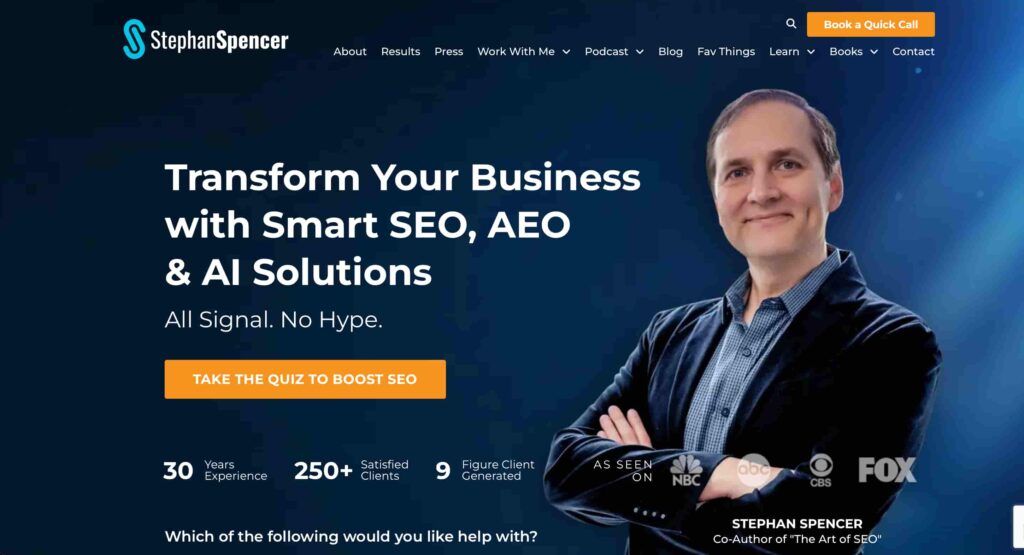
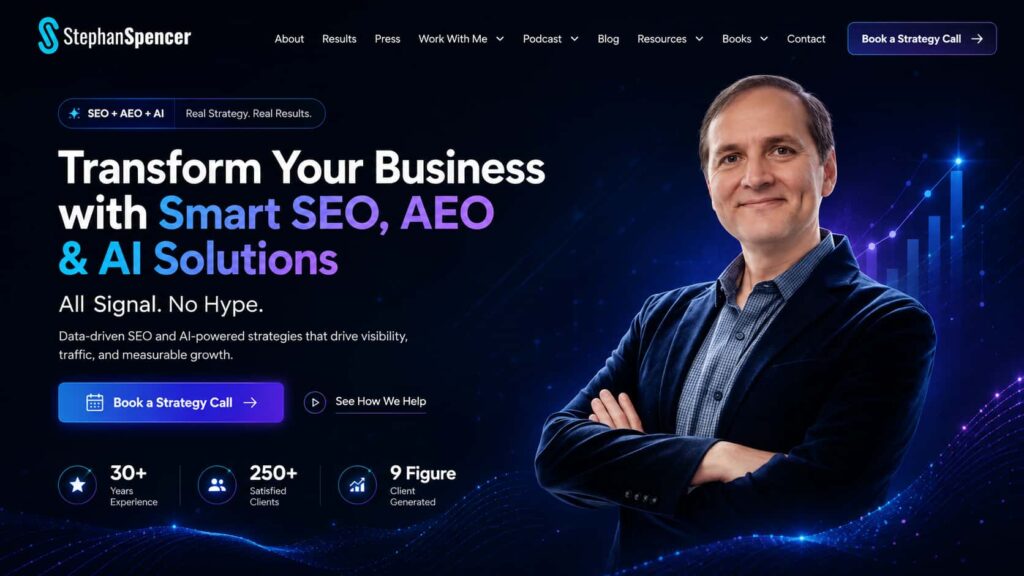
And she took a screenshot of that homepage, and then she fed it to ChatGPT. See, I would have gone to Claude Design, and I don’t get a lot of creativity out of Claude Design. Maybe it’s my prompting, maybe the context isn’t good enough or whatever, but I just wasn’t getting a lot of traction out of it. And she put it into ChatGPT with those screenshots and not a complicated prompt, just a couple of sentences. And on the first shot, it was beautiful. I’m gonna send it to my designer. I’m gonna say Replicate this. This is amazing.
It’s so fresh, and it looks slick and contemporary, but it brings forward the best elements from the existing site. I just like, “wow, this is amazing.” And by the way, she noticed right before she hit enter in the prompt that it was one one one. It was one eleven PM no coincidences. So I think that, you know, this is all just we’re playing a video game here basically called reality or life and if you’re kind of more mindful and tuned in and plugged in to infinite intelligence, however you want to refer to it as, you’re gonna get better outcomes, whether it’s with AI, whether it’s with just life and relationships, with your career, anything.
Yeah. For whatever reason, this memory’s been showing up recently. When we were in grammar school, I went to Catholic school, and we did the singing at Christmas time and the Christmas carols. I read, you know, it sounds like if you saw the movie Gremlins, like it sounded a lot like Gremlins singing, just like a bunch of voices just make right. Like it was just noise. It was just a bunch of noise, like
Must have been terrible for the nun who had a music background, actually, trying to get 30 kids to sound halfway decent. But I remember, I remember at some point my voice was the same- I think the phrase is key or note or whatever like it, but you heard the resonance. You heard it: if anyone plays a tune as you can or an instrument, you know when you’re in tune, when you’re out of tune, and there was a resonance that I heard, and I was like, that was amazing. That was like 10 years old or whatever it was, but it was different than the gremlins just making sounds, right?
Artificial intelligence is not gonna make us more intelligent, quite possibly. Share on XAnd this resonance happened with one other person around me, and that blinded out all the noise just for a moment, just for a second. Being in tune with the other person just created a different experience. And I’m hearing from you that that can happen with technology, with conversations, whatever it is, or else it’s a bunch of gremlin sounds, and then choose your favorite gremlin sound to go next. But when you can pick up the resonance of whatever it is that’s more in alignment with where you need to go, that’s the next thing that you should be exploring, and use that as your path; that’s not something you can get from a machine. That’s not random.
As you say, there are no coincidences around that. And that may not even be the right answer. It may not be the result. But it’s certainly something to pay attention to. And it does help to blind out all the other noise in a space with devices that are literally addictive, that are always just trying to get your attention and extract you from the things that we should be doing. That resonance piece, if you can quiet yourself and tune into it, and do that and learn to do that consistently over time, can change your reality and can change and therefore change what you produce for yourself.
Yeah. In fact, I would say that this is probably your most marketable skill in this AI era: having that capability and really developing it.
Completely. I mean, back in the day it was, yes, hard skills, Excel and Word and things. But don’t forget the soft skills. It was sort of like a footnote, but don’t forget the soft skills. And now we’re at a point where everything we’re talking about. I mean, you can get a non-designer or non-writer to go produce something with AI, and it may not be great. But would it be usable? Yeah. Would it be a good first version of something? Closer to that than not usable these days, but then can you work with that person? Will they respond well in a conversation? Can you co-create with that person? Can you identify when you’re both onto something, and you’re creating together? Those things are going to be way more important moving forward than the hard skills of yesterday.
Those things are going to be way more important moving forward than the hard skills of yesterday.
Yeah. So some of the other soft skills that I think are important for where we’re heading. One is like one-to-one in-person communication. So if you’re a good public speaker or you’re a good networker, face-to-face communication, we’re gonna be craving that because we won’t know what is real and what’s not real. It’s so easy to create convincing deep fakes, and now imagine a year from now. So it has that in-person component. And yeah, just being able to read the room and adapt and kind of improve your way through those in-person interactions, I think, is a very important marketable skill for this new era. Yeah.
Yeah, I find it sort of funny in an unfunny way that the things that we are inherently good at, human beings, that we are inherently good at from a historical perspective. That intuition piece, the story piece, like these things are sort of lost along the way.
We went to the keyboard, we went to the screens, and these things are highly, highly valued from a coaching perspective, from a teaching perspective, from a how you show up perspective, because we can all jump on ChatGPT. We can all do it. Some of us are better than others, but give it time, and you’ll be doing it. So it levels the playing field for a lot of folks.
Yeah, and people used to think that prompt engineering was going to be the thing. You know, you can prompt engineers with the best of them just by having Chat or Claude tell you what the best prompts are for the thing you’re trying to achieve. And you know, I don’t know what I need to ask. So ask whatever clarifying questions you need from me until we get the right super prompt.
And who needs a class or a course on prompt eng engineering anymore? You don’t.
You don’t. Yeah. I mean, just using it and repeatedly trying to get what you want is the training for it, as far as I can tell.
Yeah. But even just like I don’t have an answer to a problem and it’s technical. Where’s the best place to go? ChatGPT, Claude or Grok or whatever your preferred LLM name is. You used to go, or I used to go a lot, to YouTube, but it’s much more efficient to go to Grok or Gemini or Chat or whatever and get an immediate answer. They don’t have to watch a fifteen-minute video.

Yeah. Right. Well, it’s grabbed all that information, just sealed it down into what you’re actually asking for.
Yeah. Crazy wild times. Yes, yes. Speaking of interesting times, and you know the Chinese, it’s like, I think it’s a Chinese curse. May you live in interesting times. Have you heard that before? But if you could kind of prognosticate where you think things are heading, what would be the most interesting, kind of mind-blowing predictions that you have for the next whatever time frame? Two years, five years from now, ten years from now. Just to give you an example, I read recently that Elon Musk predicts that money won’t be a thing anymore in ten years. Like it won’t be a means of exchange anymore; it will be in such abundance that it doesn’t even make sense anymore.
My goal is to let everyone go do all those things. And I’ll do my version of it. But the more that the world goes down the rabbit hole of asking the machines and buying robots, and not doing their own thinking and therefore just like they don’t know how to show up as a human being, they don’t know how to have communication as a human being. I’m gonna spend my time over there. That’s where I’m gonna spend my time.
Yeah, their brains are gonna atrophy if they keep outsourcing their thinking.
We’re handing over our agency in many cases.
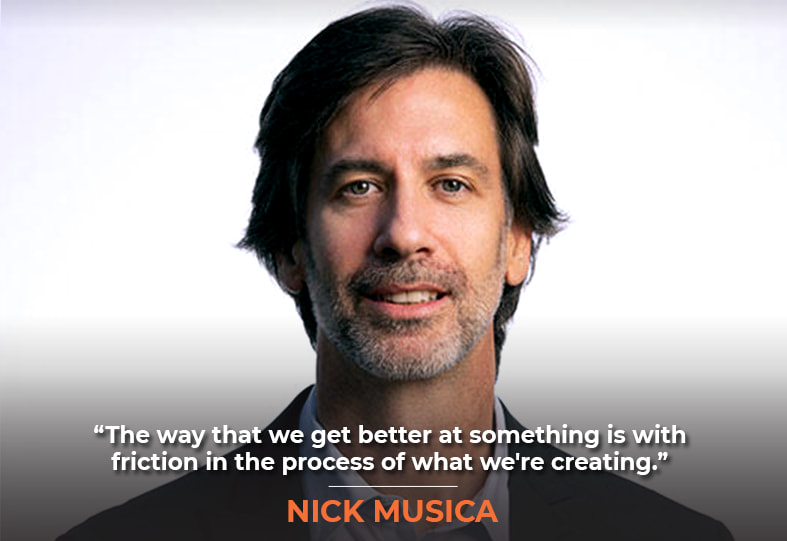
The way that I’ve been thinking about it recently is that social media did not make us more social. It did a bunch of other things to us. And artificial intelligence is not gonna make us more intelligent, quite possibly. We’re handing over our agency in many cases. I mean, the way that we get better at something is with friction in the process of what we’re creating. And what about the joy of actually creating something? If you’re handing everything over to a machine, you’re losing a piece of your humanity along the way. And at some point it’s gonna hurt. And at some point you may not even know why it does.
So what are some things you can do, from a practical standpoint, starting some new habits right now? What would be some things that would help you to keep that humanity, keep that creativity, the problem-solving, the ability to connect dots and find patterns? That pattern recognition thing is a very important skill for our new era. How do you keep that? How do you enhance it?
Yeah. I mean, my practices include getting outside, meditation, and intentionally talking with folks. I mean, it’s an effort. I can spend all day behind a computer just like anyone else. I cannot. I cannot talk to a human being for weeks and months on end. I mean, it’s available to me to do that. But that doesn’t make you; it doesn’t give you a sense of aliveness, it doesn’t give you a sense of satisfaction. So break away from the computer, take a getaway. I know it’s called doom scrolling, but I refer to it as death scrolling. Stop the death scrolling and put the machine down, walk away from the screens, go outside for a little bit, go to a zoo, like go go be around some animals and and smell the smells and hear the sounds and be with people and hear what they have to say about the animals and how they call them the wrong names sometimes at least that’s what I saw. Still, there’s so much available to us outside of the screen that we should be doing for ourselves.
Yeah, absolutely. You know, one activity I’ll share that has been really helpful for me is that, in the last, I don’t know, four years or so, I’ve been journaling every day. And I don’t type it up. I handwrote it. Not like a notebook or something on paper, but actually into a reMarkable tablet because I like it being digital, but I want to use the handwriting as a way to engage more of my brain, and it just feels better. I know I’m keeping myself sharp this way, and I feel like I’m more tapped in when I’m journaling. And this is a gratitude journal where I’m grateful to God for not just the obvious revealed blessings but the challenges too.
Choose a category and then choose an action to start to go down. Do something different. Share on XAnd I also write down the messages that I got or that I’m about to get, and then I quiet myself and listen for whatever messages come in. I do that every day. And this is a game changer for me. There’s another nuance to it that I actually learned from Bill Donius, who was a past guest on this podcast. He is an expert at non-dominant handwriting. And it’s a way to tap into your creative genius. It’s also a way to tap into, like, Infinite intelligence or just, like, your higher self. When I did this exercise where he walked us through it to write down, like, a totem animal, an animal you really relate to. I wrote down just, and he just had us do it normally. And I’m right-handed, so I wrote with my right hand; I wrote zebra. And then he had a switch: quieter mind, squeeze the pen in our left hand if we’re right-handed.
And then try to write it with your left hand, not worrying about how messy it is, and just let your hand write whatever the answer is. And this time, with the same question, I wrote “humpback whale”. What a difference. And then I reflected on that afterward. And it’s like, well, the zebra is all about ego, you know, be distinctive, be remarkable, stand out. But that’s not what my soul wants. My soul is more of a humpback whale. That was really cool. So I don’t know, have you ever tried non-dominant handwriting?
I haven’t. I have a hard time reading my handwriting with my dominant hand. I should have been a doctor from that perspective. It sounds like a variation of automatic writing. That’s what it sounds like. It has at least some characteristics of automatic writing, and that being the vehicle. Yeah. I have. It doesn’t work for me. And I say that thinking I didn’t have given it the time that it deserves.
Yeah. Have you tried automatic writing before?
There are other vehicles that I found just easier to pick up. But you know there are so many tools. There are so many tools that are available to us. Automatic writing, if that’s your bag, if you want to go down that route, right?

Yeah, can we define it for our listener who is not familiar with that term?
Sure. Yeah, I mean, so there are a few ways you can tap into the energy of the world, the energy of the universe, if you like, however you want to phrase it. And automatic writing is one of those ways. And as I said, I’ve never done it; I’m not good at it. But you just sort of start to make patterns on the page, and then all of a sudden things will start to come. And that’s probably oversimplifying and encouraging people, if that’s interesting to you, to look it up.
Still, there are other tools you can use: meditation, yoga, walking, standing in the grass, and just being quiet. All these things have in common is being quiet. Some variation of that and breaking out of thought patterns, which is a trip. You’re gonna want to break the silence by making noise and start to process. And if you can start to feel that your activity is more in your body, then that’s a path to what we’re talking about here. You get out of the intellectual and get more into the body. And that’s where the work really is.
Stop the death scrolling and put the machine down, walk away from the screens, go outside for a little bit. Share on XSo what would be our last, like, wisdom nugget to share with our listener, our viewer, if they didn’t take good notes for all the stuff that we already shared? What would be just not necessarily this needs to even be a wrap-up or anything like that, maybe even something completely out of the blue. What would be something that you want to leave our listener with as a takeaway?
Yeah, so one of the big things that shows up repeatedly with folks when they’re sort of at a point of I don’t know what to do is to start someplace, and that’s overwhelming. Well, what does that even mean? Choose a facet of your life. Maybe it’s social, maybe it’s physical, maybe it’s spiritual. Maybe it’s work-related; choose a category and then choose an action to start to go down. Do something different. Do something that you’ve always wanted to do without any attachment to what may come from it. The point isn’t the outcome. The point is the doing. And if you keep doing it, then you’re gonna get a good outcome. I mean, I would imagine you’ve run into the situation as an SEO consultant, but we want a million visits a month.
Great. I’m glad to hear it. But if we do the right things repeatedly, we’re gonna get a good outcome. And what we’re gonna get is possibly the best version for this website. It may not be a million visits a month; it could be half a million. But if you try to get a million visits, aka attached to the outcome, you’re gonna start to do things to compromise the quality of that site.
If we’re stuck on the outcome, we will start to compromise what it takes to get to that outcome.
And we can take this as the metaphor for compromising the quality of our life. If we’re stuck on the outcome, we will start to compromise what it takes to get to that outcome. If you do the right things, because those are the right things, then you’re gonna get a good outcome that’s appropriate for yourself. So start someplace with something exciting that you know you should be doing.
Yeah. Right. So kind of an analogy to that is if you’re wondering why your prayers aren’t being answered, maybe God has something much bigger in store for you than you could imagine, and what you’re asking for is still very small thinking.
Yeah, maybe the answer was no. Maybe they were answered.
Yep. Awesome. Well, if our listener or viewer wants to work with you and get some coaching advice, if they want to maybe just learn from you and follow you, where should we send them?
Yeah, nickmusica.com is the coaching website. I’m working on getting a community together currently, the founders group, so I’m looking for folks to join who are interested in pursuing what’s next for them. If you don’t know what that means for you, fantastic. Yeah, that’s the person I’m looking for. But if you’re interested in moving on, that’s what we’re looking for. We’re looking for the motivation to move, not necessarily, but the clarity. I don’t have it. Cool. This is the place for those conversations. So if you want to go to nickmusica.com/jailbreakers, you can can go there and sign up. Use JAILBREAKERS as the coupon code. That’ll be, we’ll say, for August: there’s no fee as a founding member; just come and join. Just looking for folks to start a conversation.
Thank you, Nick. This was fabulous and really inspiring. And thank you, listeners. So go out there and make the world a better place and do something innovative. We’ll catch you in the next episode. I’m your host, Stephan Spencer, signing off.
Important Links
Connect with Nick Musica
Apps/Tools
Books
Film/Movie
People
Previous Marketing Speak Episodes
Your Checklist of Actions to Take
- Take referrals seriously, because they are the ones who actually close. When someone comes to you already told about what you do and with a problem you can solve, the sale is nearly made. The people who close are the referrals, so build the relationships and reputation that generate them rather than relying on marketing alone.
- Walk away from prospects who ask for references or are interviewing several firms. These are signals that someone wants to see what the work looks like more than they want the work done. If the need were urgent, they would just hire you, so save your energy for the buyers who are ready to move.
- Use books and courses to learn, but not to change habits. Reading is a great way to test whether a topic genuinely interests you and where you want to go deeper. Real, lasting change tends to come from working one-on-one with someone who helps you shift your perspective.
- Carve out time to simply process and plan. Most people run from meeting to meeting and fire to fire with no space to think. Whether through a coach or on your own, protect regular time to get your thoughts out, decide what matters, and have someone hold you accountable.
- End every planning session by deciding what moves forward. Summaries sitting in a Dropbox do not create progress. Get clear on what is going on, define the outcome you want, and commit to the specific actions that bring you closer to it, then rinse and repeat over weeks and months.
- Do not dabble in self-employment. Either commit to building your own thing or keep your job, because a foot halfway on the gas builds nothing interesting. If you need a paycheck while you work toward it, that is fine, but be honest that self-employment is still the real goal.
- Prioritize adaptation over any single hard skill. No one, not even the people building the tools, knows exactly where things are heading. Your best protection is the ability to adopt new skills, adjust to new situations, and keep shifting rather than clinging to what used to work.
- Act on opportunities as they appear instead of sitting on them. Not every attempt will work out, and that is part of the process. If you do nothing, nothing happens, so be willing to try, to fail, to feel it, and to try again.
- Protect your humanity by getting away from the screen. Get outside, meditate, and intentionally talk with people, because friction and real creation are how you stay sharp. Handing everything to a machine costs you a piece of yourself, and at some point that loss starts to hurt.
- Connect with Nick Musica to explore what is next for you. Visit nickmusica.com for coaching, and check out his founders community if you are ready to start a conversation about your next move.

About the Host
STEPHAN SPENCER
Since coming into his own power and having a life-changing spiritual awakening, Stephan is on a mission. He is devoted to curiosity, reason, wonder, and most importantly, a connection with God and the unseen world. He has one agenda: revealing light in everything he does. A self-proclaimed geek who went on to pioneer the world of SEO and make a name for himself in the top echelons of marketing circles, Stephan’s journey has taken him from one of career ambition to soul searching and spiritual awakening.
Stephan has created and sold businesses, gone on spiritual quests, and explored the world with Tony Robbins as a part of Tony’s “Platinum Partnership.” He went through a radical personal transformation – from an introverted outlier to a leader in business and personal development.

About the Guest
Nick Musica
Nick Musica is a coach, leadership advisor, and entrepreneur who works with people navigating meaningful transitions in their lives and leadership. Drawing from business, leadership development, presence-centered and somatic coaching, story, assessment, and intuitive work, Nick creates the conditions for greater awareness, intentional action, and meaningful change.






Leave a Reply