



Growth doesn’t slow because expertise disappears. It slows when trust erodes. As markets get louder and attention gets harder to earn, partnerships only work when credibility and follow-through are rock solid.
My guest on today’s show is Dov Gordon, founder of JVGrow.co, back for another conversation. Dov has spent the past fifteen years helping established entrepreneurs grow through joint ventures that actually work. He built his network after seeing how often partnerships fail, through misalignment, poor execution, or inflated promises. JVGrow is now a tightly curated community for experienced thought leaders (myself included) who have proven offers and active funnels.
In this episode, we focus on what still drives growth, and what no longer does. We talk about why broad messaging underperforms and why narrow positioning builds trust faster. Dov explains how joint ventures evolve when audiences are skeptical and overwhelmed. We explore where information stops being useful, where mastery begins, how AI fits into the picture, and why human judgment still shapes meaningful outcomes.
This conversation brings clarity to partnership strategy, sharpens how value is framed, and shows how to grow without relying on tactics that stopped working years ago.
In This Episode
- [03:17] – Dov Gordon notes that the fundamentals of needing help haven’t changed, but the types of messages and offers that work have evolved.
- [06:36] – Dov explains that a more nuanced message is needed for experienced audiences, who have been exposed to many similar offers.
- [11:55] – Dov discusses the importance of integrating value in joint venture promotions, rather than just volume.
- [16:28] – Dov emphasizes the importance of mentorship and coaching in achieving mastery and overcoming challenges.
- [19:15] – Stephan and Dov discuss the role of AI, particularly ChatGPT, in replacing certain aspects of human expertise.
- [21:43] – Stephan explains how Google’s E-A-T (Expertise, Authoritativeness, Trustworthiness) has evolved to include “Experience.”
- [26:27] – Dov outlines the three key elements of being a valuable joint venture partner: providing valuable content, showing genuine interest, and being reliable and responsive.
Dov. It’s great to have you back on the show.
Well, thanks for inviting me. I appreciate it.
Yeah, it’s been a long time since you were on Marketing Speak. So why don’t we talk a bit about what’s been happening since? When was that, like 2018 or 2019, something like that? If you could just give us a bit of an update on some of the innovations that you’ve incorporated into your business, your practice, your community, and in what you’ve seen, more generally
Attract First-Rate Clients by Dov Gordon
My focus has narrowed a bit, not so much evolved, but narrowed in that back then we had our joint venture community, and more recently, we’ve rebranded and narrowed the focus. So it’s now called JVGrow.co, and, as it was then, our focus is to serve thought-leader entrepreneurs who actively use joint venture promotions to sell to coaches, consultants, agency owners, entrepreneurs, and other small entrepreneurial businesses. That’s our focus. Our focus is on how people grow through joint ventures. JVGrow.co.
Yep. So what sort of joint ventures are you seeing? Are we working these days, or is what worked five or seven years ago still relevant?
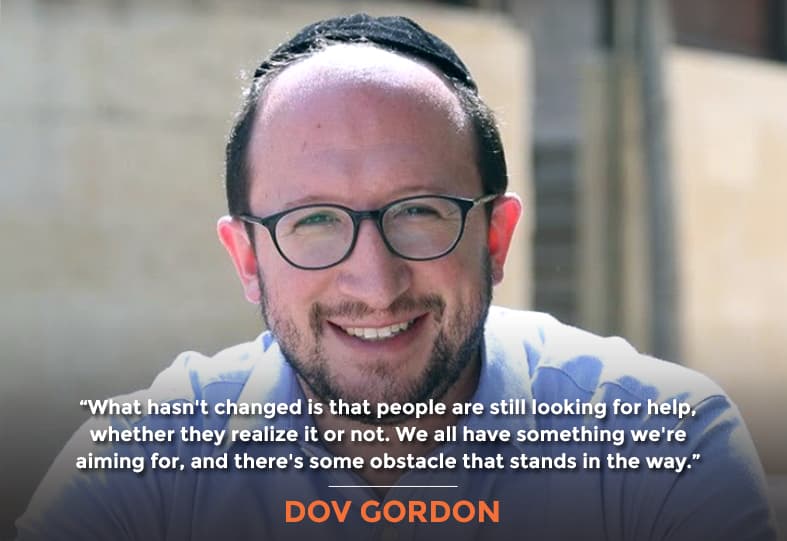
Five or seven years ago, and even before that, you could send an email to someone, and depending on your list size, you’d generate maybe 100 or several hundred. High hundreds, eight, 900 if you had a big list, opt-ins for them. People are more skeptical. People are overwhelmed with offers and information. Certainly, the same types, and the response has definitely been lower. But what hasn’t changed is that people are still looking for help, whether they realize it or not. I mean, we all realize we’re all looking for something.
We all have something we’re aiming for. And there’s some obstacle that stands in the way, or a variety of obstacles, whether it’s internal, inside our own heads or external, it’s usually a combination thereof. People still need help, and a lot of us have expertise and skills that enable us to provide help, so you’re still able to build a business upon your expertise and to serve certain types of people, that’s for sure. And there are still other people with audiences who include many who have never heard of you, but who would love the opportunity to get some of your help or to work with you in one way or another.
The fundamentals haven’t really changed. People still need help. What’s changed is how messages and offers must be delivered.
So the fundamentals haven’t really changed, because the need is still there. So what has changed, really, is just the types of messages that people respond to, the types of offers that people respond to, and the way that the messages and offers are delivered, that people may or may not be paying attention to. And then, of course, there are certain nuances: some things people turn to AI for that maybe they previously would have turned to a coach for. There is definitely a need to make it clear what you’re offering is above and beyond that, or complements that, or cannot yet be done by AI in any effective way.
As smart or as capable as these AIs are, they’re not the same as working hands-on with somebody who’s got master level skills and whatever it is you’re trying to accomplish. So that’s just kind of what I’m seeing in terms of what hasn’t changed and what has. And I think that recognizing what has not changed is always the starting point. That’s the underlying, that’s the first principles, and what has changed is that these are more details, where a lot of people get frustrated, because on some level, I think we would love to get to a point where we just put things in place and then it just keeps humming along.
That’s not real life, and the sooner we accept that, the better off we will be more like what you put in place is who you want to serve, the kind of person you want to serve, the kind of problem you want to help them solve, the kind of results you want to help them enable and create, and then make sure you’re very excited about continuously tweaking and figuring out how to serve those people at a higher and higher level, whatever that would mean, because you will need to continuously be creating and recreating. It’s got to be something that you can be passionate about.
Yeah, so from an offers perspective, would you say offering online courses is kind of dead, and maybe challenges are kind of dead, and what else has jumped the shark?
Courses aren’t dead. Webinars aren’t dead. What matters now is messaging, framing, and packaging.
I hesitate to say that any such thing is dead, because there are always people who are still doing it, well, I think that that’s really the point. It’s not, you know, email is not dead. Webinars are not dead. Challenges are not dead. What’s most important, probably, is recognizing how important the messaging, framing, and packaging of these things are, because they’re just opportunities to connect with people.
You’re looking for their attention and interest for a period of time, for a certain purpose, and the better you can communicate that like, for example, if you’re using messaging that may have worked 10/15, years ago, about how to get more clients consistently. For example, people, for the most part, need a more nuanced message right now. Sure, some people are ranked beginners, and if that’s your target market, you might be able to get away with that type of simpler messaging.
But if your audience is you’ve kind of been in in the business world, or whatever world it is, or trying to grow their their business with their marketing, whatever their Twitter, look for help for for any period of time, you know, six months or longer, probably they’ve been exposed to so much more, and they’ve probably tried certain things.
They’ve probably spent money on this or that. They’re probably taking courses and didn’t finish them, didn’t get very far, because they start to realize that, as much as this tells me, as I’ve learned, I still have these questions. I need someone to help me answer them, and some combination of information with coaching is still very important. In person, events can make a big difference for some people, but more so than that, I think that the narrowly focused message has the highest level of credibility at this point.

Can you give an example, like juxtapose, one that doesn’t work and one that does work these days?
Yeah, I’m just thinking of the top of my head. There are so many conversations I have with people, but my recall isn’t always the best.
Let me just make one up.
Yeah? Well, the idea of, let’s just say, you know how to get more clients, right? I mean, that’s just much broader, or how to get more clients on Instagram. That’s narrower in terms of using a specific platform, but we need to recognize that some people will respond to how to get more clients on Instagram, for example.
Anytime your message makes people think, ‘Oh, you sound like everybody else,’ it’s not going to be effective.
However, they still have, and I don’t know anything about it, to be honest, so it’s not something I do. But there are very specific experiences they may have tried already that lead them to feel like, “Okay, here’s another one.” Anytime your message is something that people fare likely to respond with, “oh, you sound like everybody else.” It’s not likely to be effective.
And what you need to do is to come in with with an angle that shows that you have thought this through, you understand their situation, and that understanding includes a recognition of why so many of the same messages that have been effective in the past are no longer effective, and that’s because most people do not understand the journey that they’ve been through, in the sense that the things they’ve tried that haven’t worked, the promises that they were made that didn’t pan out for them. And when you have a simple message that communicates that, or that incorporates that, then you’re more likely to get through, and then there’s also repetition.
So if somebody is on your email list and you want to get them onto a webinar or to a training, communicate. So much of the message that you’re trying to get across beforehand, communicate it during, of course, and then communicate it afterwards by sharing small clips of some of what was covered, like a one-page PDF or an image, or different ways of getting across a lot of the same information. Because not everybody’s going to show up, not everybody’s going to be on for an hour, not everybody is going to follow precisely the same route.
And if you can get that message across in a variety of ways, layered multiple times, that increases the odds that we have members who are using texting, and we hear really good, effective results from those members using the things I just described. And then, probably above all, is recognizing that sometimes the best joint venture promotions are not just about me sending out a bunch of emails for you, or a handful or a few, but about more deeply integrating our values.
Communicate your message so much of the time beforehand, during, and after by sharing small clips of what was covered, a one-page PDF, an image, and different ways to convey the same information. Share on XSo you serve certain type of audience with a certain type of problem, you help them solve results, you help them enable and I could come in and compliment that in some way, it could be more valuable for me to do a 90 minute workshop for your paid clients than for you to send out something to a list of 10,000 because I may then land two or three of your clients who also want to work with me.
And that could be just as valuable. For example, it’s looking at how we can collaborate with perhaps fewer joint venture partners. Still, at a more integrated, deeper level, that’s also something that I think is really important for people going forward. It’s not just volume. It’s not just throwing everything out there, but it’s about going deeper. And that depth comes from working backwards, as always, from the customer, from a deeper understanding of who this customer is, what problem they have and don’t want, what result they want and don’t have.
Yeah. So if, let’s say, a consultant is getting a percentage off another consultant, steal that as an existing client. I’m going to introduce you to this client of mine, and you’re going to provide services for them. And it’s not competitive, it’s complementary. What’s a typical percentage, like finder’s fee, or whatever you want to call it these days?
So the way I learned years ago how to think about anything along these lines in terms of, how do you decide who gets what, like, how much something is worth, and the way that makes the most sense to me, what I’ve what I’ve always this is the approach I’ve always taken, is you look at the overall so first of all, if you just recommending, and depending on what the service is and how hands on, if it’s a course that all the only costs involved really is just a digital download, so there’s really no marginal cost in there. People will give anywhere, depending on various factors, anywhere from 20 to 30,40, 50%, all the way up to 100%, okay?
Because it could be that they’re just buying a customer for a lower-priced product, so they’ll happily pay the $97 or the 497$ even to their joint venture partner, because they know that a certain number of those certain percentages where they’re going to sign up for a 15, 25, or even bigger offer. On top of that, if two people are collaborating, kind of working together, let’s say there’s 100% of the fee, and one consultant is working on it, we break it down. Let’s say 20% is client acquisition, 50% is delivery, 30% is perhaps managing a relationship, right? And then there’s another 10% in there, right?

So that’s the approach to take. If we look at the whole range of parts involved in landing and serving this client divide, we agree on how to break it up and what percentage to allocate, and then we decide who did what. If one consultant is handling all the delivery, they would get the full 50% of the total fee, let’s say, or maybe more. If they decide that both consultants are doing delivery, with one doing a small part and the other doing the majority, then that 50% might be split 80/20, whatever makes sense.
The important thing is not to have specific hard numbers. The important thing is in terms of, like, what percentage you want to be normal, there is no normal. What’s important is working backwards from the value that we’re creating together. How do we break that up in terms of contribution, who’s doing which part of that contribution, and then we agree on a compensation to be split accordingly. Does that make sense?
Your goal should be mastery—acquire information, go out and implement it, and come back to your mentor to share results, ask what needs to change. Share on XYep. And in your community, so JVGrow. How many folks are promoting things like courses and downloadables and things like that that can scale without a lot of extra personal involvement on the entrepreneur’s part, and how much is more done for you or done with you type things where there’s only a certain amount of the person that can go along with the offer? So they have to scale it back to meet delivery standards.
Everybody has some kind of free information offer of some kind, whether it’s what we usually, you know, more traditional lead magnet of a PDF download or videos to watch, or a webinar or whatever. Everybody paid, is there still a place for that? In terms of paid offerings, many people offer courses at relatively low prices. I don’t think I’m aware of anybody who’s just selling a $2,000 course standalone, like they used to be two $3,000 courses that people go through on their own. I don’t think any of our members are really doing that.
Mastery starts with learning, but it only happens through implementation and feedback from a mentor.
Well, you know what I did? I used to sell $2,000 courses, and I also had a $ 4,500 or $ 5,000 course. I’ve made them all free. I have half a dozen courses I charged multiple 1000s of dollars for that are all free on my site, Stephanspencer.com. Now, the new way to do business these days is we can’t overwhelm people with too much course material, because they’re not going to do it. They’re not going to probably even consume 5% of it. So, might as well put it out there and make it a very low barrier entry and then sell on the back end, things like done-for-you services, or done-with-you services, or cohort-based programs, that sort of thing.
Yeah, and that’s what we’re seeing for the most part, is that people, people may have some low price, entry level trainings that are very, very focused on a specific but valuable piece of the puzzle, anything that’s more than maybe even a couple $100 is going to have some kind of live training or coaching involved, whether it’s group one on one or, like you were just talking about delivery of some kind of, some kind of deliverable, some kind of done for you. Because the value, you know, when we only have so much information available, we still need somebody to take us by the hand.
To some degree, we still need someone to take us by the hand at certain points along our journey. We all need it. There’s always something we need to sit down with somebody and hash out, and that’s where the information clicks. I feel like the goal really is mastery of anything significant that’s worth learning; we’ve got to be going after it for its own sake, or because it’s a key component in helping us accomplish the bigger business goal, or whatever, or a life goal.
People are going to crave human connection even more as AI becomes harder to distinguish from reality.
And to me, mastery has several steps: number one, I need some information. I need some know-how, some knowledge. And there’s so much knowledge out there, there’s so much expert information, if you’re starting in any domain, it’s really hard to know how to separate the 90% from the 10% What’s that 10% that you really need to know and the 90% you don’t, or you can get there in the future, right? And you need a mentor or coach who’s already mastered this to direct you to the critical 10% that gives you 90% of what you want. And that is the valuable first step. So the first step in mastery is really to study and acquire information.
The second thing is, you’ve got to take that and implement it. You’ve got to go out and use it. And when you go out and use it, you’re going to find that sometimes you get the results, the reaction, the response that you’re hoping for, and sometimes you don’t. But you’ve got to go out and do that, because you’re never going to really understand the information until you’re using it. And then you can start to see how it actually works.
And then, of course, the third step is, you go back to your mentor, your coach, and you say, “Look, this is the information you taught me. This is what I did with it. These are the results that I got. I like these results. I don’t quite like those results. What am I doing? What do I need to change?” And your mentor, your coach, could look at what you’re doing, hear the story that you’re you know your description, and very quickly, because he’s mastered what you’re just beginning at, he can very quickly say, “Oh, this You did well, this you didn’t do well, here’s, here’s what you need to prove and change.” And that’s a role that we all still need.

Well, what about ChatGPT? Can’t we just replace that eventually, within the next, I don’t know, six months with the ChatGPT or something similar?
I am not an expert in AI. I did recently start using it for some things like this, and I am honestly impressed, but it’s still not the same as another human being who’s mastered something and is giving you their time, attention and brain power. It definitely can replace some aspects of that, and I do think that, as a community, we need to talk through it for ourselves and amongst ourselves to clarify where the weaknesses are in the various AI tools that more and more people are learning to utilize and rely on. There are still weaknesses. And where are they? What are they, and how can we fill the gaps they can’t cover? And that’s really the value.
AI gives you an 80% head start instead of staring at a blank sheet of paper.
I mean, a lot of what they produce still lacks a certain soul or polish. For sure, a lot of people will just take the output that ChatGPT or whatever AI they’re using gives them, but because they lack the nuance, let’s say, the skill at storytelling or the mastery of messaging, they’re really unable to recognize that the output isn’t quite so good. So there’s still the question of whether it’s an evolving question for us to continue to answer. What have you found?
It’s surprisingly effective. Just by doing a simple prompt, I create my 2026 goals. It’s mind-blowing. How good it is, not accurate, not precise, but boy, does it give you 80% of a head start rather than a blank sheet of paper. Yes, agree, because it’s got all its memory. It’s got all its context, history, previously uploaded documents, previously entered props, and everything it knows about you. It has access to all the sorts of information that is about you online, so it can augment what it knows about you from its internal database with what’s out there on the internet. It’s surprisingly effective.
Yeah, there still is the aspect of community, though.
It’s not just a community. It’s like people are going to crave the human connection more. And there’s this great quote from Mark Cuban: “Within the next three years, there’ll be so much AI in particular, AI video people won’t know if what they see or hear is real, which will lead to an explosion of face-to-face engagement, events and jobs.” Those who are in the office will be in the field. So that’s according to Mark Cuban, the billionaire, you know, from Shark Tank, and I’m 100% with him on this.
Google doesn’t just value expertise anymore. It now prioritizes real experience.
And also, I think that if you bring it, I’ll bring in a Google acronym, EEAT. It used to be EA T, (Expertise, Authoritativeness and Trustworthiness.) Those were three really crucial aspects of online content that Google wanted to see on your website. And now it’s not EAT, it’s EEAT, they added another E, and that is for experience, because you want to talk about basket weaving or scuba diving or running a 5k or whatever, you’d better have experience in that if it’s an AI that auto-generated that article. Well, when has an LLM ever run a 5k or woven a basket? So I think people crave that. And so you’re saying that Google is looking for some sort of signals that show that there’s real experience here, that this isn’t just auto-generated, just, you know, LLMs are a fancy autocomplete, at least at this point. It’s a probability engine.
This, EEAT, Google is using this in their search engine rankings. Is that? What? How are they using it elsewhere? And the reason I’m asking is that who’s using a search engine anymore? Who’s using Google?
A lot.
AI results at the top. Okay.
Well, zero clicks is becoming a thing. Zero-click search, but if you look at the volume of traffic.
I did that just a couple of times.
So Google has ChatGPT, and all of them are beaten by traffic and usage. I use ChatGPT a lot, but I use Google more, and I usually get the answer in the AI overview, so I don’t end up clicking. So, half the time I’m not clicking through, maybe it’s 40% that I’m not clicking through, but it’s a significant amount of time. It’s a zero-click search for me, and that’s okay, because I’m still accomplishing my task and maybe not getting, like, a brand impression from an organization that wanted to market to me.
There is always an opportunity for a joint venture, no matter how small your audience.
Still, in cases where I’m looking for a solution, I’m getting recommendations, just like I would from ChatGPT. In the Google AI overview, it’s like it’s doing heavy lifting for me and saying, “Well, this is a great solution for you,” instead of just showing 10 blue links. So, yeah, I think this is, and you asked, How is the EEAT being used? It’s indirect, because Google has used this as a basis for its manual raters, which it uses as machine learning pre-training, so that it feeds the AI, all this human-evaluated data, websites, web pages that have been evaluated by human raters who go by all these guidelines, like 160 pages of guidelines. It’s called the manual raters Google quality guidelines, and it includes EEAT, which is one of those many, many guidelines.
So it says, “Hey, look for experience.” And if you don’t see it, then this could be a suspect. And then that, when they have this army of manual raters who have, for years, been looking for EEAT, and other aspects of quality on the website, and then feeding that as a yes/no or quality score gradient to the machine learning algorithms. Then the machine learning algorithms learn, “hey, we need to sniff out the experience and really put that at the top.”
Very interesting. Got it, okay.
But I’m interviewing you, not the other way around. I know we need to wrap up here very quickly. You’ve got to go. But what would a few next actions be for our listener or viewer to take to help them uplevel in this new kind of new world order?
The partners everyone wants aren’t the ones with the biggest lists. They’re the ones who add the most value.
If you’re doing anything, there’s always an opportunity for a joint venture. And a lot of times, people are concerned or worried about why somebody, you know, why would somebody want to promote me, or my list is too small, or whatever it might be, there is always some kind of deal that can be done, yeah, and there’s always an opportunity to be referred.
Yeah, it could be a one-to-one-to-one. Like, you know, one person refers to one person to one person. It can be one-to-many, which is also nice. That’s like, you know, like, one person sends out an email to many people about one other person, and that’s all possible, but the place to start is really to have a deep understanding of what value you bring to those who have a very clear target market.
The same basics in business are what really make it easy for you to thrive as a joint venture partner. I like to say that three things make you the one everyone wants to promote. And it’s not about having the biggest list. It’s not about having the biggest whatever.
It’s number one is: make me look good; you want me to promote you. Make me look good. Make me feel good, and make me want to speak well of you. Talk well about you. And looking good means giving me something valuable to talk about.
People who get promoted everywhere simply execute the basics better than anyone else.
If you want me to talk about you, to introduce you to my audience. Give me something valuable that people will say, “Oh, wow. Though if you’re sharing good stuff, this is quality material.” So that’s number one: make sure that you’re giving me something good to tell, right? It doesn’t even have to be a lead magnet, like we’re talking about. But if you want me to talk about you, give me something that makes me look good as the messenger.
The second thing is to make me feel good, which means making sure you want me to help you. Make sure I feel that you’re interested in me, not just seeing me as some intermediary, and that you want something from me. And it really should go without saying, but it doesn’t, because it’s just so easy, even for people who don’t necessarily mean to be that way. We are all, by default, focused on our own needs, wants, fears, desires, and worries, and sometimes we can forget the other person without even meaning to.
So we really need to prioritize making me feel and look good. Number one, make me feel good. Make sure that when we’re talking, you’re genuinely interested in my business, my goals, and so on, and that you’re suggesting ways we both win together.
And then the last thing is, make me want to talk well about you. To speak well of you is that you are reliable, responsive, and communicative. That means, if you say you can do something, make sure you do it. When I send you a message, call you, or whatever, respond.
If you want me to talk about you, give me something valuable that people will say, “Wow, you're sharing good stuff. This is quality material.” Share on XAnd number three, if for whatever reason, you can’t do any of the first two properly, communicate, initiate. As soon as you realize you’re not gonna be able to follow through, let me know. Don’t have me chasing you down. Don’t have me sending you repeated messages and not getting a response. These are all really important, and it’s also very basic. But just as the black belt is doing the same moves as the white belt, with a much higher level, the people who are everywhere and being interviewed by everybody and promoted by everybody, they are doing these things just at a black belt level because they’ve taken the basics and they’ve run with it. They built it.
Yeah, that reminds me of a great book that’s called The Four Agreements by Don Miguel Ruiz. And one of those four agreements is Be impeccable with your word. And I think that really dovetails well with what you were just describing. One of my mantras has been a kind of morning affirmation. Has been for many months. That’s why ago, “I’m a man who does what he says he’s gonna do.” So, how does our listener or viewer get in touch with you, maybe join JVGrow, or potentially learn and work with you?

Well, we’re at JVGrow.co, and if you are somebody who sells to coaches, consultants, experts, service-based businesses or other small businesses using online direct marketing, specifically joint ventures and so on. And if you have a proven offer and an active funnel, we’re not for beginners; we’re for intermediates and advanced users. And you appreciate the value of joint ventures, and you’re just looking for the right partners, people who make you look good, make you feel good, and make you want to talk well about them. Go to JVGrow.co and reach out to me. You can reach out to me as well as [email protected]. We’re actually getting the JV Grow email set up, but for now, [email protected]
Yeah, and I’ve been a member of, well, what used to be called JVMM, or now JVGrow for, I think, like eight years or something now. Yeah, it’s a great organization. We appreciate you.
Appreciate you too.
Awesome. Well, thank you Dov. Thank you. Listener. Go out there and make the world a better place through your marketing. I’m your host. Stephan Spencer, signing off.
Important Links
Connect with Dov Gordon
App/Tool
Books
Film/TV Show
People
Previous Marketing Speak Episodes
Previous Get Yourself Optimized Episode
YouTube Videos
Your Checklist of Actions to Take
- Craft narrowly focused messaging that acknowledges past frustrations. Develop messaging that shows understanding of what my audience has already tried and why broader promises no longer resonate.
- Scale my tool usage based on query complexity. Match the number of research or outreach efforts to the complexity of my task. Use one tool, call, or partnership approach for simple questions that require a single source, 3-5 for medium-complexity tasks, and 5-10+ for deeper research or comprehensive collaborations.
- Pursue deeper joint venture integration over volume. Focus on fewer joint venture partners but collaborate at a more integrated level. Rather than simply exchanging email promotions, offer to conduct a 90-minute workshop for a partner’s paid clients.
- Layer my messages across multiple formats and touchpoints. Communicate my core message before, during, and after my main event or offer. Share it through email sequences leading up to a webinar, deliver it during the presentation, then reinforce it afterward with one-page PDFs, images, or clips.
- Implement the Three-Step Mastery framework. Structure my learning and coaching offerings around: (1) Study and acquire the critical 10% of information that delivers 90% of results, (2) Go out and implement it to see what works and what doesn’t, (3) Return to my mentor/coach with specific results and questions so they can quickly identify what needs adjustment. This framework positions my expertise as irreplaceable by AI.
- Make joint venture partners look good, feel good, and want to speak well of me. Give partners something valuable to share that makes them look good as the messenger. Show genuine interest in their business and goals to make them feel valued, not just used as an intermediary. Be reliable, responsive, and communicative.
- Combine information with hands-on delivery. Make comprehensive information available at low or no cost, then sell higher-ticket done-for-you services, done-with-you programs, or cohort-based experiences. People are overwhelmed with information and need human guidance, coaching, and accountability to achieve mastery.
- Use repetition and multi-channel distribution for joint venture promotions. Don’t rely solely on a few email sends. Use texting, social media clips, PDF summaries, and multiple email sequences. Communicate my value proposition across channels and over time, recognizing that different people engage through different routes and at different moments.
- Connect with Dov Gordon and join JV Grow. I can visit JVGrow.co if I’m an intermediate or advanced marketer who sells to coaches, consultants, experts, or service-based businesses using online direct marketing and joint ventures. I can also reach Dov directly at [email protected] to discuss collaboration opportunities or learn more about the community.

About the Host
STEPHAN SPENCER
Since coming into his own power and having a life-changing spiritual awakening, Stephan is on a mission. He is devoted to curiosity, reason, wonder, and most importantly, a connection with God and the unseen world. He has one agenda: revealing light in everything he does. A self-proclaimed geek who went on to pioneer the world of SEO and make a name for himself in the top echelons of marketing circles, Stephan’s journey has taken him from one of career ambition to soul searching and spiritual awakening.
Stephan has created and sold businesses, gone on spiritual quests, and explored the world with Tony Robbins as a part of Tony’s “Platinum Partnership.” He went through a radical personal transformation – from an introverted outlier to a leader in business and personal development.

About the Guest
Dov Gordon
Dov Gordon founded JVGrow.co fifteen years ago to solve a problem established entrepreneurs eventually face: How to consistently attract high-quality prospects and generate predictable sales—without relying on ads or cold outreach.
Joint venture partnerships offered the highest leverage—but only if the partners were credible, aligned, and executed as promised. Finding that caliber of collaborator was rare, so Dov built the network himself.
Today, JVGrow.co is a highly curated community for thought-leader entrepreneurs who have a proven offer, an active funnel and who want to grow sales through high-trust JV partnerships—without wasting time on unqualified or unreliable partners.







Leave a Reply