



Discovery has evolved. We moved from directories to links, then to intent signals. Now, AI systems sit between your content and your audience—deciding what gets retrieved, summarized, cited, or ignored before a human ever sees it.
My guest today, Duane Forrester, has lived every phase of that shift from both sides. He helped build the platforms at Microsoft Bing that shaped modern discovery, then advised hundreds of organizations on how visibility actually works. As the former Senior Product Marketing Manager who led Bing Webmaster Tools and helped bring Schema.org to life, Duane now focuses on one core problem: how brands stay visible when machines—not people—are the first audience.
In this conversation, we unpack his framework for a new set of KPIs built specifically for the AI era. Metrics designed for a world where ChatGPT, Perplexity, and Claude control the gates. Duane walks through the tools he’s bootstrapped to track chunk retrieval frequency, embedding relevance, and citation rates—signals most SEO platforms don’t even attempt to measure.
We also explore why so many businesses never appear in AI-generated answers, the mental models Duane uses to ship meaningful work without getting stuck in his own head, and why asking fewer, better questions beats chasing every platform update.
This episode cuts through the noise and gives you frameworks for measuring what actually matters in the machine layer. So, without further ado, on with the show!
In This Episode
- [05:44] – Duane Forrester reveals the framework for measuring success in Answer Engine Optimization and explains why traditional tools aren’t tracking these metrics yet.
- [10:25] – Duane explains the various features of the AEO tool, including citation tracking, query alignment, and competitor analysis.
- [18:28] – Duane shares insights on the consumer adoption of AI technologies and the impact of these advancements on traditional SEO practices.
- [29:54] – Duane talks about his experience of building webmaster tools at Bing and the lessons learned from that experience.
- [36:42] – Duane Forrester introduces his frameworks, including the 12 Gen AI KPIs, AI Visibility Journal & 0-4 Scoring System, and 90-Day Learning Path.
- [45:21] – Duane emphasizes the importance of giving oneself permission to leave problems unsolved and allowing the brain to work on them overnight.
Duane, it’s so great to have you back on the show.
Oh, Stephan, thank you. It’s great to be back,
So you have a new book out. Congratulations on The Machine Layer.
Thank you very much.

How did this book come about? This is a very fast-moving space. It seems like as soon as you publish a book, it could be obsolete with all the advances that happen on a week-to-week basis in generative AI and AEO answer engine optimization. So why a physical, printed book? I know you have a Kindle edition, but why a book?
Yeah, so look, this is a collection of pieces of information, of learning, of knowledge, experiential-based concepts that I wish I had two or three years ago. We were all there when ChatGPT launched, and it was a big deal. I think most of us, who are practitioners in the industry, within search, could kind of see that something was coming, and we dug in a little bit, and then dug in a lot, and then we started to see the changes happening really fast, and it continues to happen really fast. This is literally something that I wished existed two years ago.
And I sat down and thought about it, and was like, Well, what if I just start writing? And here we are, months later, you end up with a book. That’s my third published book. So I’m familiar with the process, and it doesn’t scare me. What scares me is the update cycle I’ve set myself up for, because, you know, I have a feeling that every six to nine months I’m going to want to version this and just keep up with what we know is going to be a fast-paced, continually changing environment.
Right. So you have the option to do that, since you’re not working this time with a traditional publisher, you’ve self-published, so you can do updates as often as you want.
And the timing of the updates is a big differentiator as well. When you work with a traditional publisher, they will tell you the cycle of when your book goes to market, and they will set direction on that. Give you a timeline, you get a work-back schedule, you fill in the blanks, then get it to your editor, and everyone moves forward. When it’s your own, and you’re self-publishing, you control all of that.
When you self-publish a book, you control the timeline, and that changes everything.
So if I don’t know, let’s say next week, CES is all wrapped up, and a big announcement comes out that changes the world of hardware, and then we see the platforms making demonstrable changes. I can go ahead and add a chapter to the book, then simply republish it as v2, and a week later, you have the freshest information. So as long as I can put in that time and effort, we can keep this book right at the cutting edge.
Yeah, that’s really cool. And some of these principles and frameworks that you provide in the book are pretty evergreen, right? So you have established new KPIs to measure and drive success in the AEO world, and with generative AI, you have other frameworks we can discuss during this interview. So let’s actually maybe start with those KPIs, key performance indicators, which are new, because this is a new world. This is a new era we’re entering. And presumably these KPIs will still be valid in a year or two, right?
I believe. So I just want to, like, set expectations for this. Okay? The reason I’ve started and suggested these things is that we don’t have systems that track this information, or at least, when I thought of this framework back in early 2025, say, around May, they didn’t exist. None of the tools were looking at these things. They weren’t producing these pieces of information. And I come from that world. I come from an enterprise where you do have to track key performance indicators.
You can call it goals, you can call it metrics, whatever you want. I’m using the phrase interchangeably, but it occurred to me that we have a new interface. We have a new surface that, by its nature, will generate new data. We will see this happening, right? And those I vote online as 12 KPIs. People need to understand that for a few of those KPIs, we don’t have access to the data. It has to come from the platform.
So, unless ChatGPT, Perplexity or Claude share this piece of data with us, we’re not going to see it. The best we can get are proxies. However, I encourage people to create new KPIs for themselves and track them on their own, such as chunk retrieval frequency and AI output rate. In the AI, it sounds fairly benign, like, Okay, well, how many times is my chunk getting surfaced in an answer within ChatGPT?
Sounds pretty logical, but you actually have to create the platform. You actually have to create the tracking for this yourself, because there are almost no services available that do this. Some of the newer tools that we’re starting to see. I recently had Ryan on with SERPrecon, and he’s leaning into these areas, and several others are as well. But practitioners must dig in on these things.
You need to create a report that shows LLM answer coverage. That’s one of the KPIs. And right now, that’s a lot of just grunt work. You have to create the questions that people are asking. You have to go put them into the systems. You have to capture all of those answers. You have to determine whether you are cited, there’s a link, you’re mentioned, there’s no link, or you’re paraphrased. It’s obvious that your information has had an influence on the answer, or you’re not included at all. You have to manually uncover those four states to determine what a report looks like.
Yeah. But the problem with that is that everybody gets a different result, a different output from the LLM, including yourself absolutely. When you type the same exact prompt a second time, the whole query fan out will be different, and the output will be different. It’s seemingly impossible.
It is an incredibly difficult space, but as a marketer, I would not go get the data because it’s difficult. I would capture the data and look for signals in the noise, and that’s going to be hard. This is a new world for traditional, practicing SEOs. We are used to data that’s fairly straightforward, very contained, and well-defined at this point. I mean, think about this. We’re in the better part of 30 years in the industry, which has advanced from where we began.
We have a pretty good handle on what the metrics are, how to track them, what we have access to, what we don’t have access to, and over time, the platforms Google and Bing and Yandex and every other search engine has actually given us more information to work with, so we could play in that place with some level of certainty, or at the very least, everyone has come to understand where the gray areas are and generally agreed on How to interpret them. Wild West, every person for themselves. These are phrases that filter through my mind. Now, when we look at these situations, and I’m all about the data, I just want more of that information. And yeah, it’s messy, no question, but I’d rather have the data than not.
So, have you built a tool for collecting this information, or are you doing it manually, just copying and pasting into a Google sheet where you have some sort of template or something?
The answer is yes. So I originally started with just like a spreadsheet and the usual kind of point, I very quickly iterated into a platform called N8N, where I was automating different queries into areas, grabbed some APIs from Claude, Perplexity, ChatGPT grew that pretty quickly, then just got back into writing Python code, and now I have an entire tool suite that is not launched but is available for me to do all of this work in the background in an automated fashion, so I can add in a client.
Any idea you've had, anything you want to pursue—do it with conviction, knowing the only person that you need to satisfy is yourself. Share on XI can go through and just say, “Okay, here are the reports that I want,” and it will do everything. It will go in, give me a citation overview, and tell me how I’m working. I preload queries into it. I preload URLs from my website. It will chunk from the content. It will compare that to what OpenAI, for example, would use it for, or how it aligns with a query.
Does the query fan out in the background? I query, fan out to me is not a big deal. Like, a lot of people are hung up on it, like, “Ooh, look at what it shows me.” And I’m like,” It’s a tool along the way.” And so you use that to then say, “Okay, I’m a lazy client. I’ll give you five questions that I think people are asking about me or that I should answer for the query fan out.” Filling in the blank gets you up to about 25, and then it just expands from there.
And then you can get rated against all of those. So, the content chunks from your website, how do they align? There’s that kind of reporting. There’s a technical layer in there as well. Are you blocking bots, and how much of your content is unique, or how much overlaps semantically and maybe fights itself? There is a complete view, so you can put a couple of competitors in there, and it will perform the same actions on their websites and content as it does on yours, and then tell you whether you’re outpacing them.

Wow. Are you planning to release this tool anytime soon?
Yes.
Awesome.
Yes, actually, I hadn’t really planned on it, but we’re kind of like traipsing down this pathway here. So I will say that my plan, as we record this, is within a couple of weeks. This should be a live, I guess we’ll call it a beta. I’m calling it an MVP, but it’s going to be a really advanced MVP. It will be a waitlist scenario where I want to get a few people in, maybe a dozen or so companies, pound on it, see what breaks, see what has to happen.
In fact, this afternoon, up on my whiteboard, you can’t see it, but I have the outline for the bring your own API coding that I have to put in place, because maybe people want to put their own API in there for ChatGPT and run on their own pipeline and not share whatever. I don’t care. I just want to label the feature, and that should be done soon. So it’s something again, like the book. As I was writing the book, I was learning about all of these different things. I was thinking to myself, “I built Webmaster Tools at Bing, so I’m predisposed to the concept of a tool set as a platform, and I’m really excited by it, so hopefully others will be excited by it as well and find value in it.”
I have a few friends. I’ve taken clients from them, run them through, and it’s a little bit shocking to me what the performance of some of these companies looks like. The thing that uncovers, and this is what was so glaringly obvious to me, is that these businesses are struggling to get the fundamentals of traditional SEO done right. They’re struggling to perform well in that environment, and itis not doing them any favors in this new one. It’s obviously having an effect.
So lots of KPIs. If you don’t know what you don’t know in an SEO world, then you certainly won’t know what you don’t know in an AEO world.
Yeah, absolutely.
So is this something that we could maybe have a sneak peek at? Can you maybe share your screen? I know you mentioned the Ryan Jones episode. I was really grateful to Ryan for being willing to share an inside view of the tool and how it worked, and to screen-share reports and other things. Is that something that you’re open to, or is it too close to the chest right now?
If you don’t know what you don’t know in SEO, you definitely won’t know it in AEO.
Well, the problem that I have right now is that I’m just looking at the reporting. I’m looking at the chunk Performance Report, for example, and it shows how well the chunks align with reality and which underperformers are on the website versus which overperformers are. The number one problem we have is that I’m borrowing a client from a consultant. That client’s domain is represented everywhere, openly.
Unfortunately, if I had a different business and the permissions, I would go ahead and share it. There’s no way to anonymize because this is literally meant to be like, here’s your client dashboard. You, as the client, go ahead and see your data. The difficult part, and I suspect Ryan and I are friends, we’ve talked a lot about this, the difficult part is getting people to understand that there is an importance here and that there is, I don’t want to call it an urgency, because I’m not interested in clickbait or any of those types of actions, but there is an urgency. There is a lot of change happening. I tracked something earlier this year in one of my sub stacks where I walked back, like, for the first time in time, the history of Google, doing updates and talking about them in public.
So for that entire frame of time, I compared what ChatGPT and OpenAI have done, and it was startling to me to realize that OpenAI releases ChatGPT updates twice as fast as Google releases updates. So it’s somewhere around like five and a half, it’s just shy of double. So they end up moving at a pace that is kind of outpacing Google’s. Now, unfortunately, that was looking at apples and oranges. We were talking about Google Search updates, because it’s a concept that practitioners can wrap their heads around.
And I was comparing it to updates from this new-fangled competitor that’s on the scene. I think a better comparison would be Gemini updates to OpenAI, obviously, but Google doesn’t talk a lot about Gemini updates. There’s just not a lot on an official basis. If we made this change, we made that change. Those are fewer and farther between. So the bottom line here, though, goes right back to how you opened us up right at the pace of change. It’s real, it’s fast, and I think it’s going to continue to accelerate through 26 and 27.
As a marketer, never not get the data because it's difficult. Capture the data and look for signals in the noise. Share on XYeah. Well, I love this kind of model that Ray Kurzweil offered of the accelerating rate of change, which, when you compare it to 100 years ago, is at today’s rate of change. So let’s say that you take the last 100 Years of technological advancement. How many years into the future would it take at today’s rate of change to get that same amount of 100 years of evolution happening? It’s only 20 years because we’re operating at a faster iteration rate, but it’s continuing to accelerate and is not going to stay stagnant.
Then that 20 years actually becomes 12 years. So fitting 100 years of evolution. Like 100 years ago, they were just inventing the toaster, and now we’re thinking about what’s 12 years from now, when my kid is out of elementary school and in college, that’s crazy to think that there’ll be, who knows, flying cars and replicators and who knows what, other craziness.
I looked at information about Google’s adoption from the day it launched until it reached market saturation, defined as 50% of consumers in America. It took Google nine years to reach that plateau. And if you look at ChatGPT, that nine years equate to roughly 890 million users daily. Okay, so almost 3x the population of the United States, all up, or at least double. When I tried to compare that to ChatGPT, ChatGPT is on track to hit a billion daily active users in the next two months or so, maybe three months. They’re doing that over a 4.4 to 4.5-year period, so less than half the time it took Google. That’s what it’s taken ChatGPT to reach a similar plateau, and I’d like to say maybe better advertising or something like that.
I honestly don’t think that ChatGPT has done any advertising. I don’t know that they’ve ever needed to. But the reality is, this is where we find ourselves, and I attribute it to consumer adoption. And if you look back when search started, I remember standing in a line at a grocery store, and somebody had recognized me and said, “Oh, you’re so and so’s son.” And they said, “What do you do now?” And I tried to explain to them what SEO was very early in my career, and it was a mess at about 38 seconds, the eyes glazed over, and I totally lost them.
They barely had the concept of the internet as an everyday construct in their heads. And today, all of this stuff is so native to these systems. And more importantly, I think, consumer behavior around these systems, adoption of these things, we as a species, have become so laissez-faire with eye-opening technology, because we see so much of it, we expect that it’s there. We expect the next big thing to move from awe to adoption much more quickly than it did in 1998.
Even in SEO, my focus has always been to keep things human, manageable, and at a level people can actually parse.
Yeah, I’d say we’re mostly a society of digital natives now.
Oh, I would 100% agree with that. Obviously, outside the populations that simply have no connectivity, you can point to rural farmers in Africa who have a better, faster growth curve on digital nativity than we ever had. It took us longer to reach fluency on mobile devices; for example, it’s all they’ve ever had. That’s their world. You talk about toasters being invented 100 years ago.
CES was showing off the hypersonic knife this week, which literally vibrates the blade with hypersonic energy. And you don’t need to push when you cut the tomato; you simply need to rest it, and it will slice through on its own. Yeah. I’m not saying this is the greatest use of science that humanity has come up with to this point. But if you want to talk about things in your kitchen, yeah, where are we going to be in 12 years?
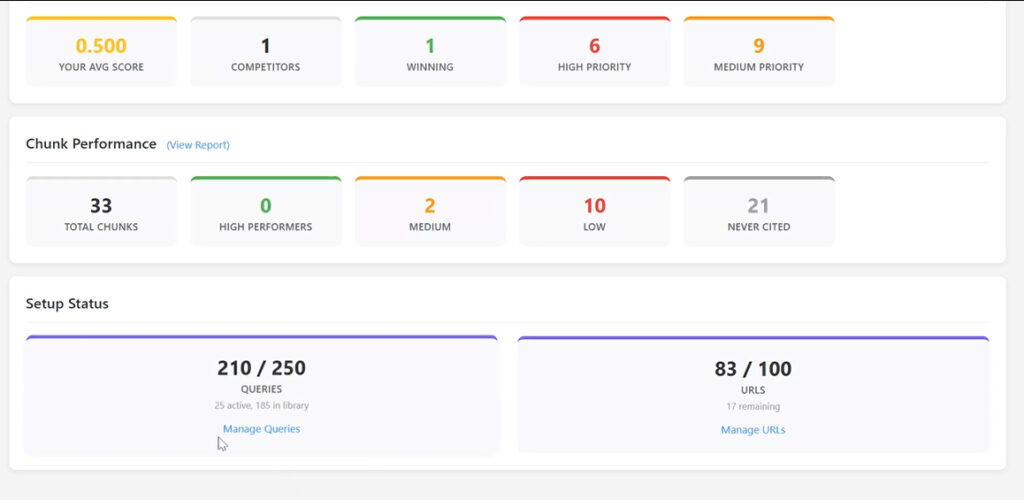
This shows you the main dashboard a client would see when they log in. It’s literally a collection of data points from all of the other reports on the back end. And I’ll hop into another one of those reports in a moment, and we can take a look at things. The query alignment is up here. It’s taking a look at 25 queries, over 100 pages on a website. It is using ChatGPT to look up the OpenAI API to understand what a score and a vector alignment score should look like for specific queries you’ve entered.
So, in this example, we can see that the average score is 5 out of 1. Some of those, if you were able to see the reports that I unfortunately can’t show you, would show a score of close to seven, like a 6973, for the best performer, and obviously lower scores in the fours and almost threes for the poorest performers. Based on that scoring, we’ll chug this up for people on a strong, moderate week, and where there’s a gap, where you’re below a point four zero, for example, that just signals an opportunity. You don’t have the right content. It’s not written the right way. It’s not aligning well with the actual query. So you can target that content, change it, and see how it performs.
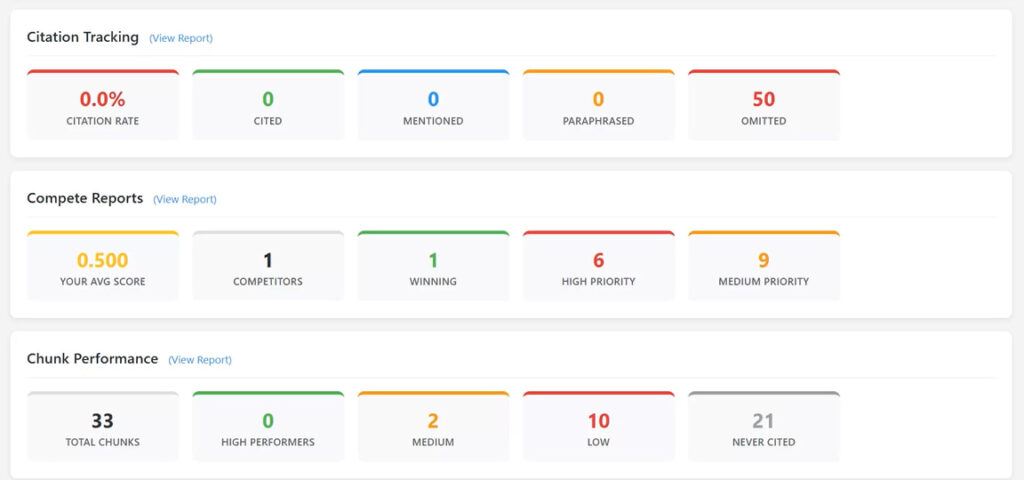
This version has 83 pages crawled. Two of these have medium technical issues. There’s nothing in here that I’d worry about other than high issues, and we will take a look at that specific report next. Citation tracking: I mentioned earlier that many companies are going to be surprised and that things are changing quickly. This is an example of that in the citation tracking, out of 50 queries that were actually tracked, not a single one included this client in an answer, not cited, not mentioned, not paraphrased. They are simply not there for any of those topics. That is a huge red flag for this business, because ChatGPT obviously is not including them.
There is a complete report here. You can put your top two competitors in, and it will run all of the same reports against them that you would run against yourself. And then it ranks it and shows you how you’re doing. In this example, you know, obviously, repeating your average score is five. It’s showing there’s one competitor in play. You’re winning. In one instance, there are six high-priority areas that you need to look at, because they’re beating you, and nine are kind of on the bubble and float anywhere just below winning, all the way down to the high-priority area.
If we look at chunk performance, we’ve created 33 chunks individually here. 10 of them just aren’t performing. 21 would never be cited. And again, this is running through the APIs at Claude and OpenAI, and we’re handing it to the system and essentially saying,’ Is this valuable? ‘Would you use this? And the system is returning a score, and from that score we can chunk it out and say, “Here’s the performance relative to these things.”
In this account, there are 25 active queries, 185 in a library. You can go ahead and move them around as much as you like and check different versions. There is a maximum of 100 URLs in here. There are 83 crawled on this website. You can add more, if you like, and cycle through them. So that’s just the main overview page. I’m going to take us into the technical report quickly.
When you say they’re up to 250 queries here, those are prompts you decide to check to see if your brand, your company, is showing up with a citation or mention without a link, no citation or mention at all, or a paraphrase. And how do you generate those prompts? Is that a manual process? Is that something that you can use AI to help you with, or your tool set to help you with?
Yeah, so the platform is built that you got to give me something, give me five that you think are important to your business, and then from there, it will go to OpenAI again via the API, and it will run the query, fan out on that, and then it brings it back and says, “Here’s a list of your queries that are related to these topics.” And you can select what you want in there, so you can go ahead and load them all up yourself, if you want. There’s a function for CSV upload in there.
So if you want to take the time to create your own list of 250, by all means, go ahead. I’ll adjust that. Don’t really care. It’s entirely up to the consumer. There are limits on these things related to launch and scalability, as well as long-term costs. I expect that as I have more backend data, I will be able to relax those limits and increase them.
Tracking tens of thousands of keywords is not a good approach for this new AI world; most of that data gets compressed because it isn’t semantically distinct enough.
However, there’s something very important we don’t talk about much. I know Ryan has talked about it. I know Dixon Jones has talked about it. Not surprisingly, these are gentlemen who run their own tool sets. They’ve come to, I think, a similar conclusion that I’ve come to, which is this approach that we have in SEO of tracking millions of keywords, or even 10s of 1000s of keywords, that is not a good approach for this new AI world that we live in. A lot of those things are tightly related to each other. They’re not semantically different enough to affect ChatGPT’s decision when it’s choosing an answer. So a lot of that gets compressed.
My focus has always been that, even in the world of SEO, you need to, like, keep it human, manageable, and at a level humans can parse. That’s why, part of the reason why we have limits in these systems. Over time, we’ll probably see these limits relax and expand. But I also think that there’s going to be a practical limit to this, where you don’t need to go track 10,000 of your top questions that people ask about you, because for most businesses, they don’t cover a breadth of topics to the point where 10,000 queries would be relevant.
Yes, unless you’re a major conglomerate or something, then maybe you need that kind of scale,
Yeah. And if you are, I can see that, especially in a large e-commerce scenario, two or three questions per product make perfect sense. And if you have 8000 products, there you go. You’re already at scale.
Yeah.
But that’s not the vast majority of the internet.
Also, know a shortcut to getting past these growth constraints as a small tool provider? Get acquired, right? So somebody like Neil Patel coming in and buying you, like you bought Answer the Public, and then these query limits and URL limits, I guess that you can or higher next year.
I mean, this is an entirely bootstrapped effort on my own, like on my own, I’m back into learning coding and using the scant knowledge that I have around it from my history.
And you’re probably using AI to help you with it, right? You’re using maybe quad code and so forth, maybe not vibe code for you, but debug and all.
For most businesses, you don’t need to track 10,000 questions; your topic breadth simply doesn’t justify it.
Oh, absolutely. I have two employees. It’s a massive time saver. Most of my time is spent in PMing, in the Project product management setting constraints, and in the actual hard-coding. When it comes to validating the code, just run it, and it will come back immediately and tell me, you know, you’ve got an extra colon here. You’ve got too much spacing in this spot. Your alignment is off in this area. And it just gives you the line number. It tells you what the problem is. And you go through, and you fix all that crap, and then it’s boring and unsexy, but after a few weeks of doing all that, you have executable code that does pretty cool things.
And you have decades of experience with this kind of thing, of building tools for webmasters and business owners. I mean, you were maybe the main guy behind Bing Webmaster Tools, or one of the main guys, right?
I will pull that robe back a little bit. I was the PM, so I was essentially the front end. I was aligned with consumers. I interfaced directly with a programming lead, and that person ran the team that did all the code work to build what I had put up on a whiteboard and said, “This is what we want.” You know, it’s a fairly common approach inside a tech company that you would, you know, you have a PM, you have a dev, and they work together, and the product comes to market.
In this case, I’m all of that. I’m the guy who, last night, at 10 pm, was still sitting here squashing bugs because I wanted to convert all of the reporting on download from CSV to Excel, because I wanted to control layout and formatting and information, and you can’t do that in CSV. You can in Excel. So I had to go through and convert all of those. That’s me. I’m staring at a six-foot whiteboard with all of these must-fix, must-adds, do this, expand that, and it’s fascinating. It’s skills that I haven’t used in a little while that I’m dusting off, but it’s allowed me to create something like this and say, “Look, I think what’s really important for people is information. Is data. They need these pieces of information to start.”
You had mentioned earlier, “What we don’t know, we don’t know, and a part of this whole concept of the 12 KPI framework, and then all the way through to these tools, shouldn’t surprise anybody that these tools are based largely around my 12 KPI framework, and trying to get as much of that information visible as possible.
Can you go through each of them? I think you only gave a few, right? So, can you give the full list of the 12 KPIs?
Yeah, I did. I gave a few. Let me read through these things for you and the audience. Stephan, so we talked about chunk retrieval frequency. It’s, you know, how often your chunks are retrieved by AI systems embedding relevance scores. It’s a measure of how closely your content’s semantic embedding aligns with the user’s query embedding.

And look, I’m just going to say straight up front, it’s totally okay if people are hearing this and they have no idea what I’m saying, entirely acceptable. When we first started talking about SEO out loud, people thought we were talking Latin. We’re at that same point in history, where we’re talking about concepts like embedding relevance, and unless you actually look it up, you haven’t encountered it yet.
Attribution rate and AI outputs. This is a simple percentage of the AI responses for your brand that is explicitly credited. The AI citation account number of times your content is linked or referenced in responses is a vector index presence rate. This is one of those things where I talked about, we need the platform to give the data. And this is one of those things because the vector index lives inside ChatGPT, and if you need to know your rate of presence within that, they are the only ones who can tell you that; however, and I’m going to put my geek hat on really hard here for a moment. You can set up a vector index with Weviate or Pinecone. Those are two separate companies. You can build your own index, a vector index similar to how ChatGPT constructs one, and then ask it to do the alignments I’m running myself through these tool sets, which is a proxy for how a system like ChatGPT operates.
It is not a mirror for ChatGPT, because the next layer that you’re going to learn about is weightings and temperatures. And the weighting shows how important something is compared to something else. We’re familiar with that concept from traditional search and algorithms. The temperature, then, is like a third dimension: now that you set the weight, you can refine how much hotter or colder it is within that area. You can build all of that on your own as a standalone platform, and feed your website’s content into it. You will get an approximation of how ChatGPT operates in the background.
It is not a mirror again, but a metric that I think is really important. And if you can create your own proxy, you can start understanding things like, Do you have technical issues that are blocking your content from getting into a vector index? Because if you do, you will never be included in an answer. It’s that simple. So I include that as a metric. We’ve got a retrieval confidence score. Another fun one is the reciprocal rank fusion contribution. And RRF has been around for a while.
AI is a massive time saver for validation; it tells you exactly where the code is broken and what line needs fixing.
I encourage folks to go look it up. It’s a fairly straightforward concept: blending a couple of different things that happen right now in traditional search. It’s one of the things that makes traditional search as advanced as it is. We have the LLM cover and answer coverage. I mentioned that one earlier breadth of topics or queries for which your content can be retrieved or used. Query fan-out plays a role, as does semantic understanding. AI model, crawl success rate, and semantic density score.
I recently did a Substack on that one, focusing on the richness and completeness of your content in a given technical area. This goes all the way back. And if you’re an SEO, you’ll remember this SEO and Bing. Heck, I was doing it when I was on stage for Bing, telling you how important the depth of your content is. That’s what we’re talking about with semantic density. And if you haven’t been doing well with that, you have to fix that. If you have been doing well with that, you’re already set, you’re ready to go.
I’m encouraging folks to look at a zero-click surface presence. This requires a lot of manual tracking of all zero-clicks. What’s happening with that? Whether it’s a smart watch, a wearable device, smart glasses, or a smart speaker, the obvious zero-click in a search panel, all of that, and create a report around that so that you have some sense of your brand in the ether.
And then the final one is the machine-validated authority. These are the trust levels AI systems assign to your content. And this is a really, really important chapter in the book. It’s fairly long; we go into that. Two gates are essentially evolved. That’s how I’m describing them. But I’m going to pause here for a moment, Stephan, because that was a ton to throw out there. I’m going to just invite you back onto your own show for a moment here.
That was fabulous. And clearly, these are not just standard metrics that everyone in the SEO industry is familiar with and uses to measure. I’m sure our listener would love to get a copy of a book that goes into more depth on each of these metrics. But do you also have a glossary, cheat sheet, or downloadable guide to these metrics that they can get for free, even if they don’t get your book?
What’s really important for people is information, data they can actually see and work from.
Yeah, so here’s what I’m going to suggest to folks. Obviously, it would benefit me greatly if you take a run by Amazon and grab a copy of the book, whether it’s a physical or a Kindle version. It’s available globally; wherever you are, you should be able to find it. If Amazon is selling, you can grab a copy. I’ve got three frameworks.
The 12 GenAI KPIs. The metrics that matter when traditional rankings stop predicting outcomes. What to measure when AI systems retrieve, synthesize, and deliver answers directly.
I’ve got an AI Visibility Journal. A tracking matrix that makes retrieval performance visible and comparable over time. Includes the scoring system that turns Cited, Mentioned, Paraphrased, and Omitted into numbers you can act on.
And a 90-Day Learning Path. A structured roadmap for building AI optimization skills without abandoning your current responsibilities. From foundation to integration in three months.
So if you’re still wrapping your head around AI and how to fit it into either your daily work or your team’s workflow, because there’s an executive layer and a practitioner layer in this 90-day learning path, all of that is available on Duaneforrester.com right now. Just hit the website and look for frameworks in the navigation, and you’ll get right to the page. So all kinds of information is in there. There are a lot of other frameworks in the book that I’m not sharing, because I obviously would really appreciate it if people read the book. There’s a lot of information in there, and, as Stephan, you know, I’m not afraid to give away secrets. That’s always been a hallmark for me. I’m happy to share and help people move forward.
Yes, and I love you for that. You’ve been doing that for a long time. We’ve shared many stages together. Remember fondly us speaking at Affiliate Summit, doing a keynote panel together at both Affiliate Summit West and Affiliate Summit East. So I have a special place in my heart for you, my friend. Also, I’m so grateful for that wonderful post you wrote about me. In 2016, we didn’t talk about it in the first interview back in episode 38 because it hadn’t been published yet.
If your content can’t get into a vector index, you will never be included in an AI answer. It’s that simple.
But later that year, you published this beautiful piece about our friendship and how impactful I was on you, your life, and your career. Do you want to give a quick summary of that? It’s a long post, so it can’t really be done in 20 seconds.
But I’ll say this, there’s a point for everyone, I think, where they recognize people who have had an impact on their life. Sometimes that’s negative, sometimes it’s positive, but I think it’s a really important action that people take for themselves. It’s like being introspective at times. It’s very powerful, and it’s very useful. You came into my life at a time when my career was just taking off and growing, and you gave me advice that helped me shape the personal frameworks I lived by throughout my career. It’s proven immensely valuable to the people who are watching this. They think maybe there’s like a one-time touch on the Well, for those watching Stephan.
We are in regular contact, and we share a great deal in terms of personal approaches to life and these kinds of concepts, each from our own unique perspective. And I can say that Stephan has just been one of the most impactful people. It was my career that made this intersection happen with Stephan, but he’s become somebody who is personally valuable to me, very much a friend. I mean, we’re sitting here a decade after that, and Stephan, I still feel this way, and you are still helping me. I become better through selecting people. Stephan, you’re still one of those people for me. And thank you.
Oh, that’s so sweet. I appreciate you so much. That’s an awkward moment here. I don’t know if I need to get a tissue or something, but you’ve done amazing things in your life, your business, and your career. If you wanted to give some life and career advice, just overall, for our listeners or viewers to improve their lives. What kind of wisdom nugget would you like to share with them?
I’m going to share a couple of things. And look, these two things, people may want to roll their eyes at it. That’s okay. These came to me through two important people. Stephan, you being one of them, and another friend of mine, Dennis. Dennis and I bumped into each other one day at an airport. And you know, I’m like, “Hey, where are you going?” And he’s like, “Where are you going?” And I’m like, “I’m going to speak at a conference.” And he said, “I’m going to a Tony Robbins seminar,” and we both just stopped and looked at each other, hugged each other, and then kept running in opposite directions.
But I kept ruminating on this idea of Tony Robbins, the value of what he does, and this kind of idea. I’m not here to tell anyone to go to anyone specifically, but I learned things. I learned to get out of my own head. I learned to cultivate relationships with people whose thinking I could validate and that resonated with me. I learned to build those relationships on a peer-to-peer level, and I need to bring as much as I get. That’s how you find this value exchange? Those three things alone completely change the direction of my life.

And I’m not going to say that I have everything figured out. I’m not going to say that I don’t get into my own head and get stuck in there from time to time. But attending seminars like this gives you a sense of developing mental tools that will help you break through those things. And so I will say this to anyone who’s watching this, any idea you’ve had, anything you want to pursue, any concept you have that you think you should move forward, writing a book, starting a podcast, doesn’t matter what it is, do it and do it with a conviction, knowing the only person that you need to satisfy is yourself, because that is the number one thing.
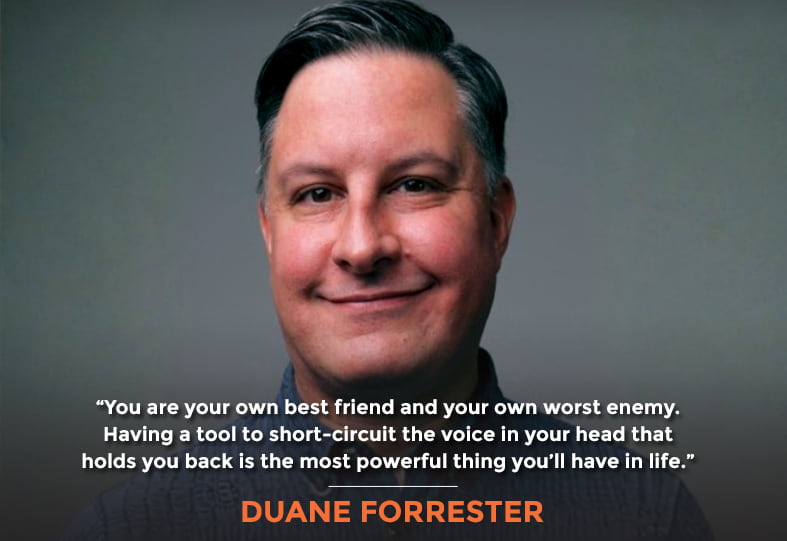
It’s not about being cool. It’s not about what other people are going to say. It’s not about what an audience might think. I write my books, I built these tools, I do all of these things because this is what I wish someone had out there for me, and I’m doing it for me along the way, I’m not blind to the fact it’s going to benefit other people, and that feels great, but I have to be okay with it. So, straight up, number one, the most powerful thing you can do is stop listening to the voice in your head. Find the mental models that get you around that let you break out of that cycle. You are your own best friend and your own worst enemy. So, having a tool to short-circuit is the most powerful thing I have learned to date.
Yeah, on a similar note, just kind of piggybacking on that, that inner critic, when I find the fastest way to silence that is to get tuned into a higher frequency radio station because, you know, think of yourself as or your brain is kind of like an FM antenna or a tuner. So if you listen to a higher-quality radio station, you’ll get different messages. So I ask God in prayer to raise my vibration, and then I find that the quality of the inner voice, the meanderings that I hear, are actually 10 or 100 times better. And from that, I can do stuff that I thought previously was impossible, set some impossible goals, and you just might achieve them. Because I love this quote from Ford way back in the day, like, “if you think you can or you think you can’t, you’re right.”
For me, it’s meditation. I’ve been doing this for the last 25 years of my life. I can sit down, I can meditate my way through the concepts, permitting myself to leave an idea behind, because it will still be there later when I come back massively powerful and that one, I don’t know if it’ll work for everybody, but that one is responsible alone for more better quality nights of sleep for me than anything else, giving myself permission to leave the idea on the shelf and not solve it immediately, it just quiets down that part of the conversation. And yeah, you’ve got to do it over and over again.
We, as a species, have become so laissez-faire with eye-opening technology. We move very quickly from awe to adoption. Share on XBut like anything with some practice, it is game-changing. Yeah, that’s awesome. Yeah. Another way to think of it is just give the problem to God and let God solve it for you, and pop it into your head. That’s the other thing, too. I will routinely stack up my problems at night before I go to bed. What is constantly a marvel to me is how many answers I have in the morning. Because look at the end of your day, you’re kind of strung out. You’re exhausted from everything, all of the input, visual, auditory people asking questions, you solving problems, energy management, all of this exhausts you, and when you recharge overnight, your brain has had time to wire its way around the concepts and the problems that you left in, and suddenly, the solution.
Stephan, you and I touched base, I don’t know, maybe two, three weeks ago, which was just a little bit before the holidays, and you said, “Hey, your Duaneforrester.com website looks like crap. You need to work on this.” And I’m like, “Oh, I’m building out a different website.” And you’re like, “Why this one is like, number three for your name? Why would you invest in anything else?” And it was a light bulb moment for me. The light bulb came on the following morning because I had this entire construct in my head. I was following the path I was on, and I justified it all, listening to the voices telling me it was the right choice, and so on.
And I woke up the next morning, and I’m like, “You’re a fool. He’s right done.” Later that day, I had reoriented everything, and now I look at it and think to myself, this is the right way. This is clearly the right way. And you know, this is it, your mind is incredibly powerful.
You know, all that was great, except for the part where you said, I’m a fool. Just delete that part. Everything else is perfect.
Not you, me.
I know, but I don’t like it. But this is the thing. Like, I don’t feel we self-deprecate, yeah? Like words are magical. They’re incantations. So when you are derogatory or self-deprecating towards yourself, that’s just, yeah, you’re speaking it into existence.
You’re absolutely right. Because I actually have that conversation with people all the time, and yet I still fall into that trap where you say these things, and there is a much better way to phrase it, so I think you’re right.
Yeah. All right, so let’s again get our listener, our viewer, to your book and your frameworks, and if they want to follow you on social platforms, LinkedIn is probably the best place to find the most wisdom there is, that’s right?
Yeah, if folks want to get in touch with me, they can email me at Duaneforrester.com. The book is on Amazon. The Kindle version is there. Obviously, I am available on LinkedIn as well. Folks want to track me down. I’m easy to find there, and feel free to reach out. I’m happy to engage, answer questions, and help folks solve their problems. Awesome, okay, yes. You’re also available for consulting. Again, track me down through the website. I’m happy to set up time with folks.
Awesome.Thank you, Duane, thank you listener, thank you viewer, go out there and make the world a better place through marketing, AEO, SEO and just all sorts of cool AI stuff, and we’ll catch you next episode. I’m your host. Stephan Spencer, signing off.
Important Links
Connect with Duane Forrester
AI Optimization Frameworks
Apps/Tools
Article
Books
Business/Organization
People
Previous Marketing Speak Episodes
YouTube Videos
Your Checklist of Actions to Take
- Start tracking the 12 new AEO KPIs now, even manually. I need to create reports showing chunk retrieval frequency, attribution rate in AI outputs, embedding relevance scores, and semantic density.
- Focus on semantic density to improve AI visibility. I must ensure my content has depth and completeness in technical areas—this goes back to traditional SEO principles about content depth. AI systems prioritize semantically dense content when making retrieval decisions.
- Use query fan-out strategically to expand topic coverage. I should start with 5 core questions relevant to my business, then use AI APIs to develop these into 25-50 related queries. This approach helps me understand the full scope of questions people might ask, where I should be the answer, without needing to track thousands of keywords like in traditional SEO.
- Check for technical issues blocking vector index inclusion. I need to verify that bots aren’t being blocked and that my content can actually get into AI vector indexes. If technical issues prevent my content from being indexed, I’ll never be included in AI answers.
- Build a vector index proxy to understand AI systems. I can set up my own vector index through companies like Weaviate or Pinecone, feed my website content into it, and use it to understand how systems like ChatGPT operate.
- Track zero-click surface presence across all devices. I should manually monitor how my brand appears across smart watches, wearables, smart glasses, smart speakers, and search panels. Creating a comprehensive report of zero-click presence gives me a sense of my brand’s presence “in the ether” of AI-powered responses.
- Create competitor comparison reports. I need to put my top two competitors into my tracking system and run the same analyses I do for myself—checking their content chunks, citation rates, and query alignment. This competitive intelligence shows me where I’m winning and where I need to improve.
- Use meditation to break through mental blocks. I should permit myself to leave problems on the shelf overnight without solving them immediately. By stacking up problems before bed, I often wake up with solutions because my brain has had time to process and wire its way around concepts while I sleep.
- Stop listening to the inner critic and find mental models that work. I must identify and use mental tools that help me break out of negative thought cycles. Whether through seminars, peer relationships, or spiritual practices like prayer, I need to develop strategies to get out of my own head because I am both my own best friend and worst enemy.
- Connect with Duane Forrester for consulting and resources. Visit DuaneForrester.com to access his three free frameworks: the 12 Gen AI KPIs, AI Visibility Journal & 0-4 Scoring System, and 90-Day Learning Path. His book, The Machine Layer, is available on Amazon in both physical and Kindle formats globally, and he’s available for consulting through his website.
 About the Host
STEPHAN SPENCER
Since coming into his own power and having a life-changing spiritual awakening, Stephan is on a mission. He is devoted to curiosity, reason, wonder, and most importantly, a connection with God and the unseen world. He has one agenda: revealing light in everything he does. A self-proclaimed geek who went on to pioneer the world of SEO and make a name for himself in the top echelons of marketing circles, Stephan’s journey has taken him from one of career ambition to soul searching and spiritual awakening.
Stephan has created and sold businesses, gone on spiritual quests, and explored the world with Tony Robbins as a part of Tony’s “Platinum Partnership.” He went through a radical personal transformation – from an introverted outlier to a leader in business and personal development.
 About the Guest
Duane Forrester
Duane Forrester is a long-time search industry leader, former Microsoft/Bing executive, and author of The Machine Layer. He helps companies navigate AI-driven discovery, visibility, and trust. Today he advises brands, builds tools that measure GenAI-era performance, and speaks globally about the future of search and digital strategy.






Leave a Reply