



According to today’s guest, most SEOs are still optimizing like it’s 2005—counting keywords, stacking H2 tags, obsessing over density metrics that search engines haven’t cared about in years. But the truth is, Google and AI don’t work that way anymore. They think in vectors, not words.
My guest for this episode is Ryan Jones, who runs the SEO practice at Razorfish and created the semantic SEO tool SERPrecon, which evaluates websites the way search engines actually work. Ryan dove deep into the Yandex and Google source code leaks and used that knowledge to build a tool that evaluates websites using the same technologies that are powering modern search.
In our conversation, we discussed why the SEO industry must evolve beyond lexical tactics and embrace semantic relevance. Ryan breaks down vector space, third-party consensus for Google knowledge panels, and how to reverse-engineer Google AI Overview citations using passage BERT. He shares his Reddit strategy, explains the flaws in traditional keyword optimization, and demonstrates how SERPrecon scores title tags using Yandex’s exact logic from their source code leak.
Stay tuned, and you’ll shift how you think about SEO, giving you a competitive edge in an AI-driven search world. So, without any further ado, on with the show!
In This Episode
- [03:25] – Ryan Jones shares his experience of coding an SEO tool inspired by the Yandex and Google source code leaks.
- [08:20] – Ryan shows how SERP Recon extracts keywords, entities, and page speed data, providing actionable insights for SEO.
- [12:20] – Ryan emphasizes the need for SEO tools to incorporate modern search engine technologies, such as BERT and passage ranking.
- [22:30] – Ryan explains that third-party consensus is crucial for appearing in a knowledge panel, as it reflects the overall internet’s view of the entity.
- [30:46] – Ryan provides tips on how to effectively use Reddit, including joining relevant communities, being active, and providing valuable content.
- [34:46] – Ryan expounds how cosine similarity helps search engines determine relevance by measuring the closeness of vectors in semantic space.
- [43:20] – Ryan highlights the importance of staying updated with the latest research and understanding the underlying technologies.
Ryan, it’s so great to have me on the show.
It’s great to be back. I haven’t seen you in a little bit since we did some conferences together, maybe a couple of years ago. Thank you for having me.
Yeah. So you’ve been on the conference circuit for a while. We’ve both been presenters at PubCon and other SEO conferences over the years. Is the conference circuit still a thing for you? Or have you kind of retired from that?
It is, I’m choosing less and less. I did two keynotes this year back-to-back. I keynoted a PubCon in a state of search, so I was really excited about it, and I got the call to be the main-stage speaker. Well, actually three, if you count a couple of panel keynotes, but yeah, still doing it. Still, it’s not as big as it used to be, right? It’s, you know, as we all get older, it’s tougher to find time, but I still love conferences.
They kind of energize and reenergize my passion for SEO, every time I start to feel a little burnout, I just go speak at a conference and talk to all the people about what they’re doing, and that energy and passion just come back to me.
So how did you end up coding an SEO tool that’s a big deal, like you’re going against the Semrush and Ahrefs of the world and so forth? What inspired you to do that?
It’s not like everybody sets out to make an SEO tool, but I don’t know if everybody remembers the Google leak that came out, or, before that, the Yandex leak. Honestly, I don’t think the industry paid enough attention to that. Yandex leaked their entire source code, and then it was a couple of versions old, but the entire source code of the search engine leaked, and it was all C++, which I took in college 20-some years ago, so I had to remember it, but I was working with Mike King on that.
We set up our own little repository, created functional prototypes and documentation, and analyzed the hell out of this code. And as we were analyzing the code, and then the Google leak hit, I was like, ”Search engines don’t really work.”. The industry thinks they work. The industry had this model of how a search engine works, mostly based on words on the page, or if my competitor has three H2’s and I have a fourth one, that’ll help me rank higher, right? Like that’s counting the number of H2 tags.
And people had this model of how search engines work. And when we looked at the actual code, it’s like, “Nope, it’s all vectors in machine learning.” That’s what it is, right? There’s a little bit of lexical components in there still, right? You’re never going to get away from it. But we hadn’t evolved our model of how search engines work, and so as we were looking through it, I’m like, I wonder if we could code something to replicate how this works, like, let me see if I can take the learnings from Yandex, and in some cases, I actually took actual not code, right, because I did everything in Python, but like logic and weights and values, sometimes originally, I’ve tweaked them since.
SEOs focus on keyword counts and H2s, but search engines ignore that. We must evolve to match how they really work.
But how do I recode something? Can I take any learnings from this and code it so that I can get some insights and measure my own kind? Tent this way and see how it scores, the way they’re scoring it. And it became useful. I started doing it on the side, then using it for client work and my own websites. And it was like, “This stuff’s working. Its ranking insights here are correlated.” And so over time, that just became a tool. I was like, “All right, if the big tools out here aren’t going to do this, if they’re not going to use vectors, if they’re not going to use machine learning, and I can get into some examples of how we’re better in a second.
But I was like, let me, let me make something. And that was its own challenge, finding a partner to help me with all the front-end stuff, because I’m a great back-end Dev. I can do everything in Python, but I am terrible at JavaScript. Oh, it’s been a challenge, but it’s fun, right? We’re going at it in stride.
That’s awesome. And so, for somebody who doesn’t have your tool, how the heck do they graduate to this new level of SEO where you are taking vectors and machine learning and account for semantics instead of just lexical as you said.
Yeah, that’s been the challenge. My biggest challenge is trying to educate the SEO community on the need to evolve, like we were joking earlier, Google Open Source BERT six years ago now, and when they launched BERT, Google was like, “Hey, it’s one of the biggest influences.” It’s been safe back there, but they said it’s one of the biggest influences in most search queries and results; it’s been open source for years, and no tool out there uses it. And to me, Google says this is one of the biggest factors in query, not factors, biggest influences in queries.
I’ll parse my words the way Google does, but it’s one of the biggest factors influencing queries and results, and every tool out there looks at it and is like, “Yeah, we don’t need to look at that.” We don’t need to put that in our tool. To me, it just made no sense. And so, like, I put it everywhere cert recon can analyze your content, and then it uses key BERT passage, the variations of BERT, to say, “hey, here’s the most relevant topics I pulled out of this page or this paragraph. Here are the most relevant phrases that I think this page is about.” And if you analyze your competitors that way, you can increase your rankings by looking at the most topics Google is surfacing in search results. Look at the topics AI cites, and analyze them using Google’s approach and Yandex’s approach.
But it’s been hard to educate because SEOs are still stuck on keyword density, or counting every two tags, or things like that, where there is no keyword density in the index code leak or the Google Code leak, they’re just not a thing they’re looking at. They don’t care. There is BM 25, which kind of takes TF, IDF, keyword density, and that sort of thing into account. And Oh, guess what? Server account does that for you, too. But we have to evolve our models and methods to work the way search engines work.
And I found the appetite isn’t there? We, as an industry, have to evolve and teach a lot to understand how a search engine works, because I think there are a lot of SEOs who get it, but overall, the majority of SEOs are still stuck in this 2005 search engine model.
So let’s actually get boots on the ground here and show our viewer, because our listener won’t be able to see this, of course, but the viewer, how do they use your tool? How do they pull up their client’s or their employer’s stuff in your tool and apply all the magical algorithms and things to improve the SEO of the site?
Yeah, let’s do it. Let me share the screen here. So this is SERPrecon. I’ve run a report here for the Word Semantic SEO tool in Detroit, where I’m located. You can pick any location you want. I ran this today, and there are three main tabs here: Optimize, SERP Competition and Page Performance.
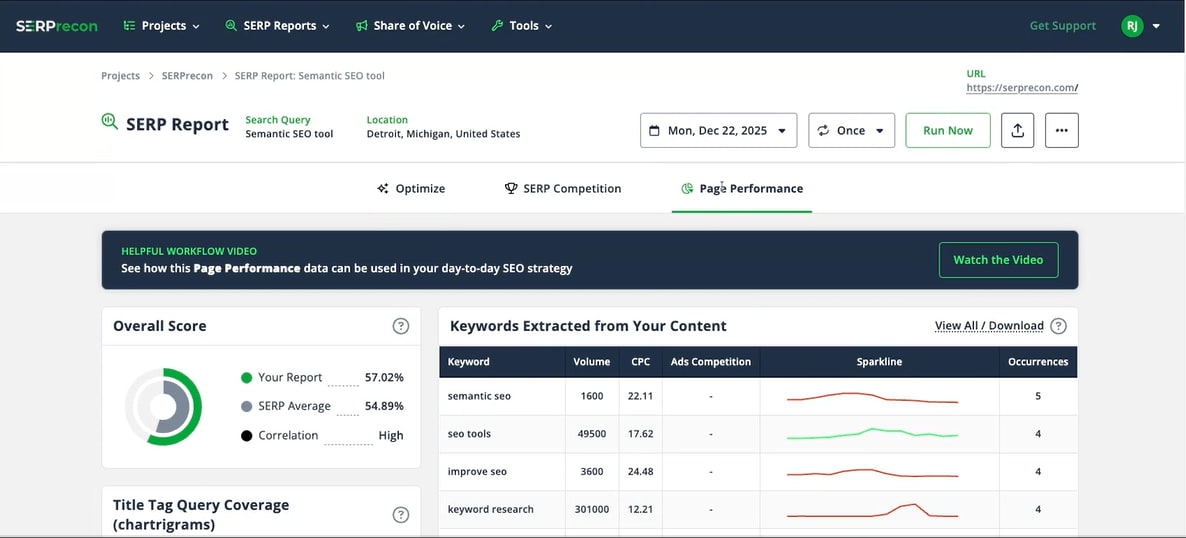
You start on the Optimize tab, which is where all the actionable items are. But I want to do a little backwards for the demo, as we do this in like two minutes, instead of a half hour, like I normally do with clients, but on page performance, what we do is you give us a URL and a query, and then we analyze your page for relevance to that query. So you can see you have an overall score. Here, you scored 57%, the average ranking result scored 54%, and our score actually correlates highly with rankings. We correlate every metric we do to rankings to show you how it works. So we measure your title tag using a metric that we stole from Yandex. This is the exact logic Yandex uses to score title tags from their source code leak.
And if you want to understand that logic, you can click on the Help tag and understand how they break it into character, trigrams of three trigrams, and calculate ratios. And you can understand what they do, but we give you a score of the SERP average and how it correlates. We actually calculate page rank using data from third-party providers. Not just count links; we calculate a page rank for your URL, and you can see how you score compared to others.
We measure semantic relevance using cosine similarity to your content, and we calculate a spam score using a method used by Google and Bing. We’re reading research papers on methods for doing that, and we’ve recreated our own method. We do BM25, which is what search engines actually use. Instead of keyword density, we extract your keywords. So I ran this against Surpre Counts’ homepage, and you can say, “Hey, here’s the keywords we extracted using BERT, and then we give you, obviously, search volume and competition and trend lines and all that fun stuff.”
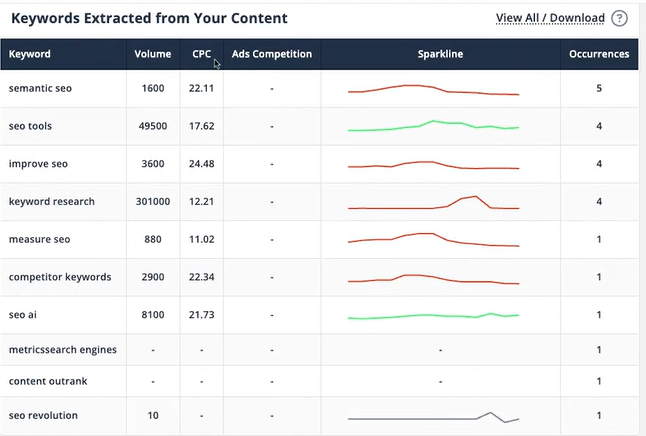
But we also say, “Hey, like, you know, semantic SEO, five other sites said that that ranked the right competitor keywords.” We extracted that from a ranked site. We have our own intent model. Some of the tools out there measure intent by saying, ” Hey, if the query contains one of these 20 words, it’s commercial. We have a machine learning model trained on 250,000 keywords. And so we use machine learning to measure the intent.
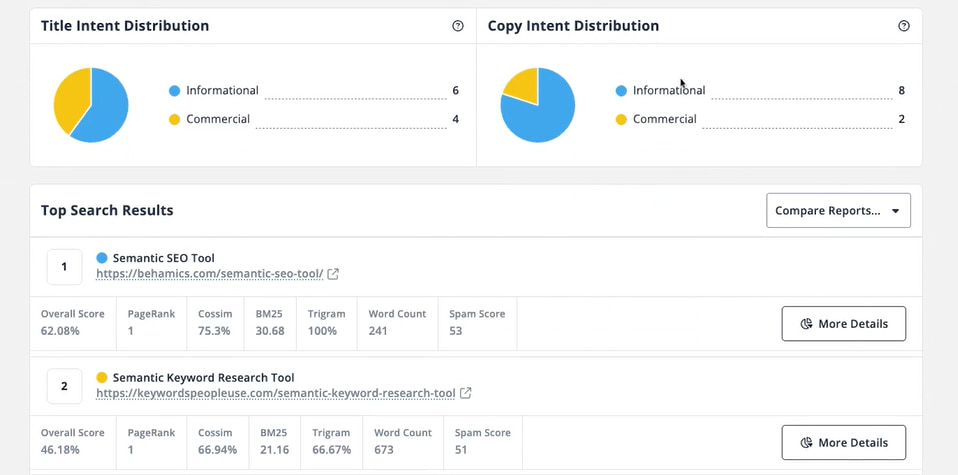
So even if your title doesn’t contain a word we’ve seen before, we can before, we can still tell you the intent of your copy and your title tags, and we compare that to the SERP average. This is super helpful because you can see in this result that the average site that ranks for this is informational, but my copy is commercial. So that’s a disconnect.
AI is all about vectors and semantic relevance. It’s less about keywords and more about meaning and that’s only going to grow.
Google wants to show informational copy here we’re commercial. So if we can make our intent match what Google’s showing, we have a better chance of ranking. We extract entities. We’ll collect page speed using the Chrome API. My tool doesn’t have enough traffic to the homepage, or to this page, where I ran to get Chrome data.
And then we show the word count. Word counts aren’t a metric, but they’re a good way for me to see if someone changed their copy or updated their site. So we also do all that data I just showed you for every other site that ranks, so you can see it all here.
If you click more details, you get their keywords, their entities, their page speed, all that data for every site that ranks right. We show you what search features are present. If there were ads for that query, we’d show them to you; we show you how Google changed everybody’s title tags. This is a fun feature I haven’t seen in other tools.
For example, for this result, their original title tag was: Google dropped all that and moved the word free to the front, which is kind of interesting. You can get some insights from this. We extract all the top keywords from everybody who ranks. Here’s your keyword research. Forget historical volumes of, like, hey, a bunch of people did this search right when COVID hit, and we learned real quick: the future does not resemble the past. People are searching completely differently. Ai, same thing when AI hit. People search completely differently.
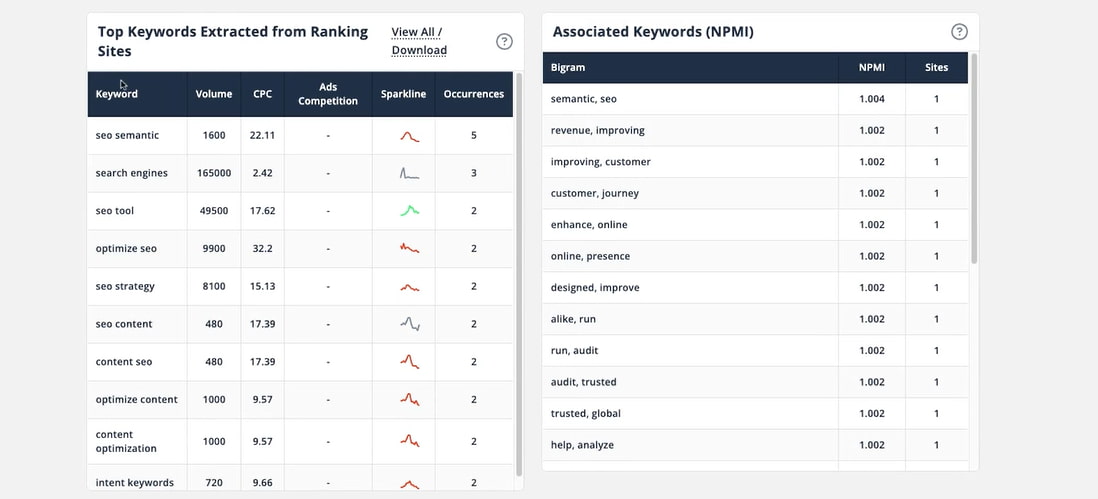
So here’s your keyword research, and you can just grab this and get hundreds and hundreds of keywords with all their keyword volumes. Export it to Excel. These are keywords extracted from Google’s BERT algorithm across all your competitors. There is no more valuable keyword research than this. It’s from their website copy. We even break it down into bigrams for you, the most common, recurring two-word phrases across all those competitors. And then we show you questions and searches if they showed up in the search results and whatnot.
But the real magic is the Optimize tab, because we give you actionable tips to improve your relevance and tell you, like, “hey, change your title tag to one of these. It’s based on everyone else’s rankings. It’s based on all that keyword research that we got. And you can check off what you’ve done in here if you want to.” We give you a Markdown editor for your content. This is your copy from your page; you can edit it. And then if you hit this rescore button, it takes, like, a minute or two. You can rerun all the original metrics we ran and see how changing your copy affects them. And so you can edit your copy right in here. Maybe take our missing keyword suggestion.

Here, it says, “Hey, you don’t say search engines on your semantic SEO page, but three of the sites that rank do, maybe put the word search engines in there. You don’t say SEO tool on your semantic SEO page. Two of the other sites do, maybe add that.” But you can see, if I can make edits here, I can rerun all the metrics. Here’s my title tag score, here’s my intent score, and here’s the keywords I extracted. Here’s the snippet that’s most likely to show in Google using passage BERT, which, again, is their own algorithm they open-sourced. It’s how they generate meta descriptions based on the source code leak.
And so you can edit your copy right here until you get the scores you want, until it shows you as relevant as you want. Right, add your keywords, and using this method, I won’t demo it. We also have Share of Voice reports, so you can get your share of voice across Google Perplexity and ChatGPT, as well as organic search, and track it over time.
We take share voice a step further, so for cellphone deals, we actually pull out the topics that AI mentions, not the keywords, but here are the topics AI is talking about for that keyword. So if you want to rank for this in AI, maybe these are the topics you should focus on in your page. So we do, we do a couple of other things like this too, but I will shut up now and let you get some words in, because that’s the tool in a nutshell. Wow.
You are not optimizing for a keyword in AI. You have to be the authority on that topic. You have to have all the other words and topics AI expects on that page. Share on XThat’s impressive. How would somebody go through the whole discipline of SEO using your tool? Let’s say they don’t have Ahrefs or SEMrush, but they have your tool. It seems pretty clear to me how they would do keyword research or topic research. I’m curious: is there an application for Link building with your tool, or is it more of a citation-building tool? What are some of the different use cases, and how exactly would somebody start applying your tool? Let’s say they got access to it. They got their boss to sign off on a subscription, so now they have it.
Yeah, so I took a kind of novel approach. I partnered with a company called Manilo. It’s a web dev agency. I should give them a shout-out for handling the entire front-end design. I did the back end, which we didn’t want to reinvent the wheel. We didn’t want to create stuff that already exists and works well in the marketplace. We wanted to fill the gaps. We wanted to bring the gaps of semantic SEO to people as quickly as possible. While we’re adding other features, we’re also looking at link building. We’re like, “Hey, Ahrefs is great at this. We don’t need to do link building features because most people already have a link building tool.”
What they don’t have is a semantic relevance tool, a copy optimization tool. How do I measure the semantic relevance of my copy? How do I create a new copy that is relevant to this term to get ranked? You know, we do tell your page rank. So we can tell you, “hey, like your links are lacking, You need more.” But we wanted to focus on just filling the gaps and being good at that one thing first.

And so that’s where we are, and we priced it accordingly. Our plan started at 10 bucks a month for the very basic plan. We’re not coming in with 1000s of dollar plans. I think our Pro Plan is 150 bucks, and that should be enough queries for most people, unless you’re running a giant site, which we have nice to that, but yeah, we just wanted to fill the gaps and be good at the one thing we do. And we’re not trying to take people away from SEMrush or Ahrefs. We’re trying to fill the gaps left by these tools.
So what sort of tools are you using to augment your tool here? Like, what are you using for link building, link outreach, other kinds of competitive analysis, and so forth?
Yeah, at Razorfish, we still use Ahrefs a lot. It’s one of our go-to tools. We also use BrightEdge & Conductor, depending on the clients. We’re pretty tool-agnostic here. I do like to think I’m kind of spoiled when it comes to link building. Link Building, though. That’s what I love most about working with Fortune 500 companies: an auto company just puts out a new car, and I get a million links from news articles about it.
So, like, I don’t have to do link building, right? We have a consumer electronics company that recently launched a new phone, and a tech blog worldwide is talking about it, so yeah, would I really have to do links? So with other companies, it gets a little more creative, but my biggest source of Link building is just doing newsworthy stuff. And it doesn’t matter if you’re a plumber or if you’re a local restaurant, you can still do cool, interesting stuff that people want to talk about.
It gets a little harder, but you can still do it right. Like, if you’re a plumber, right? You see all kinds of disgusting stuff. Start blogging about that or putting it on Instagram, right? That’s going to get links. You don’t have to, “Hey, dude, reach out to people and beg them to link to your plumbing site.”
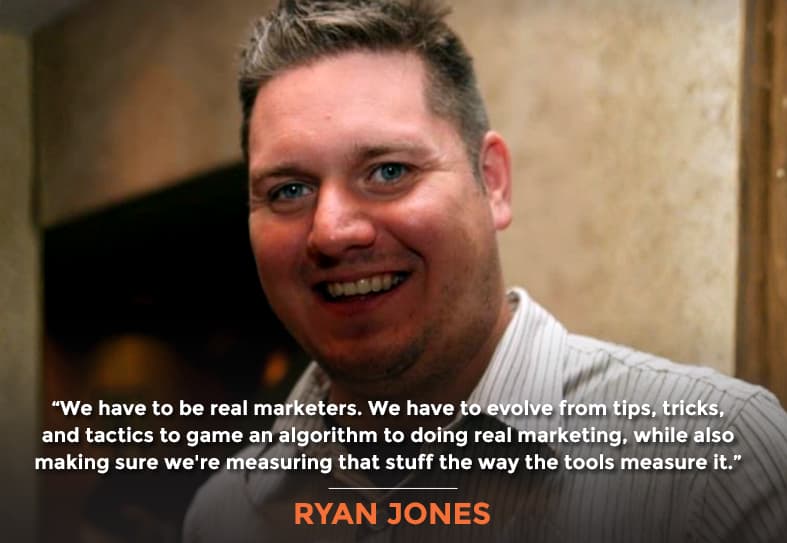
So it’s hard work, though, but it’s real marketing, and honestly, that’s where the industry is going. I kind of got a little off topic on tools here, but that’s where the industry is going these days. We have to be real marketers. We have to evolve from tips and tricks and tactics to game and algorithm to doing real marketing, but also making sure that we’re measuring that stuff the way that the tools measure it, and our old ways, especially as AI comes into account, our old ways of measuring. Is something relevant, is something good?
My top link-building strategy is creating newsworthy content. Real marketing earns links naturally without begging for them.
AI is all vectors and semantic relevance. It’s less lexical than a search engine, right? It’s fewer words per page and greater semantic relevance. And it’s only going to grow in the future. It’s only going to get more that way. The shift is happening.
So what are some of the top tips that you have for somebody who wants to show up more prominently in ChatGPT prompts, for example?
Yeah. I mean one, I would say, use or create content. And look at all those topics we give you, know, for your query, and write content about them. The one feature I didn’t demo is that we actually have a content outline tool based on all the data we scraped. You can click a button and get an AI-generated outline, but we feed in a huge prompt with all that data. You can get an outline based on all your competitive data, and when you follow that outline, it usually ranks pretty well. I have a client that sells microwaves, and I won’t name the client, but if you were to search for things for microwave sizes or what is a convection microwave, most of the citations are us. It works really, really well.
So my advice to you is, understand the full topic, right? You are not optimizing for a keyword in AI. We have been trained to think in terms of optimizing for a single keyword. But every AI search, unless it’s a simple search, like, you know, I had a client come to me, and they’re like, “Hey, I lost all my traffic, and I looked at their keywords and, like, their number one search is, how old is Jenna Ortega?” Like, yeah, that’s not coming back. AI knows that. Like, it doesn’t even need to go to Google to get that number. Like, it just knows it, right? You’re not getting that traffic back. Like, take a different topic.
But my number one piece of advice is to stay completely on topic. You can’t just optimize for a keyword. You have to be the authority on that topic. You have to have all the other words and topics AI expects on that page, because we get to the semantic space, right? It queries documents all plotted in space, and you don’t have to just be relevant to that query. But what are the other words around that query in that cluster? Your document needs to be relevant to that stuff, so expand the topic and address everything in it, which goes back to understanding user intent.
There is no more valuable keyword research than extracting keywords from Google's BERT algorithm from all of your competitors. It's from their copy on their website. Share on XWhat are people who search for that looking for? Right? You can’t just say that, repeat that keyword a bunch of times. You’ve got to have the other information they’re looking for around that keyword, and that changes over time. So it’s not super easy, but it’s definitely doable. It’s definitely still reverse-engineering a bowl to see, you know, what kind of topics AI is looking at, and then just go after it.
Could you show me? Said you didn’t demo that part of your tool, but could you show it?
Yeah, let’s go back here. We’ll focus on semantic SEO and generate a content outline. It takes a couple of seconds, and then you can see this is based on all the data, so it’s actually a pretty good outline. It says, “Hey, if you want to write for semantic SEO, do an explanation of it, the importance of it in SEO strategy. What is semantic search? Key differences between traditional SEO and semantic SEO.” We just talked about that, right? How to identify semantic keywords, for example. Give some examples. Right? Is structured data important for semantic SEO? You should talk about that, right?
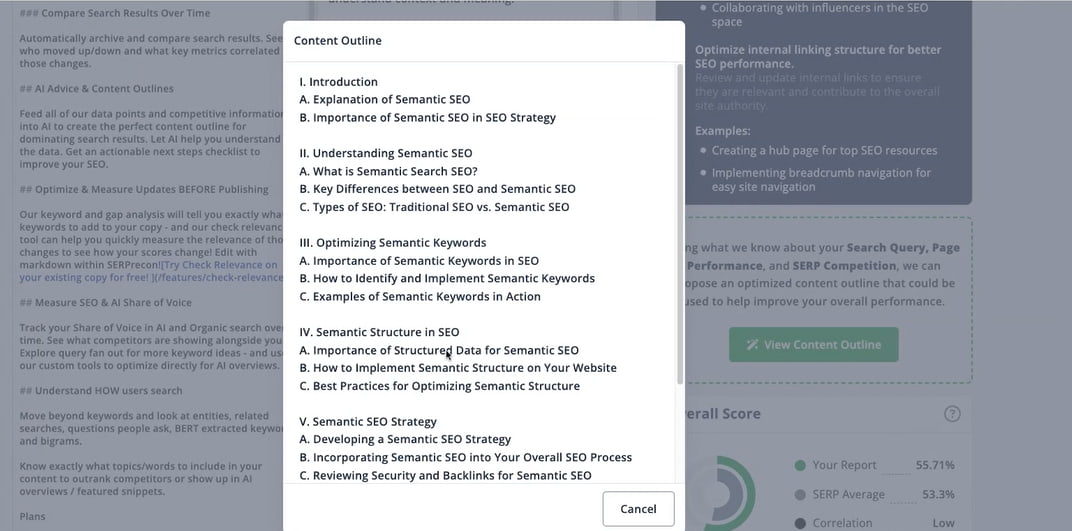
So it’s a pretty good outline, and that’s based on all the keywords and all the entities and even the intents and title tags, like every piece of data we pulled from every site that ranks in here, every piece of their data feeds into that, all these keywords, entities, feeds into that prompt for the outline. So, you know, one of my pet peeves is a lot of tools out there. One of my pet peeves is that many tools out there just ask AI for answers. And everybody can do that. So it’s all about what data you feed into AI if you’re going to use it as a tool.
Yeah. Cool. So what about getting a Google knowledge panel? Let’s say that a client wants a knowledge panel and they don’t have one yet. Do you have the besides a Wikipedia article, which they might not be considered notable enough for that? Let’s say they’re not. What’s the advice you would give to somebody who wants to get a knowledge panel, but they’re not notable enough for Wikipedia,
The advice that Google would give is to become notable enough. It’s all about third party consensus. I’ll give a related example. I just had a client. I’m going to make up a product here, and so I don’t give away the client. We’ll just go by car. They said, “hey, when I search for the best SUV, why are we not showing up?” And again, this is not an SUV client. I’m making up a product here to not give them away.
But I went to the client, I was like, because nobody on the internet says you’re the best SUV. I go to any of the car magazines or blogs or consumer reports, not one of them is saying you’re the best. So if you want to show up for the best, maybe get other people to say you’re the best, right? How to or be the best? And how does that relate to knowledge graphs? It’s a third party consensus, right? What are the other sites saying about you? What is the rest of the internet saying about you? And that goes to ranking in AI, too.
To rank for the best you need third-party consensus. Let others validate your authority. That’s how knowledge graphs and AI rankings work.
Lots of people are spamming Reddit right now, because everything loves Reddit. Why does everything love Reddit? Because they have a huge human moderator system that makes it hard to spam. So if it stays on Reddit, it’s probably not spam, they’ll trust it, but you have to get the rest of the Internet to verify what you want it to be. That goes to knowledge graphs. It goes to ranking in AI. I mean, Wikipedia is the easiest way, and I understand that Wikipedia can be a cult.
There was a famous person that edited their own birthday, and then they got banned from Wikipedia. I thought that was funny. Like, funny. I didn’t hear that one page. There’s an actor or somebody, but they were like, “Hey, you got my birthday wrong. And they edited their own birthday.” And Wikipedia abandoned because you can’t edit your own Wikipedia page. So what better source do you need of someone’s birthday than the person themselves?
So it is kind of a cult. It’s hard to influence. I hate that. Maybe you can go edit Grokipedia. I’m kidding, but yeah, it’s, it’s internet consensus, right? You gotta get everybody else saying the things you want the internet to say, and that comes down to hard work. There’s no quick hack for that. It comes down to hard work. Yeah, what do you think of Grokipedia?
By the way, I can’t believe it hasn’t been sued yet. I haven’t played with it much. I actually thought it would be more politically slanted than it is. I find that kind of funny, because they just turned it over to full AI, and I thought it would be, I won’t get into politics, but I thought it would be a little more charged than it is. And there’s a couple articles I saw where it actually says the real truth. And I’m like, “Huh, that’s pretty cool.”
Okay, so what’s the story behind WTFSEO because that’s a brand. That has been around for a long time, and you’re the creator of it.
It is. We need to get back to that. And I had a lot of help. I won’t list names, but major contributors to Search Engine Land, Search Engine Journal, some major SEOs you’ve seen speak at conferences, I think about 20 or something in total. And you guys, everybody listening. You know, these people have all contributed that under pseudonyms. It started as a joke between my friend Rachel and I, because we were just talking about the state of the SEO industry, and everybody was just writing the same articles.
And it was like, here’s the top 10 people. I’m only mentioning these people because they have a big following, and I want them to share it on Twitter, or this is a press release disguised as an article, or it was all just the same crap a lot of sites were writing, and so we wanted to make fun of the crap that the people who are writing, and do it in an obvious way.
Traditional keyword research tools are outdated. Reddit shows you what people are talking about right now. It is perfect for real-time insights.
So we’ve started a satire blog called WTFSEO, and it got pretty popular. I regret that I haven’t written an article for it in over a year. I take that as a good thing for the SEO industry. I feel like we’re putting less crap out there lately. So I’ve had less stuff to make fun of, because, you know, the industry is publishing less crap, and I’ve had less people reach out to want to write for it. But there’s still some really, really good articles out there, like our favorite is our ‘SEO Is Dead’ article.
We had an evergreen ‘SEO Is Dead’ article, because it feels like every few months someone publishes another one. I think the first notable one was by Jason Calacanis, back when Google punished Mahalo. We even make fun of him in the article, which is funny because I actually met him back then.
We put an evergreen ‘SEO Is Dead’ article because we’re like, instead of doing it every six months we’re just gonna put an evergreen one. And we have some really, really funny articles on there still, if you look through the archives and whatnot. But yeah, it’s, I feel like the SEO industry is doing a much better job. There’s a lot less stuff to make fun of lately, and I think that’s a good thing.
Yeah. So what happens if the answer engines, LLMs, start using your satire articles as real content, and start citing how SEO really is dead. Look at the evidence here on WTF SEO.
I really, really hope they do.We’ve done some fake algorithms too. Like when Google did RankBrain, we put in RankHeart, which was, instead of logic, all feelings. And there’s some pretty funny quotes in there. But I really, really thought they did. I’d love to see, I’d love to see this attire influence it. And that’s a real worry, right?
As we start publishing more and more AI, Slob AI is going to train on the sloth. I feel like, on a long enough timeframe, like the more data you feed AI, the more likely it’s gonna become a Nazi that believes birds aren’t real, right?
We should just kind of start getting the fringe pieces of the internet. So, I feel like maybe there’s a limit in training on AI where we shouldn’t feed it all the information, because there’s a lot of bad information out there. Yeah, my site included,
Yeah. And I just asked Google when WTF SEO was founded? And there’s two answers according to AI overviews, one was 2012 and then there’s another was 2022 which is kind of funny because it also cites that there is a WTF SEO 2017 SEO ranking factor study, which would mean that it couldn’t have been founded in 2022 if you were running SEO ranking factor studies five years earlier.

It was not in 2012 somebody had the Twitter name before me, and when I launched the blog, they actually reached out and were like, “Hey, do you want this Twitter name? I haven’t used it in years.” so maybe that’s where some of the confusion comes from, because somebody was tweeting on that prior to just giving it to us.
And I don’t even know who the person was, but I thank them for giving us the Twitter handle so many years ago. But so when, when did we do ranking factor studies? They’re all bullsh*t, right?
It makes sense. I mean, it’s a satire.
Yeah, I don’t know. I think it’s older than 2022, definitely, for sure, but I don’t think it goes back to 2012. It’s somewhere in the middle of there. I don’t remember. I’d have to go look at the blog and see when we first did it. There’s some other people using the name and other places.
So that’s probably why it’s getting confusing. There’s a, I think somebody created a marketing agency called WTF SEO, but they never owned the domain name. So that’s weird.
That would be a very strange name to call your agency. It’s hard to be taken seriously if that’s the name of your brand.
Yeah, I don’t know why you’d start an agency with that name. And if you did start an agency with that name, why wouldn’t you buy the.com because I bought it.
Search engines do not work the way the industry thinks they do. It's all vectors in machine learning. That's what it is. Share on XSaying my serious agency that works with Fortune 500 companies is called Lolcats or something. You know, it’s like, it’s hard to take you seriously.
I’ve seen agency names named after everything. I know a couple in Detroit that are literally named after Coney Island or the coffee shop where the founders decided they were going to start their own company. So, like, there’s weird agency names out there, for sure.
Well, back in the heyday of before the .com crash, this was a long time ago, but there was a company called Accompany like, we accompany you into success or sort of thing. And of course, they went belly up. But can you imagine getting a phone call like your CMO or something, and it’s like, “Hi. This is Joe from Accompany.” “Which company?” “Accompany,”
Right? That’s like, who’s on first? It’s, yeah.
Let’s talk about Reddit. How do you get visibility on Reddit? Because there are rules in terms of service there and so forth. I’m sure you must have had clients who say, we need more visibility and Reddit, because that’s being cited by LLMs and so forth. So help us get into Reddit?
You have to join the community and be part of the conversation. Real marketing takes work.
Yeah, we’re actually doing a Reddit project with a couple different clients right now. And by Reddit project, I mean, we’re doing the strategy, but the easiest way in Reddit is you, you the company, go, go do the posts and be present. You know, I can’t do that for you. You have to actually join the community. You actually have to be part of the conversation.
Again, real marketing, hard work. We can help you with what to say and how to sure they’d tell us. We’d know. ay it and where to say it, when the strategy, but the voice has to be you. It has to come from your account. It can’t be just a new account to where your first tweet is like, or your first Reddit post is bragging all about your company, like you have to join the topic and join the community.
The best way to do that is to pay somebody and hire a person whose job it is, you know, to respond to stuff on Reddit and not just respond, but be active and talk to them in the community. And so we have some tools internally, and there’s some tools in the market. Kenny Hyder just launched one.
Kenny Hyder just launched Subred Monitor, so I’ll give them a shout out there. But we have some tools that are mentioned in the topics that people are talking about or the themes. I have one internally. It’s very, very similar to that that we built at Razorfish to help our people do our jobs. But it’s the same thing. Give it a subreddit. It’s a subreddit. It scrapes it and extracts topics. It extracts keywords from that subreddit or from that query search, just so we can understand the topics people are talking about and do our keyword research that way.
Because, again, keyword research tools are outdated. Google’s keyword, Google’s AdWords, or any tools metrics out there are telling me, here’s what people searched months ago. Surpre counts telling me, here’s what’s on your website. Now, the Reddit tools out there are telling me, here’s what people are talking about right now this second, and that’s helpful for its own keyword research.
So use that learning, use those topics, and then go post interesting stuff, join the community, engage with people. A lot of companies out there have influencers. You’re paying people. You’re given a country music star a truck, or you’re given a rapper some clothing or jewelry, right? Like there’s companies that do this. This is how it works. You give a social media influencer your Stanley Cup to put in their videos, if you’re paying these people. Get them on Reddit talking about stuff. Get them joining the communities too.
You already have all these influencers on staff. Give them the talking points, give them the topics and tell them, hey, go be you on this Reddit board. But you know, talk about this stuff. That’s how you influence Reddit, because it’s genuine. It’s authentic, and it’s still steered toward what you want to steer it toward.
Yeah. Are you active on Reddit yourself?
I am. I’m active in a lot of the SEO communities and then some weird niche stuff. I’m real big on the Curse of Oak Island, which, again, if they found Templar treasure, it wouldn’t be in Season 13 at 10pm on History Channel. I’m sure they’d tell us. We’d know.
So I don’t know why I watched that show. It’s like Finding Bigfoot, right? Like, if they find him, they’re not gonna wait till Animal Planet‘s Thursday night special to let us know they found Bigfoot. But I like talking on that community board. I’m really big on that Penn & Teller: Fool Us or like people try to figure out magicians tricks. To me, I’m not a magician by any means, but I like using my creative brain to try to figure out how they did stuff. So there’s a whole bunch of weird subreddits I’m into, but mostly SEO stuff.
Gotcha, okay.
I play way too much Cornhole, so I’m involved in those Reddits.
I don’t even know what Cornhole is.
It is a bag toss game, the board with the hole in it and the bean bags. I’m in the top 20 in the state of Michigan right now. In Cornhole, I play way too much. I’ll leave it at that.
Wow. Is there like an Olympic sport for that or something?
They’re trying. They’re trying. There’s no Olympics yet, but hopefully one day.
Cool. So why don’t we switch gears to get really, really geeky and talk about some of the terminology and some of the science behind things such as, let’s start with, let’s say cosine similarity, because I saw that in one of the screens on your tool demo. Can you explain that and what that means for somebody who’s maybe not a super SEO geek?
So the good news is to understand cosine similarity, you do not need to understand trig from your high school days or any of the math. Essentially, what it is, it’s basically the main factor of how AI and search engines work. It is like the main relevance metric in every search engine right now, in every AI tool, right that’s all every AI itself right now is cosine similarity.
And what that means is it’s essentially converting words and content to vectors. What is a vector? A vector is a long series of numbers, hundreds, sometimes 1000s of dimensions, but essentially it takes every word and it maps it into this space of vectors. Like, think of plots pointing plots on a line. I’m trying to not get as geeky as I want to, because I don’t think, you know, I don’t want to go math here, but essentially plotting every word in space.
The cool thing about vectors is, once you convert words to vectors, you can do math with them. And it’s really cool. So like, if you have the word for road, and it’s over here in space, and you have the word for airplane over here in space. And then you add those words together, you’ll get a dot over here that’s really close to the word runway, because it knows the semantic meaning of stuff.
Cosine similarity isn’t just a math term. It’s the core of how AI and search engines determine relevance today.
Everybody uses king and queen in this. I don’t want to give gendered examples, but you can start subtracting words from other words, and it gives you this new vector that’s very similar to other words. And so you can start understanding the meaning of documents and the meaning of words as to where they lie in semantic space. And that’s what Google does. They embed all the queries people do, and they embed all the documents that they have, and they say, “okay, which documents are closest to this query, or which documents are closest to these queries? Or they can do it in reverse. For this document in space, what are the 10 or 15 words around it that are most similar to it, or the phrases around it in space?”
And so you can start to do really cool stuff and understand the meaning. You can start to fill in gaps in queries, you can start to get to other topics that may be related, not just because someone else searched it, but because it’s related in that semantic space with vectors and so cosine similarity is just a score. How close are these two dots in space when we map them, how close are these two dots to each other?
So that’s how search engines determine it’s one method of determining relevance. I hope I did that justice. I just did a bunch of diagrams, actually, for Jenny house’s new book that’s out on Amazon. So if you look at her book, most of the vector diagrams I generated for her, she gave me a shout out. So thank you.
But that’s how search engines work, and we as marketers, we’re still stuck in there. Well, my page says this word 19 times, and the other page says it 12, so I should be more relevant. Well, that doesn’t matter in vector space at all. It’s not how it works.
So you got to update our model. And there’s a whole bunch of good learning resources out there. I won’t link to them, but I recommend taking the time and doing a quick refresher on some of this stuff, because it can be a very valuable SEO skill.
Okay, so you mentioned that you like to code and you did all the back end stuff for your tool. How much are you using AI to do this for you and with you, versus you doing it the old fashioned way?
Converting words to vectors lets you do math with them and understand their meaning in semantic space.
I would say it’s about 70% me right now. I am definitely using AI, the problem I’m running into, especially with the newest stuff. So where I use AI is like, if I want to function to hit someone’s API and do something, right, there’s only one way to code that, like the Google entity API. There was only one way to get data from the Google entity API. So I could say, “hey, AI, I need a function that takes this as an input, hits this API and puts this as an output.” And it’s really, really good at that, and it saves me a ton of time.
But when you’re doing stuff that hasn’t really been done a lot, AI tends to invent libraries or invent methods of ways of doing stuff. When it comes to computing, some of the stuff, like bm 25 is a really known metric. There’s tons of Python libraries out there that do it, so it’s really easy to do. But the machine learning stuff for our intent models, I had to code that because AI just didn’t know how to do it. It invented stuff that didn’t make any sense when I looked at the code.
So I’m using it for the basic stuff. And you have to be really, really specific. You have to, like, give it a function prototype, and be like, here’s how this function should work. It should take this in, it should spit this out, etc. But it has been a time saver in a lot of other areas. Like, “Hey, I got a JSON string. I need to format it into this, this and this.” And like, “Yeah, I’ll spit that out in 10 seconds,” way quicker than I can code it. So it kind of depends on the ask, but for the stupid easy stuff, there’s only a couple ways to do it. AI has been a real time saver.
I do caution people, though, because I’ve seen some people put apps out there or projects out there. AI is not really, really good at best practices when it comes to security. There was that one startup. I won’t name them because I can’t remember their name, but they put out, I think it was a dating app or something, and they got hacked within like 10 minutes of being live, because it was all AI vibe coded, and they just didn’t do any security best practices, and so they were instantly hacked, and not a good look, right?
Yeah, yeah, it’s unfortunate. So would you consider yourself a prompt engineer? And. As well, like you’re spending a lot of time writing and finessing your prompts and whatever chatGPT and Claude and so forth. And by the way, what is your favorite LLM?

It depends. My go to LLM for most questions is Gemini, because of the Google grounding, right? Google is still one of the best search engines in the way they ground stuff. It’s still good. But when I code, I have Claude codes installed on the command line. I also have Llama because with Llama being open source, I can integrate that into anything else I want on my computer through the command line. So there’s some geeky stuff you can do with that, but mostly cloud code. I love the way it integrates with VS code to use it.
My main use for cloud code is either writing those simple, stupid functions, or I will brainstorm with it. Like, “hey, take a look at my code base. And is there any way you think we can improve the speed or efficiency of this? Don’t code it, but give me your top five suggestions for increasing the speed or efficiency.” And it’s really good at helping me find stuff like that. Real example for SERP recon.
It was like, “they found something, and it’s like, why are you not doing these calls asynchronously? You’re waiting for one call to return before doing the next. Why don’t you async this whole subroutine and you’ll get a lot of speed.” I was like, “I missed that good call Claude,” and then I did. I coded that up asynchronously and got a huge speed increase in some of the SERP recon stuff. So that’s my main go to for it, is kind of brainstorm with it. Don’t just tell it to make it for you. It’ll make something for you if you tell it. But I wouldn’t trust it for production stuff like use that human in the loop, or give it really, really, really specific instructions for what you want it to code.
Speaking of instructions, do you have custom instructions that you want to suggest to our listener or viewer?
Prompt engineering is a skill, but the engineer title is a real earned degree.
Nothing really simple or easy, right? Everything I have that is custom is super custom to me, and probably wouldn’t apply to anybody else, but I do want to go back to the one you mentioned. Do I call myself a prompt engineer? That’s a pet peeve of mine, if someone with an actual engineering degree, but it’s actually illegal in Canada, in Germany and a few other countries, you cannot call someone an engineer unless they actually have a degree.
So I always laugh at that title, because companies are rolling it out. And if you have Canadian employees, you can’t call them an engineer if they don’t have an engineering degree. That’s a real earned title. And Germany is the same way.
And I think there’s like eight or 10 other countries that I don’t know off the top of my head, where if you want to be an engineer, you have to go to engineering school. You have to have an engineering degree. So kind of a pet peeve, but there’s definitely a skill to prompting, for sure, but the engineer part is a pet peeve of mine.
That’s awesome, yeah, like the amount of time it takes to get, let’s say, a chemical engineering degree. I think someone would take issue with someone calling themselves a prompt engineer because they took a four hour course online?
Yeah, we see a lot with Title software engineers. In some countries, like a lot of companies, just call all their developers software engineers. Well, if you didn’t go to school and get a computer science degree, you are not a software engineer. Legally, you can’t be so I’ve actually worked at a company in the past where they had to change all their titles once they started branching out of the US and hiring people in other countries. It’s kind of funny.
Yeah, okay, so I know we’re getting close to time here. So what would be a few of your best tips and tricks for SEO and AEO that we haven’t already talked about, or just maybe even life hacks?
I don’t know if this is a tip or trick, but what I like most about ranking for AI and SEO, the AI features now it’s so new that most of the technology works the way the patent and research papers were put out in Google. It’s not the case. You go read the original PageRank paper. Google doesn’t use anything like that system of PageRank anymore at all. It’s nowhere close to it, but all the AI research, it’s so new that the actual systems still work the way the research papers were written.
And there’s a lot of information we can glean in the research paper as far as like, how is query fan out work? Or, how does AI citations work? So my tip is, go read the research papers. Go read the patents that people filed, because they tell you a lot of the specifics and we don’t have time. We could spend two hours getting into specifics on how this stuff works, but go read it, because they’re literally telling you exactly how the technology works right now. And that won’t be the case, you know, in a year or two, but it’s so new right now that that is the case, and it’s definitely exploitable. So there’s a tip. You got to do the work.
Well, point our listener in the direction of a particular favorite research paper or something that you recently read.
Read the research papers and patents. They reveal exactly how the technology works now and that knowledge is exploitable.
Yeah. So my favorite was the Google AI overview patent. It actually tells us how they find citations. If they don’t actually like, they summarize the search results for AI, and then the AI generates a summary based on the search results it feeds it, but it doesn’t know what content it used from what search result it was fed. It doesn’t know that.
So they back door into the citations, and they say, “Okay, let me use bert. Passage BERT, and they generate some phrases from the AI answer that they generated, and then they say, Go find me a website that has this phrase I just generated. We’re going to start that because I don’t know where I got it from. I don’t remember. I don’t have memory of phase one or two of the AI like because AI works in phases, and each phase doesn’t have memory of the other phase.
They’re separate processes that don’t know each other’s memory. So they kind of back door into the citations. And so we built that into SERP recon, literally following the patent logic of, okay, use BERT, generate phrases, right? Here’s the phrases that it’s going to go from this answer, here’s the phrases it’s going to go look for on a website that is very, very, very reverse engineerable right now. When I do that method and then write content to incorporate those phrases, I get the citations, and I’m really, really good at stealing citations using that method. Probably shouldn’t share that, because it works. It works really, really well. I can steal citations for a lot of stuff just by reverse engineering it like that.
Oh, that’s cool. A nice tip. All right, so how does our listener or viewer get your tool? How do they learn from you? How do they follow you, all that sort of stuff? And I think you’re giving a discount, some sort of coupon code for your subscription to recon.
We will.
Awesome.
We can so everybody gets a free seven day trial. If you just go sign up, you get a seven day free trial. I’m really big on everybody should be able to try the tool before you give me money. But if you want time off, use code, SLEIGH26 will give you 26% off, and it is for life because I messed up when I created the coupon code, it was supposed to be for a year, but it’s 26% off for life because I screwed up and entered it wrong and didn’t fix it. So if you hurry and use SLEIGH26 you’ll get 26% off for life.
When you say hurry, when does the coupon expire?
You have till the end of January.
Okay, cool. Well, thank you for that. And then where are you most active on social media? Like, where are you dropping your wisdom nuggets?
Yeah, I’m still on X and Bluesky these days. It’s just Ryan Jones on both platforms. Pretty simple, because I’ve tried to get my name on everything, mostly on X, because that’s where the customers are still and then Bluesky as well. I tried Threads. It got way too political, so I left. But X and BlueSky right now and LinkedIn, always LinkedIn. LinkedIn if you want my more professional posts, if you want my snark and fun takes, that’s X and Bluesky. But the professional stuff is all on LinkedIn.
All right. Well, thank you, Ryan, this was a lot of fun and a lot of ninja stuff you’re working on. And thank you for sharing what you’re up to and how it applies to the SEO practitioner and how they can do a better job with their clients and their employers.
Well, thank you so much for having me man, it’s been fun.
Thank you. Listener, thank you viewer, catch you in the next episode. I’m your host. Stephan Spencer, signing off.
Important Links
Connect with Ryan Jones
Apps/Tools
Article
Businesses/Organizations
Films/TV Shows
People
YouTube Videos
Your Checklist of Actions to Take
- Optimize for complete topic relevance, not single keywords. Stop thinking about keyword density and H2 tag counts—AI doesn’t work that way. Map out the entire semantic cluster around my target query and ensure my content covers all related words and topics AI expects to see.
- Extract keywords from the current top-ranking competitors using BERT. Forget historical search volume data that tells me what people searched months ago. Use BERT-based tools to extract the actual topics and keywords from pages ranking right now—this is my most valuable keyword research because it reflects current semantic relevance, not past search patterns.
- Match my content’s intent to what Google is actually showing in results. Use machine learning intent models to analyze whether my content’s intent aligns with the SERP. If the average ranking result is informational, but my copy is commercial, I have an intent disconnect that will hurt my rankings.
- Reverse engineer AI Overview citations using Passage BERT. Follow the exact method from Google’s patent: use Passage BERT to generate key phrases from AI-generated answers, then deliberately incorporate those specific phrases into my content.
- Build an authentic Reddit presence by actively participating in the community. Don’t spam Reddit with promotional posts. Instead, hire someone whose job is to actively engage with relevant communities, or leverage influencers you’re already paying to participate authentically in subreddits.
- Establish knowledge panels through third-party consensus across the web. Google doesn’t care what my own site claims about me—it’s all about what the rest of the internet says. Get news coverage, industry publications, and authoritative sites to state the facts I want in my knowledge panel. Do newsworthy things that naturally generate these third-party validations.
- Study current AI research papers and patents while they’re still accurate. Unlike PageRank, which evolved far beyond its original research, current AI search technology still works exactly as described in recent research papers and patents.
- Implement asynchronous processing in my code and workflows. When making multiple API calls or processing data, run operations asynchronously instead of waiting for each to complete sequentially.
- Understand cosine similarity and vector space for semantic relevance. Modern search engines convert words and documents into vectors and plot them in a multi-dimensional space. Relevance is determined by proximity in this space, not by counting keywords.
- Try SERPrecon with extended trial benefits and connect with Ryan Jones. Get a 7-day free trial at SERPrecon.com, and use code SLEIGH26 for 26% off. For snarky, fun SEO insights, follow @RyanJones on X and Bluesky.
 About the Host
STEPHAN SPENCER
Since coming into his own power and having a life-changing spiritual awakening, Stephan is on a mission. He is devoted to curiosity, reason, wonder, and most importantly, a connection with God and the unseen world. He has one agenda: revealing light in everything he does. A self-proclaimed geek who went on to pioneer the world of SEO and make a name for himself in the top echelons of marketing circles, Stephan’s journey has taken him from one of career ambition to soul searching and spiritual awakening.
Stephan has created and sold businesses, gone on spiritual quests, and explored the world with Tony Robbins as a part of Tony’s “Platinum Partnership.” He went through a radical personal transformation – from an introverted outlier to a leader in business and personal development.
 About the Guest
RYAN JONES
Ryan Jones runs the SEO practice at Razorfish, and is the founder and creator of SERPrecon – a semantic SEO tool that evaluates websites the way a search engine does.







Leave a Reply