



Your personal brand is the only asset you’ll carry from cradle to grave. Sell your company, and the brand goes with it. But your name? That stays with you forever.
Greg Merrilees, my guest on today’s show, is the founder of Studio1 Design, a conversion-focused web design agency I’ve collaborated with for over a decade on multiple client projects and my own digital properties.
In our conversation, we deconstruct the complete evolution of my personal brand websites—from my 1995 agency site through multiple redesigns of stephanspencer.com, my two podcast sites, and beyond. We examine when to create separate brand properties versus consolidating under one domain. We explore how to showcase authority without creating decision paralysis. Greg breaks down why your FAQ section–rather than answering industry basics– should instead obliterate hiring objections. We discuss the strategic placement of social proof that shifts contextually across pages: client logos on your results page, media outlets on your press page, speaking venues on your speaking page. And we reveal how timeline-based storytelling on about pages builds the kind of authentic connection that AI simply can’t replicate.
This case study gives you the blueprint for building authority that survives algorithm changes, platform shifts, and the rise of AI agents making decisions about who to recommend. So, without any further ado, on with the show!

In This Episode
- [09:07] – Stephan recounts his speaking career and discusses personal branding.
- [12:40] – Stephan’s release of “The Art of SEO” in 2009, co-authored with Rand Fishkin, established Stephan as a thought leader in the SEO industry.
- [14:26] – Stephan recommended Studio1 Design to his clients, highlighting Greg’s expertise in design, marketing, and strategy.
- [27:45] – Stephan’s website now includes a comprehensive press page, showcasing his media appearances and contributions.
- [31:16] – Stephan’s personal brand website serves as a central hub for his various projects, including podcasts, books, and consulting services.
- [44:21] – Greg Merrilees discusses Stephan’s two podcasts, Get Yourself Optimized and Marketing Speak, which are integral parts of his personal brand.
- [56:29] – Stephan’s approach to personal branding and SEO is centered on authenticity, storytelling, and providing value to his audience.
Thank you, Greg, for coming back on the show.
It’s a pleasure, Stephan. It’s always awesome to be here. Yeah. These case studies are fun. And now this one’s going to be more fun because it’s all about you, and you’re going to be like, probably not a big note in yourself because you don’t do that. But I just wanted to mention to everybody that’s listening that Stephan is the OG of SEO. You know, when you think back, Stephan, when you started, I’m surprised that SEO was even a thing. Like, when did you actually get started online?
1995, well, actually, I got started with building my first websites in 1994. I didn’t even have a company yet. I launched a bed-and-breakfast directory called Innsite.com, added writers and an author community called Writers.net, and also launched it in 1994. So those were while I was a graduate student at the university.
I dropped out of my PhD program in ’95 and started it; it was called Internet Concepts back then, but Netconcepts, and got the domain netconcepts.com in ’95. Yeah, I’ve been doing SEO since then. I started with just web marketing and web development.

I quickly learned that the engines back, there were number of them like like Lycos and Alta Vista, Webcrawler, HotBot, et cetera, there’s a lot of them, probably seven or eight of them that were important enough to create separate, back then they were called doorway pages, but landing pages essentially for each of those search engines. And then Google came along, and I think it was ;97.
And that changed the game. I was very excited that it was a search engine that was actually really high quality. The results were markedly better than all the other engines. So I really doubled down on Google and figured out how reverse engineering worked. Yeah. So it’s a fun way of getting into the SEO game in the very early days using tools like web position gold to create these multiple doorway pages for all the different search engines and trying to do stuff that was ridiculous, trying to manage all these different slight variance of the same page and realizing like, “this is icky. This just doesn’t feel right. There must be a better way.” then with Google, kind of putting all my chips, betting all my chips on that one search engine and really focusing on reverse engineering it.
So did they have an algorithm back then? Did they call it that?
Yeah, yeah. So the main difference maker for Google was that it was a weighted form of link authority. Instead of each link being a vote, they were weighted. It’s called citation analysis. So the more authoritative the site linking, the more juice, or equity, or link popularity, flows to the destination. So if you think about CNN.com, lots of link equity, that is a high-value link. Jim Bob‘s personal homepage, not so much. So if you’re playing the game with the other search engines, they didn’t get that. It was just a numbers game, and spamming was much easier. So that was the difference maker.
Case studies are an underlooked resource. Prospects want results, so highlight the results you deliver for clients. Share on XAnd that is still foundational to Google to this day: it’s a link authority with a weighting factor called PageRank, named after Larry Page, not WebPage, but Larry Page, the co-founder.
There you go. I had no idea. So then you started your Internet concepts website?
Yeah, I called it Internet Concepts, but it was netconcepts.com, 1995. Yeah. So this is actually a version from a couple of years into it. We did have a designer on the team, and he designed it. So we had much smaller screen resolutions back in the day. So there’s a lot of blank space, as you can see, if you’re looking at the video, the listener/viewer.
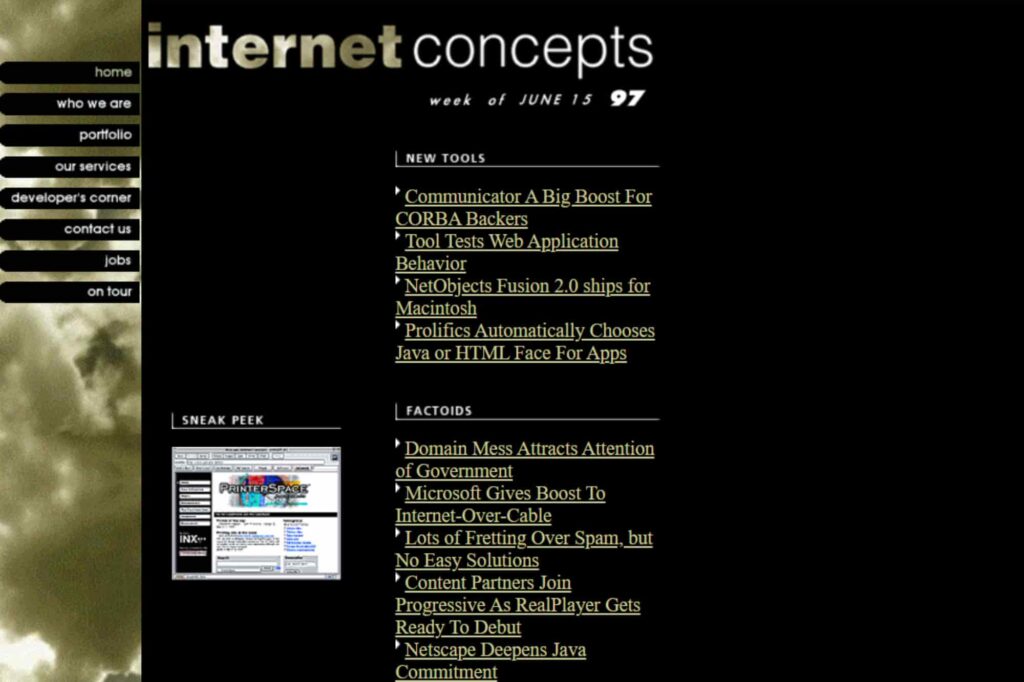
But back in the day, that kind of filled the screen and the sites there, those screenshots that are rotating through like an animated GIF. We designed those. So we did work for some pretty big brands like INX International Inc. It was, I think, a nine-figure business back then. Printer Space was one of the sites that we built on my recommendation. They actually created a separate brand community, kind of like what I had for Writers with WritersNet. That’s the WritersNet site there. I designed a site for the department where I worked and got a master’s degree from the Institute for Molecular Virology. Let’s see, seton.com, we designed that site for Brady Corporation. Yeah, so did the design and then built some SEO into the sites. So we weren’t just a development house; we were doing SEO baked into the sites. We even had our own e-commerce platform.
Again, that’s pretty amazing.
Yeah, so back in the day, you know, with these open source ecommerce platforms, like how WordPress is open source, we picked one that looked promising, and it did end up being a good pick, and then baked in a lot of custom SEO stuff into that. And that became a platform that we called Gravity Market, which we eventually sold to another web development outfit a decade later, back in 2008.
If you really want to attract similar types of clients, go to this level of detail with case study pages. It's just going to give you the best chance of attracting better clients, essentially. Share on XOr maybe it was, yes, not a decade, but seven, eight years later. The big acquisition was in 2010, when I sold my agency and the Gravity Stream platform, which was a way to proxy a site and bake an SEO in real time, regardless of what platform they were on. So it was like a middleware layer to inject a bunch of SEO goodness into the site that they wouldn’t be able to do without hundreds of thousands of dollars in expense retooling, or maybe even millions of dollars in retooling, an expensive, unwieldy platform like Blue Martini or IBM WebSphere.
Yeah. You really did cut your teeth before anybody even knew what the internet was. You’re already doing all those incredible things, building websites, doing SEO, getting websites ranked and yeah, it’s pretty amazing.
And then I started very early on in the speaking circuit when that wasn’t really a thing. First, yeah, my first talk was on how to market educational programs online, at an IQPC conference that cost $2,000 to attend. And I not only spoke at that, but I also gave an after-conference workshop, a post-conference workshop, and I was the chairperson of that. So, I was terrible. I was a very unrehearsed and awkward speaker because I hadn’t been trained in speaking.
The only way to improve is to keep doing it. So, I spoke everywhere I could.
Still, it was just really fortunate that I got this opportunity to speak, and because I was top billing on that brochure that they sent out to a lot of people, the competitors, IIR and WBR and all these sorts of conference organizations saw that I was a speaker. And so I started getting calls from the competitors saying, “Hey, can you speak at our conferences?” So I just said yes to everything, even though I knew I was a terrible speaker. I’m like, I just need to get better.
The way to get better is to do it a lot. So I spoke everywhere. I did, like, I don’t know, a dozen conferences a year and just became a road warrior, speaking at events. I’ve done hundreds and hundreds of speaking gigs.
Incredible. Yeah, put in the reps, and yeah, it’s like anything you’re gonna start somewhere, but put in the reps, and you’ll certainly turn pro at some point or be good enough.
Yeah, yeah. And I did get speaker training, multiple speaker trainings from folks like Michael Port, Heroic Public Speaking. Yeah, it’s been an area of focus. I think it’s important that you have your bits rehearsed, know how to grab an audience, build rapport and a sense of relatedness with them, and don’t sound awkward. You use pauses instead of ums and just filler words. If you have nothing to say, say nothing, just use the power of the pause to get people to be more wrapped up in what you’re saying. So it’s okay to just have a second there, where they’re just hanging on the last word that you said. So you learn all this stuff through training and through repetition. Best, of course, is to have both training and repetition, so you’re not repeating the same bad habits.
So you built your reputation offline, but what about online? When did you get your personal brand website? Your first one.
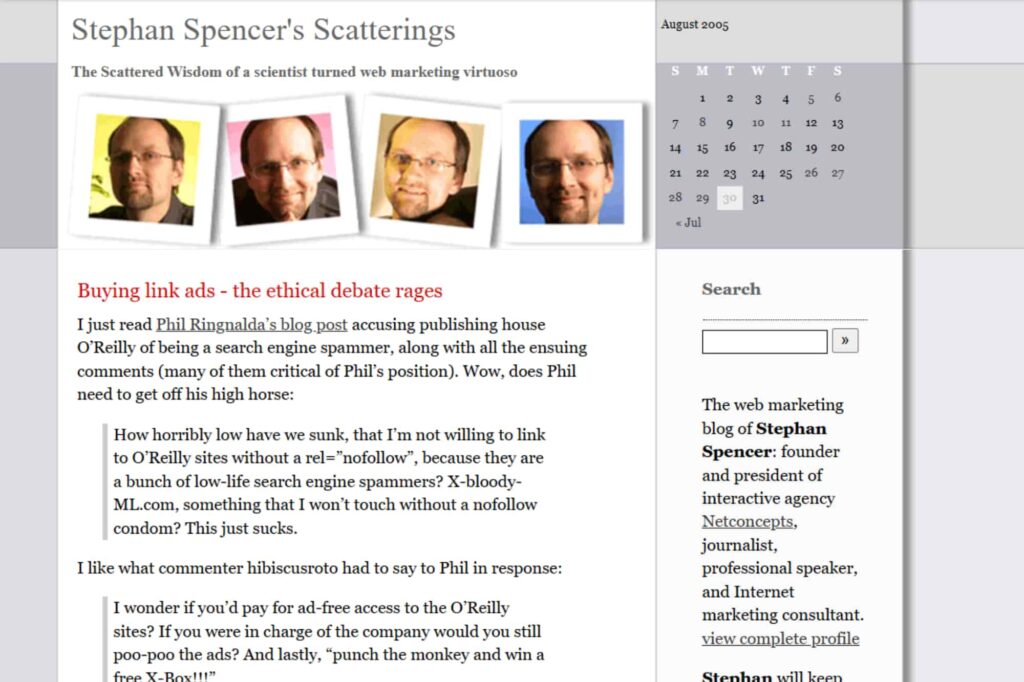
Yeah, so that was 2004, and I was a real laggard in that regard. So if you’re seeing the screen here, that is the first iteration of my brand, personal brand website. It was just a blog, a WordPress blog. And then after I sold the company in 2010, I left the acquiring company about eight months later. Then I invested in a redesign, but yeah, I blogged pretty regularly. That was the thing back then, 2004, I was an early blogger. That wasn’t as popular back then. So I kept that up, and now I don’t blog so much, hardly ever, but I do.
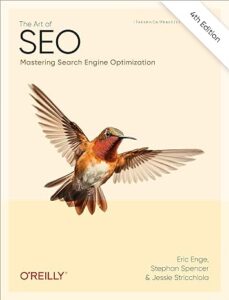
The podcast and YouTube videos that are based on the interviews and so forth. So that is, you know, the thing these days, blogging is not so much, but I really built my reputation on speaking, and then the really big evolution or jump happened in 2009 when I came out with the first edition of The Art of SEO with my co-authors. One of those co-authors was Rand Fishkin, founder of what was then called SEOmoz, which later became Moz. One of the big names in the SEO industry, bigger than my name.
And we did a book together, and that became the definitive book on SEO, a reference, a textbook, a literal textbook used at universities to teach SEO. And many second- and third-generation SEO folks learned their craft from the first edition of The Art of SEO, published in 2009. The second edition came out in 2012, the third in 2015. And then the latest edition is the fourth edition, and two years ago, a little over two years ago, two and a bit. So that’s the evolution of the book, which really became like my calling card. It’s essentially like a big business card. If I go to a prospect and I hand them a copy of the book, they’re like, “Wow, I will never read that. It’s like almost 800 pages. But thank you. Can I just hire you instead?”
Of course, that’s an obvious yes, and then the conversation unfolds, and then we end up working together.
It’s got the thud factor when you drop it.
Yeah, right. Yes, my industry friend Amy Africa would joke that my book is better than Ambien.
Very cool. And so at that point you came to us, think 2013 or 14, something like that.
Yeah, so I met you through a mutual friend. It was because I was in his mastermind. It’s Taki Moore. So Taki had this mastermind called Black Belt. Served internet marketers, business owners, coaches, and so forth. So I was in that, and it was a five-figure-per-year investment. Well worth it. It was great, but the biggest takeaway, the biggest ROI I got out of that investment was your name.
Thank you. That’s incredible. Yeah.
So, Taki had highly recommended Studio1 Design and you, as the founder. And we just started chatting and working together. And then I brought multiple clients to you. I started recommending you at my speaking events and so forth. I just, to this day, I mean, I’m raving about you constantly because you are such an amazing not just designer, but marketer, strategist, and thought leader. You get it, and you apply this, the stuff to your own stuff, your client stuff. And it’s just, it’s such a breath of fresh air. I can’t imagine working with any other design firm.
So yeah, thank you for all the great work that you’ve done over the years, and it all started with our own website because that was the first site I hired you to work on, which was this personal brand site.
Yeah, thank you for all that. Yeah, but yeah, we just have to do a good job. So you keep coming back, and you have for a while. So yeah, that’s a good thing.
The Art of SEO became the definitive textbook on SEO—literally used in universities.
Yeah, I can’t. I’ve lost track of how many sites you’ve designed just for me. Yeah, I mean, we would do microsites for different seminars that I would try to sell, like Passions into Profits. We did a site for that. Did, yeah, a bunch of different sites. I can’t even recall all of them, but there were at least seven or eight different sites over the years, and stephanspencer.com was one of the most important. We’ve several redesigns of that, my podcast websites, marketingspeak.com, getyourselfoptimized.com, my other show, and my agency site, netconcepts.com. These are all Studio1 designs. And thank you for all that.
Pleasure. Yeah. And so I think you came to us in 2014 or thereabouts. And, yeah, I mean, this is, if you’re looking at the screen, listener or viewer, I have a video on YouTube, so you can see what it used to look like. It’s not terrible back in the day. Right. And it was a challenge from my point of view, because Stephan was an authority, even back then, with his three books that he had and all of his speaking gigs. And it’s like, “Wow. Okay. I just felt like. His website didn’t match his level of authority.”
And I guess that’s probably when you decided, Stephan, that you needed to level up your personal brand website because you were being searched for. If we go to Google now and search for your name, it would probably look a lot different back in the day, but you did, you know, always have some form of a knowledge panel because you have books and all those sorts of things.
Well, yeah, not just books, but a Wikipedia entry and so forth. That basically is an automatic thing. If you have a Wikipedia article, then you almost certainly have a knowledge panel on the Knowledge Graph, in Google’s Knowledge Graph. So yeah, that definitely was a part of it. But really, for people who met me at a conference where I spoke and so forth, they would check out my site as just a confirmation that this is the guy that we want to hire. This is the team that we want to hire to do our SEO. And I was working with pretty big brands, like Chanel, Sony Store, Zappos, and so on. And they got to do their due diligence. So it’s got to look to the level of some of these really big agencies that they’re used to getting pitched by, like iProspect. And of course, they’re a nine-figure business or some crazy thing. So it’s like, yeah, “how do I look larger than life?” And I’d better hire Studio1 to help me with that.
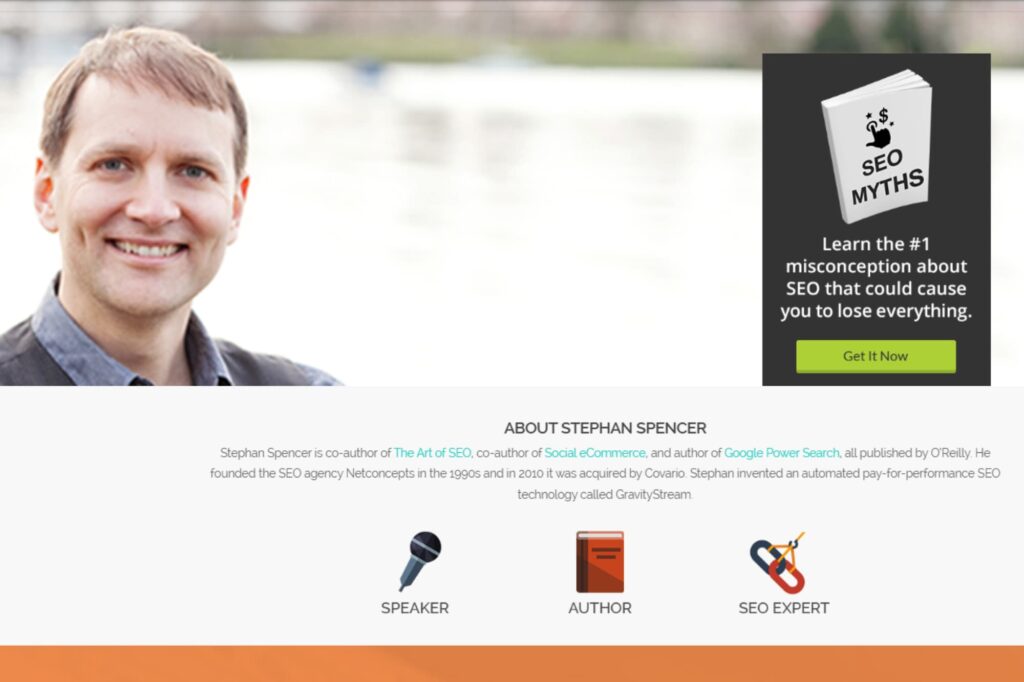
Awesome. And so, yeah, just bringing up a couple of the internal pages, how they used to look back then. That was your about page.
And this was the speaking page back then. Not sure if that’s rendered correctly.
Yep, that’s pretty awful. It’s just a bunch of links to different speaking gigs.
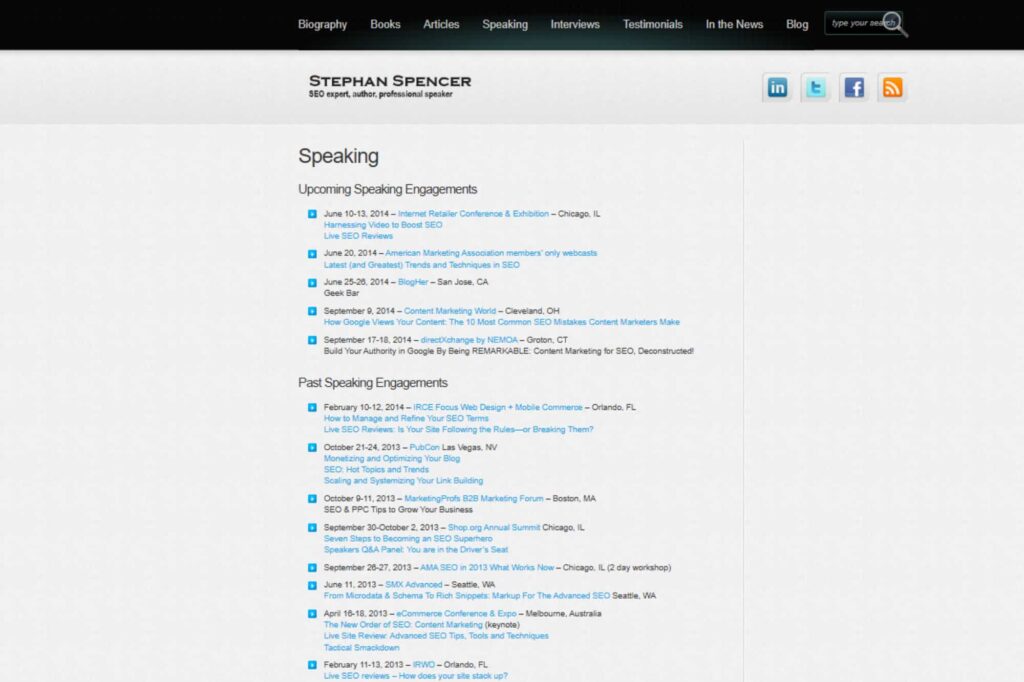
That’s all right. Still authority though. He still shows the volume. So, you know, there are some good things in that.
Yeah, that’s an insanely long page, because even back then, a decade ago, or over a decade ago, I had hundreds of speaking gigs. That wasn’t even all of them.
Amazing. Yeah. Wow. It goes back to 2003. Yeah. Incredible. And so, the point is, we needed to make sure that your website represented the authority level. And yeah, when people come to your website, they either take you seriously or they don’t, based on how professional they think it is. You know, that’s just one of the contributing factors to whether or not they trust you. So we just need to make sure.
We minimize them, thinking that you’re not the real deal, and maximize them, thinking,” wow, this guy is incredible. We must hire him.” So that’s where we came in. Yeah. Um, and so, if you’re watching this, you can see what the pages used to look like, the about page, um, not much copy, and we’ll show you our signature style about page shortly for the redesign. But yeah, this type of page was very standard for an about page back then. It’s really just your credentials and what led you to this point, but without any sort of story or, you know, copy that helps people feel engaged with your brand and who you are. So, yeah.
Your website is never finished. Keep iterating—adding social proof, making sure it's completely relevant to what you offer today. Share on XYeah, because people want to know, like, and trust you. And if you don’t have the storytelling, you just have a flat bio.
Yeah, exactly. Exactly. So then we were just showing a bit of evolution in Stephan’s brand. So this is when we first redesigned your website. Do you remember what year this was, this version, when we first did this one?
No, I think maybe 2016?
Something like that. Yeah. We probably went live with something a little different, but it’s changed a bit since then to this in 2016. So not bad, right? It’s not bad for back then. And it did last a test of time.
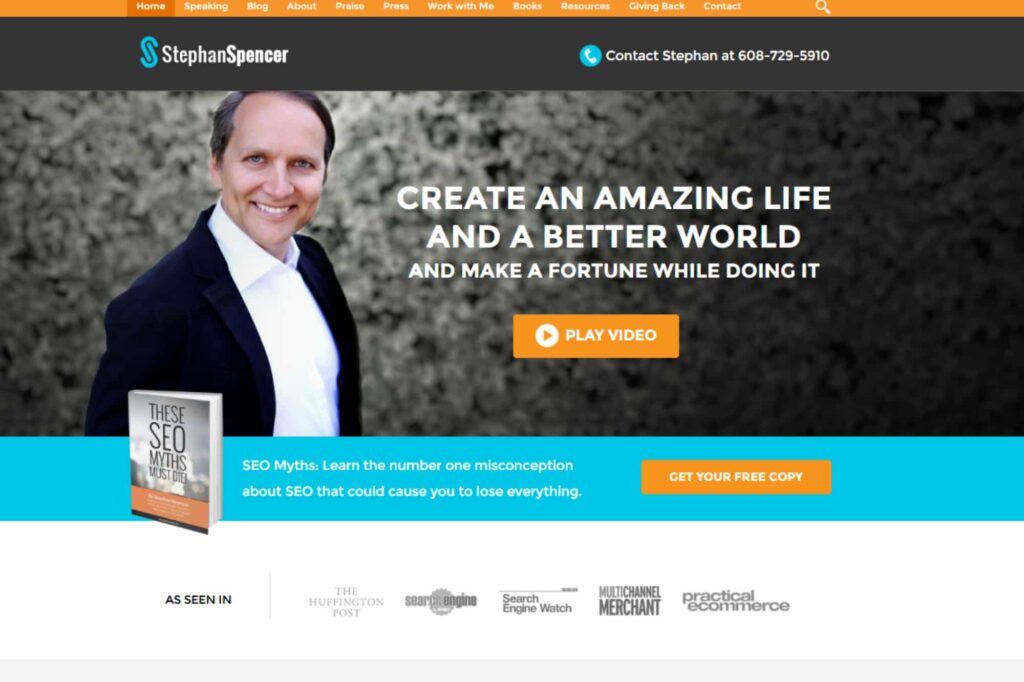
Like, we only updated it again this year, essentially. Right. And so, yeah, this, and you build a lot of brand authority on this website. You put all of your social proof with people like Tony Robbins and Jay Abraham saying awesome things about you, and testimonials from clients and case studies.
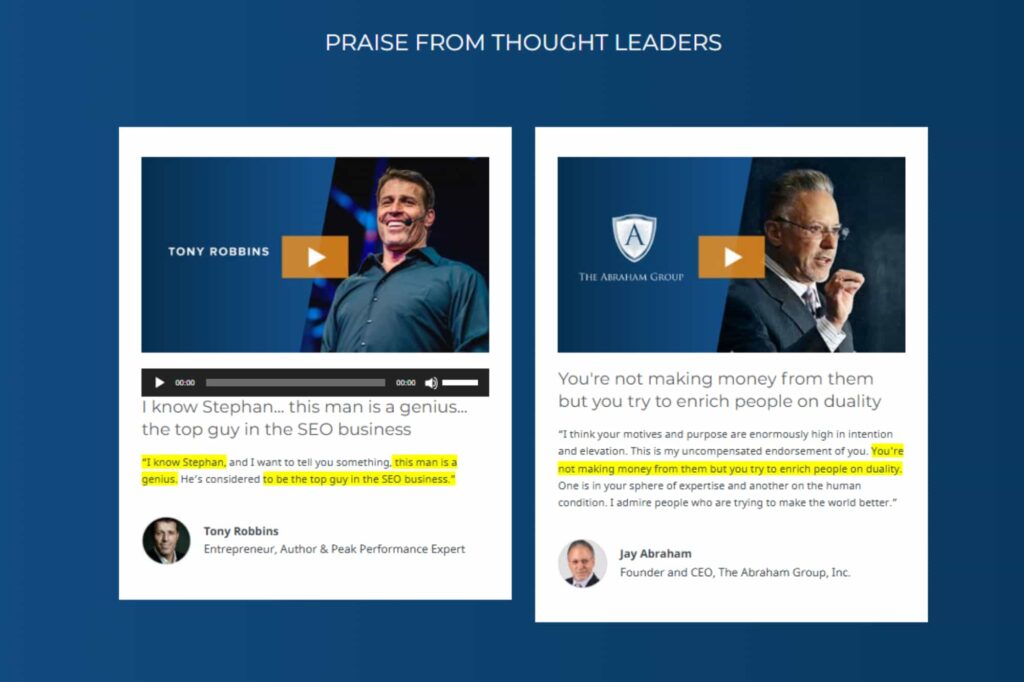
Not all the videos are loading because it’s on the Wayback Machine, but you know, you put your podcasts in here. When did you start your two podcasts?
Yeah, 2015, both of them.
Yeah. So it wasn’t called Get Yourself Optimized back then. Was it, was, what was it again?
No, so it was the Optimized Geek. I operated under that brand for the first, I think, four years.
Why, okay, so why did you change the name?
Right, so one of our mutual friends, James Schramko, was my coach, one of my coaches, and he said that that name kind of boxed me in. It wouldn’t resonate with somebody who doesn’t identify as a geek. And so they probably wouldn’t listen to it. Here’s all this great knowledge about biohacking, personal development, mindset and so forth. But if you’re not a geek, you’re probably not gonna give it a try to see how good it is. So we rebranded it to Get Yourself Optimized.

Understood. So yeah, all aspects of your branding, you up leveled around this time. So changing the brand from the Optimized Geek to Get Yourself Optimized. And I guess it’s hard to find a domain name available for a brand you resonate with. That’s not to remove from the previous one. So that would have been a challenge.
Yeah, so it wasn’t unfortunately available to get your getoptimized.com, which would have been easier to roll off the tongue. But yeah, Get Yourself Optimized was what was available. I’m open to spending money on buying an aftermarket domain. So if it was only a few thousand dollars, I would have paid for that, but you know, it just wasn’t available.
Fair enough yet. Cool. And it wasn’t a bad website. And like I said, at the end of the test of time, like we made some tweaks to it over time, updated your books, obviously brought your content on here as well. And all of your press, you get mentioned in a lot of different press. I won’t open this cause it’s on the way back, and it’ll take too long, but we showed people the new press page shortly. But yeah, that’s kind of what it was until 2020. Would you say we started the redesign process in 2024?
Actually, we started a couple of years earlier than that. Just took a while to be ready to launch it.
Yes. Because we kept getting busy with client work. So you put your own, your own project last. Yeah.
Yeah, that’s a theme. That’s a theme. So if you look at just the various aspects of SEO, not just design and conversion, we get the dregs, the last bits of attention from things like our link-building team and so forth. It’s just that I focus on my clients, and I guess you could call it an excuse, but not in the sense that I have to make strategic decisions about where to invest our time, energy, and attention. I put that on my clients.
So that’s good news for the clients. And if you’re a prospect listening to this, know that you’ll get the best of my best and my team’s best attention, time, and so forth. And yeah, we just don’t put the same level, not even close, maybe a hundredth of that to our own presences. But yeah, that’s why it took an extra several years to finally launch the redesign of stephenspencer.com.
SEO is no longer just Search Engine Optimization—it’s Search Everywhere Optimization.
Yeah, that’s probably a good thing anyway, because you evolved a lot in that time as well, you know, and that was sort of partly why I would say recently, before we went live, you decided to change the copy again to match where you are at, which is more, you don’t just help people with SEO anymore. And you haven’t for a while. In my opinion, every time you send us a client, like you’ve helped them write a book, you’ve helped them get discovered on all sorts of platforms and boost the, you know, their authority on their website as well.
But you know, that’s why it now says ‘future-proof your web traffic.’ Like it’s all of the web, wherever they are to be found, you’ll help them get found and then build last in authority with a data-driven SEO strategy and AI, minus the hype. And I love that bit, minus the hype, because, yeah, this is something you evolved into. I would say probably even the last two years, but your website copy just wasn’t reflecting that.
Yeah, that’s right. So I was pigeonholed into the SEO space, even though that’s the majority of what we do for clients. People weren’t realizing how deep I was in AI, YouTube, and so forth. Again, if you look at my own YouTube presence, I have 8,000 or so subscribers or whatever. Still, I help clients get really significant results, much bigger than my presence on their YouTube channels, because that’s where I put 99 % of my time and attention, which is on my clients. So this is an important evolution and positioning evolution for me to put that out there and say that I help you with these other areas. And it’s not SEO Search Engine Optimization anymore. It’s Search Everywhere Optimization.
Absolutely. Yeah. And, know, just some little things that are subtle as you land on the homepage above the fold. So you’ve got the very clear benefit-driven USP. You’ve got all of these impact metrics that show the 30 years of experience, 250 satisfied clients and a figure client-centered, you know, it’s really letting people know when they land on the website, what you do, how they’ll benefit and who it’s for.
If you send people off-site too soon, there’s a real risk they won’t come back.
Yeah, now that last metric is a guess. I’m sure it’s somewhere in the nine figures of client revenue generated.
Yeah, that makes sense. Mean, you can’t be specific because it’s across, you know, 250 clients. So it makes sense. But then yeah, little things like as seen in all the different places you’ve been saying. And you know, if you’re watching this, you’ll notice these are clickable, and they’ll take you not to the external websites of these brands, but to your individual press page for each of them, right? Stephan.
Yeah, that’s really important. If you send people off, they can, of course, validate and verify that you were on those media outlets. But what’s the likelihood they’ll hit the back button and then come back to your site? So that’s a risk. If you keep them on your site by sending them to the media page or press page, then you can overwhelm them with all the media presence, not just those As Seen On logos. And then if they click off, you’re less likely to lose them because you kept them on the media page or press page instead of sending them off at the first click.
Exactly. And obviously, you have press in the top nav as well, which is really important, you know, to showcase that authority. And when you go there on the press page, you’ve got a beautiful section at the top of the page, you’ve got press and media appearances as seen on the big ones, you know, household names, but underneath that, you’ve got a selected category below. So you’ve got TV appearances, conference interviews, podcast appearances, article mentions, byline articles, and all of these, when pressed, will anchor-link down to that section of the page. So whether they press it or not, or they just scroll, they see the sheer volume of places that you’ve been mentioned. So it’s yeah, super impressive. We just make it easier by having those tabs so people can get to the relevant things quickly if they want.
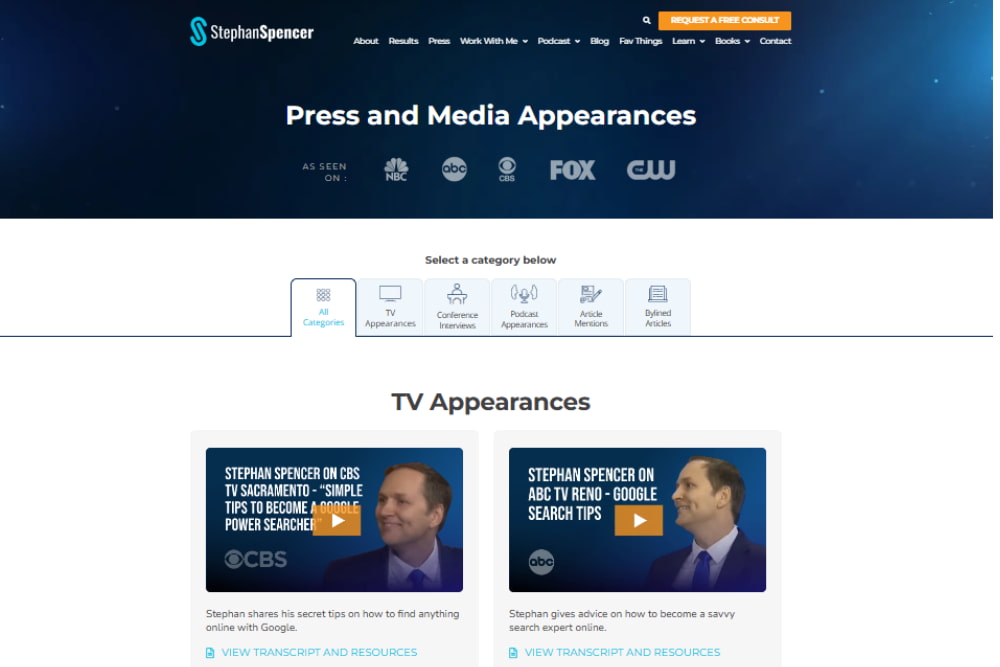
Yeah, and this is the sort of thing where you might think, well, is that a bylined article? Is that press? I consider that to be relevant enough to be on the press page because those are media outlets. It’s Harvard Business Review, Founder Magazine, Content Marketing Institute, Search Engine Journal, Adweek, etc. The fact that I wrote for those media outlets instead of getting a feature story in them or being quoted as a source, there’s still a lot of vetting that goes on to allow you to write for an outlet like that, or for CNET, or practically commerce, or whoever. So that’s why those are there even though they’re not technically press mentions because they contributed articles or columns, but yeah, that’s why those are there.
Yeah. And I imagine part of the strategy for doing that stuff is, correct me if I’m wrong, that you probably get some backlinks from those publications as well. Right.
Keeping visitors on your site lets you overwhelm them—in a good way—with your media presence.
Yeah, of course. Yes. But you’re also, if you’re doing what I’m doing here, linking back to them. So it’s a bi-directional link, which looks more like a business relationship to Google than a link earned by merit.
So that’s okay. Meaning, there are different reasons to get links. And sometimes you overrule the SEO benefit in favor of another business reason. So that’s why we linked back. More important to me is to have that social proof on the press page.
Yes, exactly. I agree. And the beauty of having a link out to them legitimizes that it really happened, so I think that’s pretty smart.
Yeah, it’s not just to the home page. I find the exact article on the site, or my team does, and then, if the article gets deleted from the site, we switch it to the Wayback Machine or archive.org so they can still see that the article was posted on that site, even though it’s been removed.
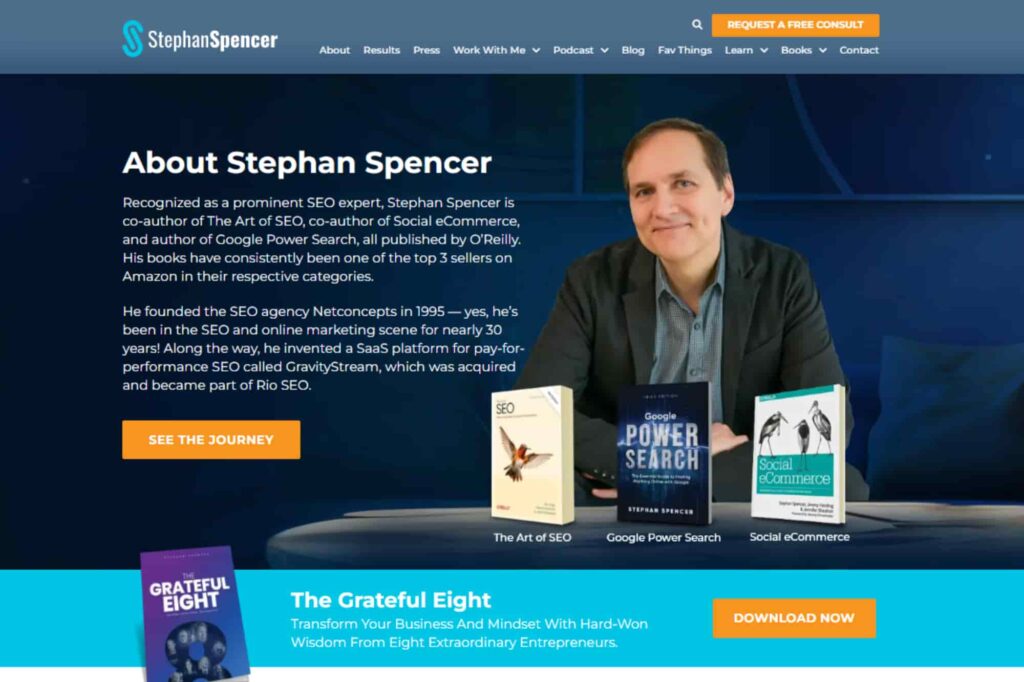
Incredible. Yep. And so, a few other things on the homepage to showcase your authority. I mean, you’ve got a co-author of the art of SEO. That straight away says you’re an author, which is an authority in people’s minds. They think you’re an authority because you’re an author.
We’ve talked about the impact metrics. Then, if you think about the top nav as well, like the fact that you’ve got press, you’ve got results, you’ve got podcasts where you’ve got two podcasts, and then you’ve got your books up here as well. And you hover over it, and these are what we call a mega menu. And so it shows an image of all the books, a little description, and then you can link off to the individual book landing page, which will still keep people on your website. Right. So yeah, just having that.
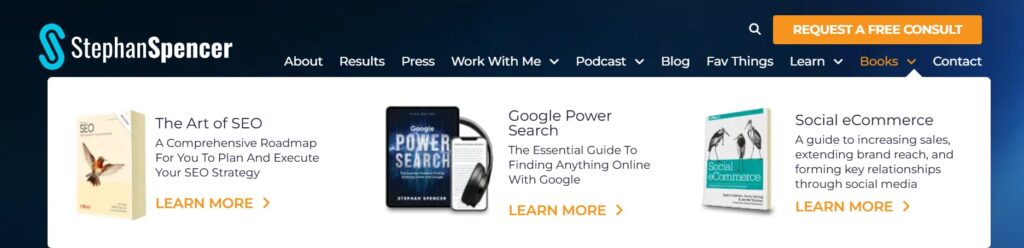
Yeah, so that’s an important point. And those are other examples of your work. If you go to the Art of SEO book website at artofseo.com, we don’t link directly to it. We keep people on my site first. My personal brand site has a landing page for the book with a lead magnet for a free chapter and some book bonuses.
And then, if they want, they could go to the Art of SEO website at artofseo.com. Yeah, suppose you send them off-site too quickly, even if it’s another site that you own. In that case, you take a risk because it’s now a jarring experience to end up on a completely different website, with different branding, nav structure, site structure, et cetera. So we try to keep people on as long as possible. But yeah, I love that mega-nav with the imagery: when you hover over books, you see pictures of the books; when you hover over the podcast, you see pictures of the podcast. Now you see the two podcast covers. Good stuff.
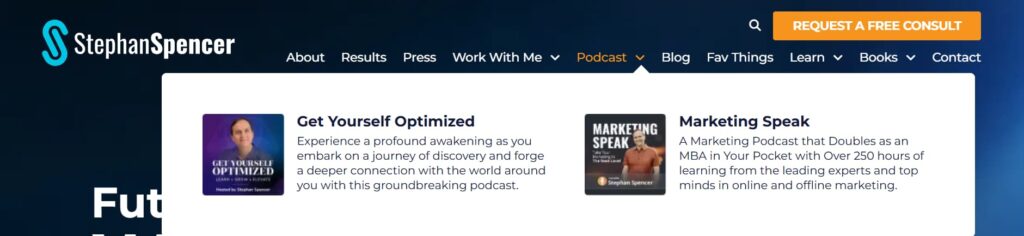
Yeah. And just a little thing as well. As you can see, I’m hovering over the text. It’s all clickable. So it’s going to take me there. You don’t, we don’t want to make it hard for people to go, right? I have to click on the image. They click anywhere, and it’ll take them there. So it’s just a little.
Yeah. Well, yeah, actually, if you look under the learn item, there are the marketing and personal development sections, which have images. But if you want to go directly to the courses, instead of just the marketing learning center area, they’re listed there. You can jump straight to the courses, which I have made all free. Back in the day, some were $2,500, and one was almost $5,000. I’ve decided to make them all free. So if you go to stephanspencer.com/courses, you can sign up for free.
Amazing. Wow. Yeah. And there’s what? Seven courses. Yep. Incredible. I also wanted to point out that on the book landing page, we’ve got some serious authority. Like, you know, you’ve got Rand Fishkin, you’ve got Robert Cialdini saying awesome things about the book. Even Neil Patel. Wow.
Navigation should make it effortless for people to get exactly where they want to go.
And some of the people who were mentors or people I really looked up to decades ago, writing blurbs about the book, Brian Tracy, for example, I’ve been listening to his content for decades since the 90s. I love Brian Tracy, and he wrote a wonderful blurb for me. And this is a big difference maker if you have a book to get the endorsement quotes and really put the effort into it. I put a ton of effort into getting 60 blurbs, which is kind of unheard of. And it’s not just so you can put it in the book, in the front matter, or several of them on the back cover, or whatever. It’s so that you can leverage that on the web. Not just on the book website, but also on your personal brand website and other places where you need testimonials, endorsements, or anything, you can leverage those quotes. And it’s just, it’s such an overwhelming number with really high-quality people that you’re like, wow, this guy must be the guy to hire.
Yeah. And I think the beauty of you having these two different podcasts is that you’ve got a whole network of super authorities in both types of areas, from marketing to personal development, et cetera, where, when you work with a client, you will. You recommended, for instance, one of the clients that we work with together, Chris Parker, to write a book, and you helped him with that, but then you helped him get testimonials and book reviews for his book based on the network of people that you’ve built up over the years. Think that’s just a hidden, extremely valuable bonus for clients.
Yeah, yeah, in fact, with Chris, we talked about this on the case study episode about Chris and his various sites, including whatismyIPaddress.com. Since the recording, just a few months ago, he has exceeded 14 million monthly visits.
Wow, it keeps going up. Amazing. Yeah. Let’s speak. Speaking of results.

Yeah. Yeah. So it’s yeah, I’m really proud of our work together with him. But that whole book, Privacy Crisis, that came out this fall was My Brainchild. And I got him a ghost writer, most of the endorsement quotes, and all the things. I really shepherded that book to completion and launch.
I’m really proud of it. And it was actually gonna be my book. I said this on that episode, but I decided to give that to Chris. He’s more of an expert in the privacy and security space than I am. And even though it was my brainchild and I was the solo author at the beginning of it, I thought he’d be a great fit as a co-author, then, you know what? Let’s just let him have it. He can be the sole author of his first book, rather than a co-author. So yeah, really, really proud of him and proud of the work that we’ve done together and continue to do together.
Yeah, and you helped Brandon Yosha from Yosha Law. Yeah, you were very involved in that. It was your idea, wasn’t it?
Yeah, yeah, it wasn’t on his radar to write a memoir. And again, I hooked him up with a ghost writer whom I’d worked with myself, a different one in that case, but yeah.
So yeah. And there are some really good case studies. If anybody’s watching this on YouTube, you’ll see the effort we put into, you know, creating case study pages. It’s not just a testimonial; there are multiple videos and results. There’s just the whole situation and what the client says about your services. But everything on this page is essentially a template that we use for all of your client case studies.
We tweak it to suit each case study, but yeah, it’s a really good best practice for case studies that the listener/viewer should probably check out.

Yeah, but it’s not formulaic. It can be templated to some degree, but if you’re stuck in the background, solution, results paradigm, it’s very boring. Nobody wants to read those formulaic case studies. So you’ve got to do great storytelling, hero’s journey, this whole story arc, surprise and delight, et cetera.
And that means the design can sometimes vary from case to case. If you look at the Brandon Yosha, Yosha law firm case study, compare that with the Chris Parker, whatis myIPaddress.com case study. There are different sections. And it’s not just a swap in and out of different images and different text.
It’s a whole different kind of story arc, different kinds of screenshots, and different ways of telling the story. And that’s because they’re vastly different types of sites and businesses with different results and different metrics for success.
Yeah, that’s a very good point. Yeah. So, yeah, but it’s a really good example of how to design case study pages. If you really want to attract similar types of clients, go to this level of detail, and yeah, it’s just going to give you the best chance of attracting better clients essentially. So I think case studies are an overlooked resource.
And especially these days, like, even with LLMs, they want to know that you have a lot of social proof. Therefore, we recommend a single page for all your social proof, which we call ‘results’. And we say results most of the time, because you’re essentially, you want to highlight the results that you get for clients, as opposed to just having a client testimony or saying nice things about you. Nobody cares about that, but because other prospects want results. So you want to highlight the results, and that’s why we lead with case studies.
Then you’ve got, you know, a whole range of case studies for a section. You’ve got client testimonials, client interviews, praise from thought leaders, likes, and a client list, which is super impressive. You know, people might think, why not put that at the top, and Stephan, you’ll probably think, well, you know, it’s just logos, and I don’t want to brag. I want to show people the results I get. And that’s probably why you have it in this order. Is that right?
Yeah, and I also renamed this section from ‘praise’ to ‘results’ years ago because I wanted to focus on the results. As you say, people hire you for results; they don’t hire you for all the fluffy praise that you get. So cut to the chase, show them the results and call it that.
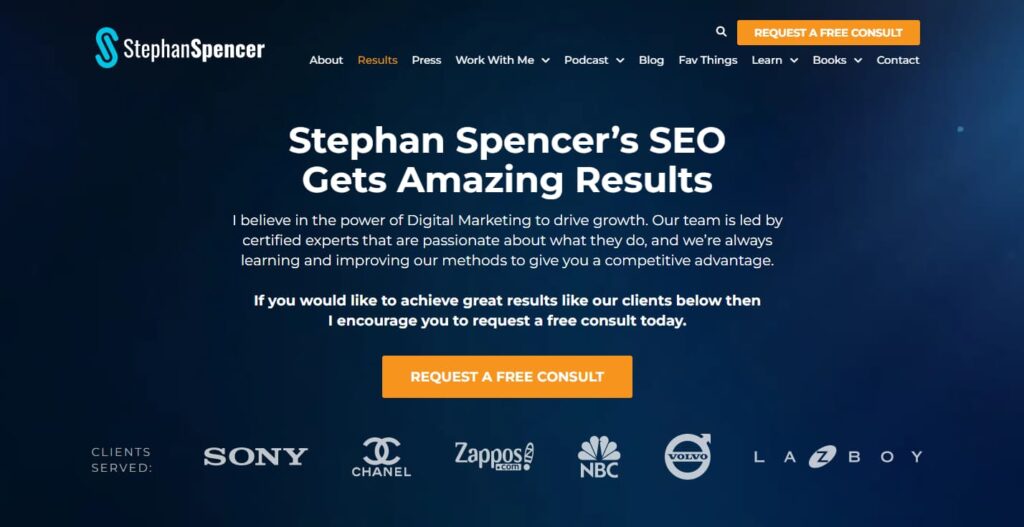
Yeah. Love that. Yeah. Incredible. But having it all on one page is super impressive for, you know, prospects and LLMs, from what I hear. So it’s a good idea.
Yeah. And if you have a podcast, use it to talk to your clients and turn those episodes into case study episodes so you can get a range of testimonial quotes. And the reason they almost didn’t hire you can be extracted in an hour-long interview, or 30 minutes, or whatever it is. Whereas if you just ask for a testimonial quote from a client, you might get a couple of paragraphs, you might only get a few sentences. Here, there’s much more opportunity for storytelling and for surprise and delight. You got a whole 30 or 60 minutes of content in conversation with that client.
It’s a good point, actually. Absolutely. Yeah. And so you put them on there as well, which is super cool. And then I mean, I just wanted to mention your two podcasts and show people your about page, but yeah. So what Stephan does is because he has two podcasts instead of just taking people to the podcast website, because let’s say they know Stephan for SEO and marketing.
They may not even know he has a Get Yourself Optimized podcast. So there may be a major disconnect if we just take people from the top nav, mega menu feature section, to the actual podcast. Stephan has what we call a bridging page. So it’s still on the Stephan Spencer website, but it’s an introduction, and it’s pretty much the same as what you would see on the podcast page. It accepts and displays all the categories, and it just builds more trust when you do it this way, rather than taking people directly off the site. Now, he’ll show all of the featured episodes. He’s got all the categories at the top. And then, if you click on any of these, it will take you to that external website. And I think it’s just a really smart approach before you take them there to really show the bridging page for the two different brands, Stephan Spencer and Get Yourself Optimized.
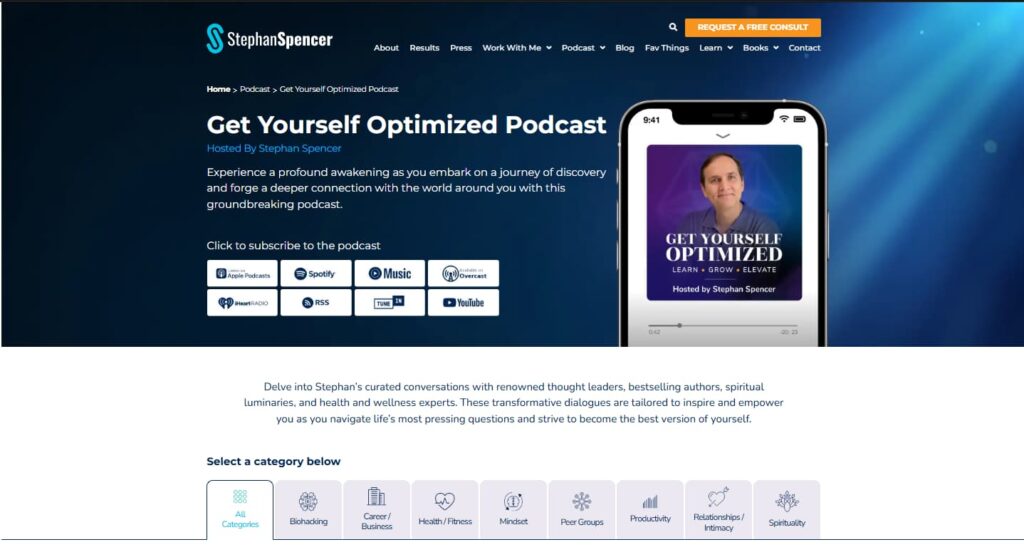
Yeah, so now our listener or viewer might wonder why we don’t have the podcast live under the personal brand website. Just like you see, many authors have their book information on their personal brand website and don’t have a separate site for the book, or they don’t have a separate site for the podcast if they’re a podcaster. And the reason for that is because if you believe that the brand of the book or the podcast has staying power, it has a life of its own, it may even get acquired at some point, right? It’s not a business if it’s not acquirable. Could it be its own standalone business that gets acquired, or the IP?
If it is big enough to warrant its own brand, it needs its own website. So if The Art of SEO is as big as I tout it to be, it should have its own website, because it’s that important and that big in the industry. So that’s why we have separate websites. But you do have to do link building for all those websites, not just the personal brand website. So there is a cost, a downside, if you don’t aggregate all your content on one big website.
Yeah, yeah, absolutely. And look, there are two podcast websites; Get Yourself Optimized. When did this one go live? Is it 2025?
If you split your content across multiple sites, you have to build backlinks for every single one.
This went live this summer.
Yeah. Okay. Cool. So 2025 and then Marketing Speak. It still looks really cool, but this went live. What year?
I think two years earlier.
Okay. Yeah, sure. And you’ll notice, you know, this still has the same sort of structure because this structure works, and you get yourself optimized. It’s pretty much identical. It just has, you know, more authority, a better design, and more social proof on there as well. So, yeah, they’re the things, and we’ve got a nice image of you in a section for hiring you to speak. Now people might also be wondering, Stephan, like, you’ve got a speaking page on your personal brand website. Why would you do the same on your podcast website?
Because I want people who are listening to the show or are interested in the show to see that I speak and could do a keynote presentation at their conference, now, it’ll be a very small percentage of my audience that are conference organizers or who are decision makers or decision influencers for conferences and seminars and so forth. But it’s important enough that I wanted to have that kind of stand out.
Yeah, that makes sense. Yeah. And yet, because they may not be interested in, obviously, getting yourself optimized. You’ve got topics that relate to getting yourself optimized.
Yeah, personal development, spirituality, mindsets, biohacking, those sorts of topics that I can speak on that I’m not as known as a thought leader in that space, versus SEO, marketing and AI.
Exactly. Yep. And then you also have Marketing Speak, a consultant, and coaching, because these are the things people may want to hire you for. Um, and they may not know that you have a personal brand website at this point. They may have heard you through marketing speeches. I think it makes a lot of sense. It might take more effort to have a consulting page on your personal brand website and to align your marketing speak, but I feel like it’s a better pathway for the listener. And so it’s really about what’s in it for them, worrying as opposed to worrying about making it simple for you.
When an article gets deleted, we point to the Wayback Machine so the proof never disappears.
Yeah. And so again, if you think of SEO as “Search Everywhere Optimization”, you want to be everywhere, not just consolidated on one website. Even though it’s more work to do the link building and citation building, et cetera, for multiple sites, if you have these, these big projects or initiatives, whatever they are, if it’s a podcast, a book, a documentary or whatever it is, invest in a proper website that’s not just a one-pager. Google and the LLMs aren’t going to take you seriously if you have a one-page website about whatever it is.
Yeah. And, we’ll wrap up shortly. It’s up to you how long you want to go for, but I want to talk about the frequently asked questions, since you put a lot of effort into them as well. Like, if you’re watching this, have a look at the segment that runs horizontally across the top of the frequently asked questions. And then you have a whole bunch for each, but it’s really nicely organized, rather than just having it all on one big, long, expanded page, which would be really confusing for visitors. Think about putting it into sections like pricing, offering consulting, scope, etc. I think it’s just so much easier for the viewer to digest.
Yes, and these aren’t SEO FAQs. These are FAQs about hiring me because I’m trying to obliterate or at least limit the objections that people might have in hiring me. If they’re concerned about budget, well, I’m not the cheapest SEO out there by a long stretch, so having a whole category in the FAQ on pricing is really important, preempting and handling the objections before we even have a call.
Exactly, yeah. So it’s pretty smart, I think, going into that level as well. But the way it’s organized, I think, is a good user experience. Cool, all right. So let’s have a look at the About page, because we showed what it looked like in the Wayback Machine, which is the one we’re looking at now.
And then kind of a stub of a page there, the previous version.
And so this is your new one, and it does have a good intro, obviously about Stephan Spencer, good for SEO, right? In the big, large font. Then, yeah, this is a position in peace. And then you go into, obviously, you’re gonna request a consult call to action. We haven’t talked about call to actions, but they’re strategically placed throughout this website. But then, yeah.

It’s all authority copy above positioning. And then you go into kind of what’s in it for them. And then you go into the journey that led you to this point so far, in a beautiful timeline that just has images and a little paragraph for each of the milestones that started back in 1984.
And I encourage anyone to look at this timeline to see the history that led Stephan to this point, which is pretty cool, I reckon. I’ll laugh at some of these images because they’re so dated, but yeah, that’s the way the internet was back then. So yeah, this is really cool.
Yeah, those are the two websites we mentioned earlier in the episode, Innsite and Writers.net. Yeah. Which looked beautiful back in 1995. Mean, those screenshots were probably from 97. The site looked less designed in the early iteration than it was. I’m not a designer, so I just coded it the best I could without having a proper designer.
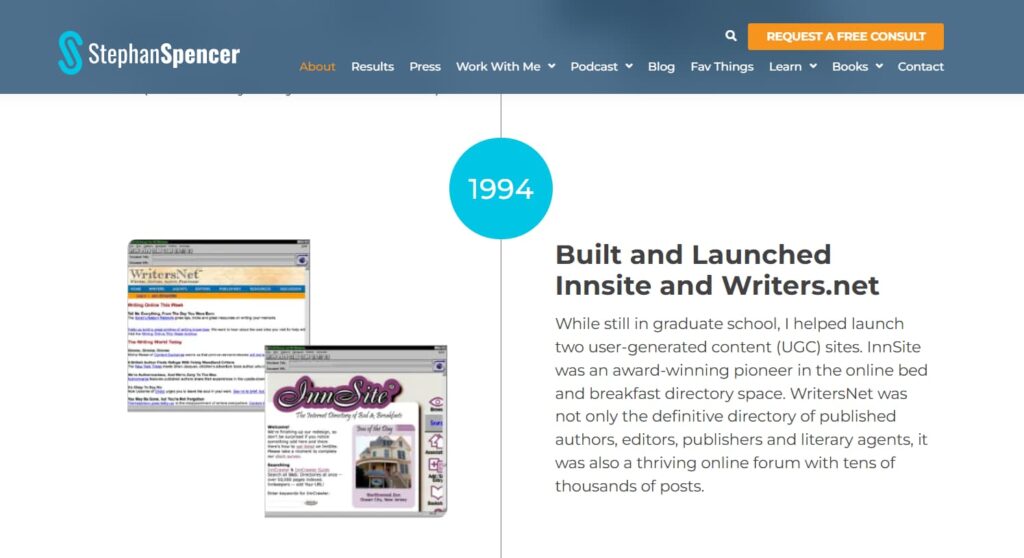
Cool. Yeah. But then, yeah, all of these, you know, magazines that you were featured in and journals and yeah, like it’s pretty impressive. This one here in business, explain that one. How’d you get on the cover of that?
I don’t remember how I got that, but it was a cover story. So I worked with a local client in the same city and delivered outstanding results. We got a journalist assigned to us, and they kind of diary-ed the evolution of a site rebrand and relaunch. A case study is based on a timeline. Yeah, it was pretty innovative back in the day to do it that way.
And now we’re doing a timeline in a timeline. So, what I like about this as well is that it’s your personal brand website, and it’s not just, you know, authority-boosting things. When I got this awesome client and featured here, as you talked about your personal journey as well, when you moved the entire family to New Zealand in 1999, I just loved that aspect. Cause that’s what people are looking for.
People want to know who this person is behind the brand, and yeah, I think you’ve got a good mix here of authority boost and things, along with personal brand and personal story. You know, you talk about your daughter. Yeah, there are a lot of things that you talk about when you get married, which is coming up soon. Here we go. Yeah. So make your soulmate, Orion, you know, incredible, but yeah, I just love that the way it’s unpacked, and you haven’t just put business stuff in there, which is what I really like about it.
Yeah, because people want to know, like and trust you, and you’ve got to highlight your story of struggle, the hero’s journey, trials and tribulations and not just your Instagram-ready success moments, but some of the crazy wild ride as well. If you look back to 2009, 2010, there’s a before-and-after there: the 2009 photo and the 2010 photo, juxtaposed, showing me before and after a huge life reboot, where I got like Lasik and a hair transplant and changed my diet. I started working out, and I became unrecognizable from the previous version of me to the point where I would go to conferences to speak. If I didn’t have the badge on me or whatever, people wouldn’t recognize me.
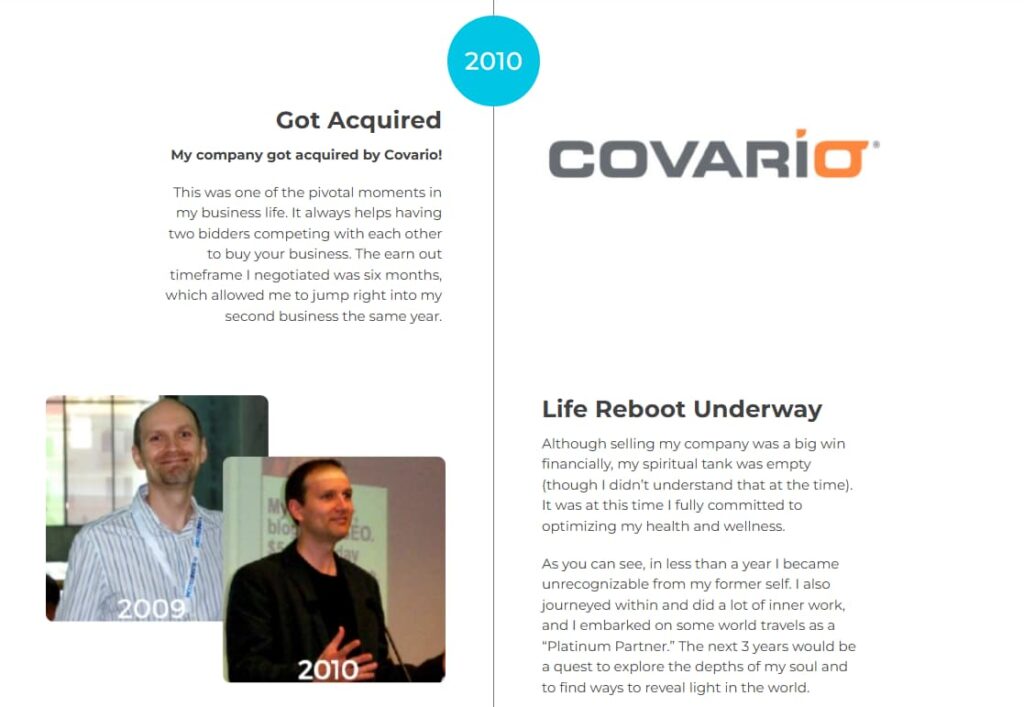
And so I’d hang around in a group of other speakers for a few minutes, and they didn’t know who I was. That was fun for a while, but now everybody knows what I look like. So I don’t really recall what I used to look like. But that’s part of the, might try and hide that.
But I don’t think that makes you real to hide all your previous versions or whatever. Just want to be authentic and share my story.
Yeah, I love that. It’s all those things that led you to this point, and it’s a personal brand website. So I think it’s really important that you keep those in as well. So yeah, very cool. That’s the birth of David, 2019. So the point is, I think this is a vast improvement on your previous about page. And then you end the page with another section, which is the call to action to request a free consult. If they’ve read your journey, what do you want them to do next? And yeah, for you, it’s a request for a consult. And I think that’s the smartest approach for a call to action on this type of page.

Yeah, that’s for any page, because any page is a potential landing page or entry point from Google or from an LLM. So what’s the next action? It should be clear. It should be singular. I shouldn’t have to make a bunch of choices. Like, do I request a free consult? Do I get a free chapter of Stephan’s book? Do I download a speaker kit?
For each page, it’s a thing. So if you’re on my speaking page, download a speaker kit.
If you’re on, let’s say, the results page, it’s to request a free consult. And, the elements of social proof change as well. So if you notice here on the results page, the clients served logo bar is prominent. Sony, Chanel, Zappos, et cetera.
Well, you go to the press page, and it’s now called media outlets as seen on. You go to, let’s say, the speaking page, and now you’re gonna see, yeah, it’s under work with me speaking. So you go to the speaking page, and you see the logo bar is events that I’ve spoken at.

Right, so the Affiliate Summit, IRCE, and speaking at Stanford University, etc. Because that’s relevant, so the social proof is relevant, the call to action is relevant, but it’s simple, it’s clear. Clarity is king.
Yeah. Couldn’t agree more. Yeah. Good point. But it’s also, you know, what’s in it for them on all of these pages. You do have some copy that talks about the benefits of each offer, and, you know, the fact that you understand their situation and that you have social proof to back it up on every single page. Again, it’s all relevant social proof, you know? So all those things are super, super important to make sure it’s relevant and with clarity, like you mentioned before.
So. Cool. Well, look, I mean, that’s a good overview of the evolution of the personal brand and your, you know, podcast websites and, you’ve, you’ve redesigned your agency website as well. And so, yeah, is there anything else you’d like to sort of add here? I mean, from my perspective, it’s all about the listener thinking about you. Do you have a personal brand? It’s more important than ever, in the age of AI, to invest in your personal brand both offline and online.
Yeah, what else do you want to add, Stephan?
Yeah, the personal brand is the brand that you take from cradle to grave. And when I invested in the early years and the Netconcepts brand, I didn’t realize I would later sell it and then reacquire it.
But I did not realize that was something to invest in. Cause I always thought that these are intertwined. My company and I, at some point, you’ll hopefully sell your company, and then what are you left with? Only your personal brand. If you haven’t invested in one, then you’re left with nothing. And as you say, especially in the age of AI, where that’s the difference maker, somebody could just say, “Hey, find me some SEO expert to hire, blah, blah, blah, blah, blah, here are my criteria.”
But suppose you already heard me speak at a conference, or you’ve read my book, or you have benefited from my content online, whether it’s articles, courses or whatever. In that case, you’re gonna direct the AI to specifically look into Stephan Spencer. So that’s critical for the future is for them to have you, the listener, top of mind when they’re prompting an AI.
Absolutely. And your website’s never finished. So keep iterating, like adding social proof, and make sure it’s completely relevant to what people are thinking. Like Stephan made this shift with his copy because his offer shifted, you know, because that’s what the audience, that’s what he helped this audience with. So the point is just always review your website. I would say every three months, these days, to make sure it’s completely relevant to what you offer today, and that the social proof is always up to date.
Yeah, I’ll always be looking for opportunities to get testimonials, case studies and interviews with your clients so that you can refresh and add more social proof. Because, as you say, your website’s never finished.
Well, thank you so much, Greg. That was fabulous. If our listener or viewer wants to work with you, where do they hire Studio1?
Studio1design.com and that’s the numeral one. Thank you.
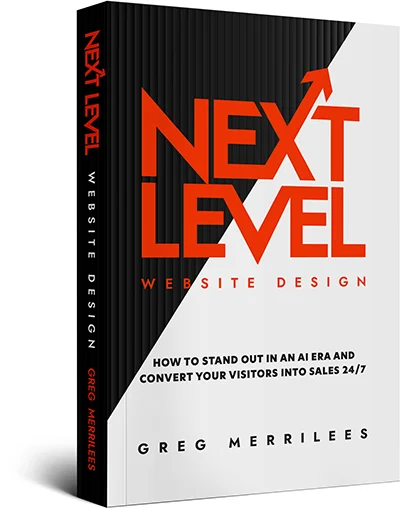
Awesome. And you have a personal brand site too, gregmerrilees.com. And you have a book website too. NextLevelWebsiteDesign.com.
Spot on, spot on. Thank you, Steph, and I appreciate the plug.
Yeah. And of course, if you want to work with me on SEO, AEO, brand building and overall marketing, StephanSpencer.com or NetConcepts.com.
Awesome.
All right, we’ll catch you in the next episode. I’m your host, Stephan Spencer, signing off.
Important Links
Connect with Greg Merrilees
Connect with Stephan Spencer
Apps/Tools
Books
Businesses/Organizations
People
Previous Marketing Speak Episode
Building Trust Through Design: A Case Study with Greg Merrilees
Crafting An Expert Facebook Ad with Taki Moore
Digital Course Website Overhaul: A Case Study with Greg Merrilees
Don’t Just Speak, Perform! with Michael Port
E-commerce Redesign Secrets: A Case Study with Greg Merrilees
From Hobby to Empire: A Case Study with Greg Merrilees
Getting the Most Out of Facebook Advertising with Nicholas Kusmich
Hacking Your Productivity with Nir Eyal
Hard Lessons from Growing a Startup with Rand Fishkin
High Converting Landing Pages with Greg Merrilees
How to Build a Digital Marketing Agency with Stephan Spencer and Greg Merrilees
Local Services Website Teardown: A Case Study with Greg Merrilees
Marketing in a Zero-Click World with Rand Fishkin
Mastering the Art of Persuasion with Dr. Robert Cialdini
More Traction, Less Distraction with Nir Eyal
Raise Your Internet Marketing Standards For Exceptional Results with James Schramko
Scaling to 12 Million Monthly Visits with Chris Parker
Secrets to a Persuasive Website with Greg Merrilees
Stress-Free Automation with James Schramko
The Real ROI of Good Design: A Law Firm Case Study with Greg Merrilees
When Clean Design Kills Conversions: A Case Study with Greg Merillees
Previous Get Yourself Optimized Episodes
Your Checklist of Actions to Take
- Invest in my personal brand as my permanent asset. Build my personal brand website as the brand I take from cradle to grave. Unlike company brands that can be sold, my personal brand stays with me forever and becomes critical for AI-driven searches, where people will specifically prompt for my name.
- Create bridging pages between my personal brand and sub-brands. Instead of linking directly from my personal site to separate podcast or book websites, create introduction pages on my main site that showcase categories and featured content. This keeps visitors engaged longer and provides context before they navigate to external properties.
- Customize social proof elements for each page’s context. Change the logo bar on each page to match its purpose—display client logos on my results page, speaking event logos on my speaking page, and media outlet logos on my press page. This targeted approach reinforces my credibility in the specific area visitors are exploring.
- Implement singular, relevant calls to action on every page. Don’t overwhelm visitors with multiple choices. Match my CTA to the page’s purpose. Remember that any page can be an entry point from Google or LLMs, so clarity is king.
- Build comprehensive case study pages beyond simple testimonials. Create detailed case studies with multiple videos, specific results metrics, and the client’s full story, including their initial hesitations. Use a template structure but customize storytelling and design elements to reflect each client’s unique journey and outcomes.
- Include bylined articles on my press page to demonstrate authority. Articles I’ve written for outlets like Harvard Business Review or Search Engine Journal belong on my press page because they show vetting and expertise, even though they’re contributed content rather than traditional press mentions.
- Link to external sources from dedicated pages to balance credibility and retention. When showcasing press mentions or media appearances, link to the original source to legitimize my claims, but do so from a dedicated press page on my site. If articles are removed, switch the link to the Wayback Machine to preserve proof.
- Share my personal journey alongside professional achievements on my About page. Include personal milestones like family moves, marriage, and life transformations—not just business successes. Create a visual timeline that shows the authentic evolution of who I am, because people hire those they know, like, and trust.
- Treat my website as never finished and review it quarterly. Every three months, audit my website to ensure copy reflects my current offerings, social proof is up-to-date, and positioning matches how I’m actually helping clients. Always be collecting new testimonials, case studies, and client interviews to refresh my content.
- Connect with Greg Merrilees for website design expertise. Visit Studio1Design.com to see examples of personal brand websites and case study pages. For questions about transforming my online presence, email Greg directly at [email protected] to discuss how Studio1 can help elevate my personal brand website to match my authority level.

About the Host
STEPHAN SPENCER
Since coming into his own power and having a life-changing spiritual awakening, Stephan is on a mission. He is devoted to curiosity, reason, wonder, and most importantly, a connection with God and the unseen world. He has one agenda: revealing light in everything he does. A self-proclaimed geek who went on to pioneer the world of SEO and make a name for himself in the top echelons of marketing circles, Stephan’s journey has taken him from one of career ambition to soul searching and spiritual awakening.
Stephan has created and sold businesses, gone on spiritual quests, and explored the world with Tony Robbins as a part of Tony’s “Platinum Partnership.” He went through a radical personal transformation – from an introverted outlier to a leader in business and personal development.

About the Guest
Greg Merrilees
Greg Merrilees is the founder of Studio1 Design. He’s passionate about really good-looking website design that gets results!






Leave a Reply