



Your website should work harder than your sales team. Keith McMaster, my guest on today’s show, is the CEO and founder of Firefly Legal, who brings a high-performance mindset from years of football coaching into business strategy. He specializes in building disciplined systems that help organizations operate with clarity and perform at championship levels.
In this case study, we break down how my team at Netconcepts transformed fireflylegal.com from an outdated legacy site that generated one or two leads per month to an SEO and conversion machine that now brings in a client per day. We discuss why Keith volunteered for a website hotseat critique during one of my training sessions for Jay Abraham’s clients, the strategic recommendations I provided for SEO, content, and design, and how implementing those changes led to an 850% increase in top-three keyword rankings in under two years.
Keith shares his experience working with my team alongside Studio1 Design to create a results page featuring AI-powered case studies instead of generic testimonials. We explore how location-specific service pages eliminated the need for physical offices in 18 cities, how a lead magnet featuring AI prompts successfully converts attorneys into clients, and the technical SEO work that now has prospects finding Firefly through ChatGPT instead of Google.
So without any further ado, on with the show!
In This Episode
- [02:15] – Keith McMaster describes his early days working with his father, a police officer, in private investigative work.
- [08:09] – Stephan discusses how his team provided strategic recommendations for SEO content and design, leading to significant improvements.
- [11:00] – Keith’s lead magnet for Firefly Legal focuses on AI prompts for the legal industry, providing valuable insights and tools for attorneys.
- [20:08] – Keith explains the difference between a results page and a testimonials page, emphasizing the need for social proof and compelling case studies.
- [28:20] – Keith elaborates on the importance of FAQ pages for addressing client concerns and improving SEO.
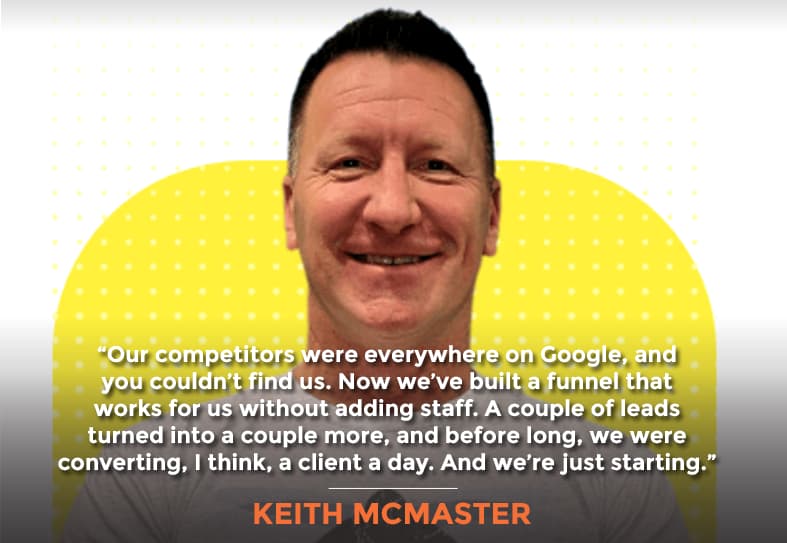
- [33:58] – Keith shares the significant increase in leads and clients due to the SEO and AI strategies implemented.
- [42:44] – Keith’s personal branding efforts aim to help other entrepreneurs and business people through coaching and mentoring.
Keith, it’s so great to have you on the show.
Thank you for having me. It’s great to be here.
So first of all, let’s start with your origin story. How did you end up doing what you do with what’s this whole business that you’re in, with things like skip tracing and chasing people down that are trying to evade you? Like that sounds intriguing for a listener who isn’t familiar with what your company does.
Yeah, it started as kind of a part-time gig. My dad was a police officer trying to feed six kids, and he had a job on the side doing private investigative work, locating people. He would also bring people summonses, complaints, subpoenas, and that’s where I kind of fit in, into the gig work of that, while I was going to school in college. And then it was in the 90s, and it seems like yesterday, but it’s now a while back, 30 years ago, there was the tech revolution back then. And back then, it was computers, right? It was going from word processors to computers, and Windows-based systems had just come out. And so it started way back then, like kind of gig work, and then looking at how we could integrate computers into that business. And here we are, 30 years later, doing that work more throughout the nation.
It’s your constitutional right to be notified of any pending legal action. Our job is like a carrier for the court system, delivering that notice to you.
And so process serving is serving someone papers if they’re getting sued, for example, and your client is trying to serve those papers on, let’s say, a defendant, and that’s what they would hire you for, or the lawyer that’s representing the client is the one that hires you.
Yeah, so the lawyer would be the one to hire us. The lawyer on the plaintiff’s or defendant’s side, or maybe an attorney who needs a witness for a case, would hire us to go out and, in the United States, it’s your constitutional right to be notified of a pending action against you. So our job is kind of like a carrier to the court system, letting people know there is a pending case they need to respond to. And so that’s what we bring out. Most times it goes pretty friendly. There are occasional times when it’s a little different, but most times, it’s a pretty easy job, and it’s the equivalent of being a notification person, a mail carrier to defendants for the courts.
Yep, got it all right. So how did you end up following Jay Abraham or working with him? Because we met through Jay Abraham, and you became a client. So how did that come about?
So Jay, and he didn’t know it at the time, but he was like, almost like a mentor, a hero. I followed somebody through his books. And the one book that always stuck out to me was Getting Everything You Can Out of All You’ve Got, that’s the book I had. I followed a lot of his teachings there, followed a lot of his chapters, and the one chapter that really hit me along the way was the one on fish, where the big fish are, or the one model. And I started looking for those volume clients, volume customers. And again, if you think about the late 90s, early 2000s, computers were just starting.
So that’s when we realized, “Oh, if we take some of the technology that’s becoming available at the time, along with some of the teachings of Jay Abraham, then we can expand into other areas”. And we did. We started expanding. And it wasn’t until COVID, when I really had a lot of extra time on my hands, that Jay was offering a course. I jumped into the course. You were one of our guest speakers, and I volunteered to “hot seat” my website for you. From there, we’ve been partners ever since.

Yeah, that was fortuitous volunteering. So thank you for doing that.
It was a humbling experience.
Yeah, so I try to be gentle, but I want to call it like it is because it doesn’t do any favors to just say, “Wow, this is great” if it’s not great. Yeah, yeah. So we started working together. It’s been several years now, and we’ve delivered great results for you. But before we talk about the results, let’s discuss the journey and how this unfolded. What were the objectives that you were after? Why did you want to hire us? Why did you maybe not almost hire us?
Sure? Well, the reason I volunteered for the hot seat is that I knew, inside, our website was old, dated, and legacy, so I needed somebody who could give me honest advice. And I wanted that feedback. I didn’t just want a yes man; you gave me one, and that’s also one of the free marketing tools. We’re a family-owned company, so we have limited resources to go out, make sales, attend conferences, and do other things. So what we were looking for was that billboard, that marketing tool that’s out there doing work for us without getting pushed to the background, right?
And a lot of our competitors, you could see them on Google. You could find them under common keywords, but you couldn’t find our company, Firefly. So I wanted to make sure we moved the charts up so that if someone’s looking in the Chicago area, Florida, or Ohio, they can find Firefly. It didn’t take any time from us beyond answering their questions, answering their calls, and having them come to us. So it became a funnel, an automatic funnel that just flowed for us without hiring an additional person to put out there trying to bang on doors, make cold calls, and honestly, it’s easier.
It was a team effort between Keith, Studio1, and Netconcepts to create a site that’s beautiful, functional, and converts at a higher rate.
Yeah. So we tackled several aspects here. The first thing was to get the SEO in order. That involved conducting keyword research and targeting those keywords through content. You did not have much content on the site. It was pretty thin in terms of content. So we had our writing team working on content for you, blog posts and so forth. We had technical work to do. It’s a WordPress-based website, so it’s pretty easy to go in there and make changes. So we were going in and optimizing the site’s technical structure, doing, as I said, keyword research, and also building links.
As part of a comprehensive SEO engagement, we also recommended hiring another company to work alongside us to redesign the website, as it doesn’t look like it. If someone sees you at the top of the search results, clicks, and it’s not well-designed, it doesn’t look contemporary, up to date, or like a quality brand. So you took that advice to heart and hired Studio1 Design.
In the previous episode here on Marketing Speak, I actually did a case study with Greg, the founder of Studio1, going through your site and providing a lot of behind-the-scenes of what we did in the redesign process. So it was a team effort between you, Keith, Studio1, me, and my team at Netconcepts to come up with the final design and the live site, which is beautiful, highly functional, gets the job done, and definitely converts at a higher rate. So thanks for taking that advice on board.
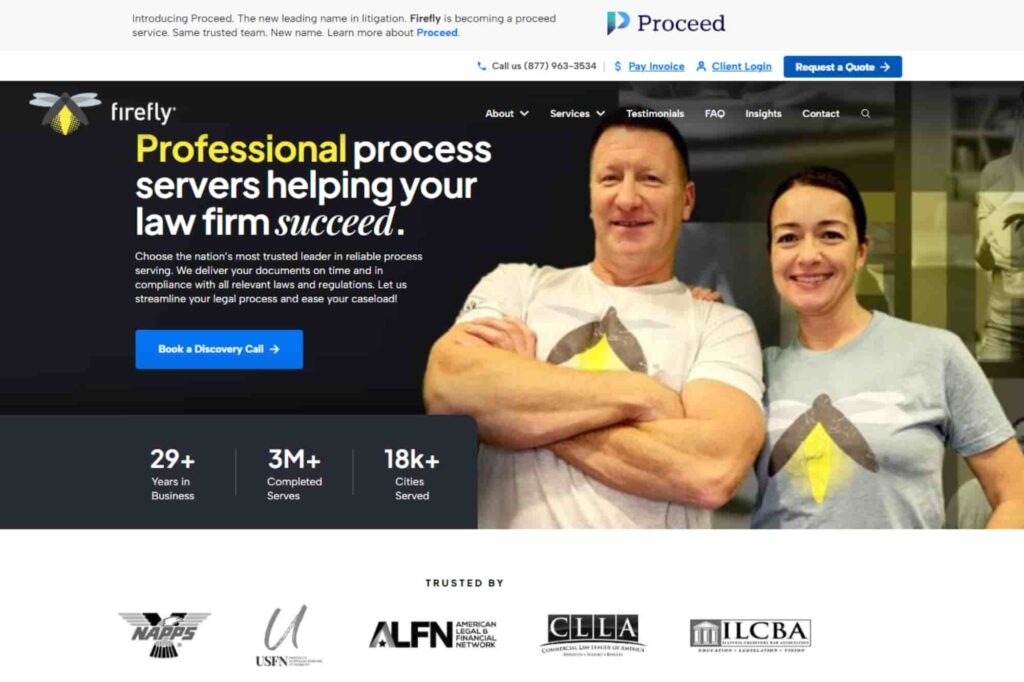
Yeah, it converts at a much higher rate. And to just talk about Studio1 real quick, I think what they did is they took who we were, as people, as our company. They really portrayed that, which was great, and it’s not the same boring, generic websites that everybody else is going to have, like, I’m on the top of that website. In my own environment, we’re kind of wearing our T-shirts, which, again, if you’re a person on the street going out to serve somebody, you’re not going in a suit and tie.
For the most part, you’re kind of just a regular dude. And so that’s how they portrayed us as regular people, regular people that you’d want to know, want to have a conversation with. And it’s converted. And so, taking that along with all the new articles and things the writing team did for us has just been awesome and exponential for growth. So it’s been great.
Yeah, yeah. So, for some of the technical SEO, we made sure that things like titles and meta descriptions were optimized, as well as heading tags. A lot of the behind-the-scenes HTML coding, not just revising and rewriting content, but going into the HTML, making sure schema markup is added, doing things that would help, also with AEO answer engine optimization, or, you know, AI SEO, essentially.
So we tackle all the aspects of that. And when you said that Studio1 really understood your brand, we wanted to make sure, as the company and the team that already held the relationship with Firefly, that we were on the same page. We wanted to make sure that when we brought them in, they understood what we already learned about your brand.
And so we did a very thorough briefing process with them. I’m a big fan of The StoryBrand 7-Part Framework.
There’s the book by Donald Miller called Building a StoryBrand, and in it he talks about things like having a common enemy that your visitor can say, “Oh, yeah, I hate that. I hate those things, or those,” like planned obsolescence. You know, we can all get around, get behind, hating planned obsolescence, like I hate having to buy a new iPhone every two years, or even every year. That bugs me because I’m environmentally conscious, so we can all agree to hate that. So what’s the common enemy in your case, with Firefly legal and your constituency, your target audience? What would you say is the common villain, or shared villain?
There’s been some problems in our industry, and so one, you want to show that. You want to portray integrity, but you also want to portray speed, accuracy, efficiency, all these things tied into one, right? And the most important thing is that you get it done correctly. So if you don’t get it done correctly, a case can be killed in court. It might have to start over. It could cost somebody money. It could cost somebody a case. So it really has to be done correctly. It has to be done efficiently. There has to be communication with the clients, and you and your team conveyed all those points through our articles, blogs, and website design. So everything came together. It all flowed very perfectly. So it’s great.
And now we’re working on YouTube shorts and Instagram reels for you that portray that as well.
That’s right.

Yeah. Speaking of that, your social channels kind of went stagnant for a while, nudging you to get them revitalized. You want to talk a bit about that?
For about, you know, 10 years or so. I think they were sitting there.
Not quite that long, but multiple years.
So now it’s fresh, and it’s updated, and it doesn’t seem like it’s been sitting there, not producing, but that’s also as the younger generation comes up, that’s what they’re on. They’re on Instagram, Facebook, X, even the younger kids are on TikTok, and there are other platforms I don’t understand yet, but I’m trying to stay relevant with where the industry’s going. And that’s kind of how I’ve always been, from the way we started the company with the tech industry, to building a mobile app before an iPhone came out, to trying to use AI in our industry. So it makes sense to stay on top of social media, the website, and all that, since they’re integrated.
Yeah. So there’s this concept called a lead magnet in online marketing: an irresistible offer you don’t have to really hard-sell, because it doesn’t cost any money and it’s high-value. It’s a no-brainer for someone who’s, let’s say, a first-time visitor to your site; it might be offered via a pop-up, an ad in the sidebar, or at the bottom of the page. So we came up with a lead magnet idea for you, which you really liked. So you want to talk about that.
It’s AI problems for the legal industry. And you and I have been working, and really, you’ve been mentoring me in the AI world and how to start advancing in it and using ChatGPT, Gemini, Grok, and countless other tools along the way. Because of using those AI tools, we’re able to say, “Hey, you know what? We could share some of those things on our website. We could share some of those prompts that really would produce good results in the AI world, for attorneys or for people with questions in our industry.
And so many people think it’s just a question-and-answer session with AI, but it’s not. The more descriptive, the more down to the nitty-gritty you get, the better answers you get out of these LLMs. So we’re trying to help provide and provoke and move our clients, or potential clients along that path, and say, “Hey, at least if you don’t like our services, at least you get something that we can give to you that makes sense and hopefully helps you along the way, and then one day, maybe you’ll come back if you do like it, hopefully give us a call and send us some work, and it’s a fair exchange.”
The more descriptive you are, the better results you're going to get from AI. It's not just question and answer—the more down to the nitty gritty you get, the better. Share on XYeah. So if your primary industry, or one of the primary industries that you’re targeting, is the legal industry, and you offer a high value lead magnet in the form of prompts and tools for AI that will really help up level their skill and the output that they get from AI every time they use that new prompt or new approach or that new tool. Hopefully, they’ll remember you or at least some of those times, and that will make them more inclined to work with you or hire you when they need it, even if they don’t have a need right then and there.
So we did the research, my writing team did the write-up of this, I think, it’s what a 10 or 15-page document might be, a 30-page document. It’s a great document, yeah, and it looks pretty good because Studio1 did a great job with the design. Still, yeah, it’s really about the content and the value it conveys.
Even if it’s a pretty document, it needs to deliver on the promise of saving the reader a lot of time and improving their productivity with AI, which I believe it does. And so, you know, they’re probably familiar with some of the tools. For example, Harvey AI is pretty well-known in the legal industry as a legal-focused AI platform worth now multiple billions of dollars, so they’re doing really well.
But some of the other tools we highlighted, I bet they hadn’t heard of, so we did all that research and figured out the different kinds of prompting approaches. Act as an expert in such and such a field, etc. Act like you’re Jay Abraham or a mix of multiple top copywriters and marketing experts, and do this thing for me. Then they’ll get better output, which could make a huge difference in the strategy they ultimately implement or the document they use as a kind of North Star for their business. So yeah, that’s a really great lead magnet.
Yeah. And for me, our business is all about helping people right, whether it’s helping attorneys get things done or helping people know that they’re notified. Here again, we’re helping people learn this brand new world of AI, and who knows, maybe they can help somebody else learn that, but just the whole act, as an expert, I put that almost at the end of or at the beginning of every single prompt. As an expert in X, tell me how I can do A, B and C, and I will try to be descriptive and give those prompts. And so again, it’s all about helping people, and I think this is a free tool on our site that you can grab, and hopefully it helps people, our legal industry, and somebody else along the way.
Another trick that you might want to add to your prompting game is to ask the AI to ask you questions to clarify and provide better output. So if you have any clarifying questions, that will make for better output. Please ask me now.
Ask ChatGPT to identify gaps and suggest ways to make it more compelling. That’s how we built deeper, more effective case studies.
I think it worked out when we were trying to create a results page for the website. We were building the case studies, and I put in all the information, then I asked, “What am I missing?” Ask me questions that can fill in the blanks that make sense. A better case study, and it’s been great. And I’ve used it not only for the Firefly site, but also for my personal information.
Yeah, for your personal brand site you’re launching here soon. Yeah, awesome. Well, we’ll talk about personal brand in a little bit, but let’s go deeper down into the rabbit hole of a results page. So, by the time this episode goes live, we might have the new results page live, but we may not. Depends on Studio1. It has to code the page and the site section. But let’s juxtapose these two different ways of doing things: the testimonials kind of praise page approach, which is what we have on the current site, and a results page we’re about to go live with soon. What’s the difference in your mind and in the potential client’s mind between a Testimonials page and a results page?
So when we started the redesign, I think what was missing was the social proof, right? We didn’t have social proof, so we started building it, right? So that was step one.
Yeah, and that would include things like logos of some of the bigger clients that you work with over multiple engagements, testimonial quotes, even videos, if you could get those, those are harder to get than just the text quotes. But, yeah, social proof is very important.
So like, that’s where we started. That was step one. But then, as we’ve gone along, it’s been, “How can we make this better?” How can we show even more that we’re experts in our field? That’s where, when we were discussing it, you were like, “Can you create case studies? Can you do certain things?” And you know what, with AI, with thinking, with my staff, with different things, we could create those things.
The difference between a testimonials page and a results page is huge. It’s not just about praise; it’s about showing real, measurable impact.
And now you have an even more compelling story to give to a potential visitor to your site, a potential client who’s not just, “Hey, my friend Joe just gave me a you know, these guys are great.” This is like,” we’ve done this for this client, and this result happened, and here’s what it provided,” right? So you’ve got testimonials. You’re not losing those. You’ve got your social proof with you, you’ve got your logos, you’ve got your associations that you’re involved with, but now you’ve got real life. How can I help you succeed? And here are some different ways, and these are out of the norm ways, and these are case studies of things that maybe you’ve never seen, thought of or heard of, that can help you as a potential client in the future that we’re thinking of.
So you alluded to this already, but I gave you a fair bit of AI training to help you level up your personal AI games and get more output and more value from your LLM usage. So do you want to talk about that? And then we’ll move on to how you used AI to draft these case studies.
Sure. I mean, I guess it started with ChatGPT. I was on it. I had the $20 platform, or whatever, and you’re like, you know what? You’ve got to upgrade that, get the best version available. And I did. And one of your suggestions was just to talk to it all the time. You’ve got thoughts. Talk to it, let it know you. And with the memory system built into the earlier ones, the memory wasn’t so good unless you paid for it.
Memories are getting better and better and better, but the more you talk to it, the more it knows you, the more it knows your voice, the more it knows your thoughts, the more it knows everything about you. As a matter of fact, ChatGPT refers to me as Coach Mac all the time, like, Okay, Coach. And they just like it when I refer to myself as coach, coach, coach. And that’s because I use it not only for work, but also for football and for holiday recipe-making. So, but it started with ChatGPT.
And then now, when you say that, you talk to it, you also hear it talk back to you, so you can talk to it and have it transcribe what you are saying, and then it will give you typed output back. That’s pretty straightforward, but when you have a conversation with ChatGPT, because it can speak back to you, that opens up a whole wealth of opportunities where you can now work on things where normally you would be just dealing with dead time sitting in traffic. Maybe you could listen to a podcast, but here you can get real work done while you’re sitting in traffic by having a conversation with ChatGPT.

Yeah. And you know what’s cool is, and this is not a promotion, but I drive a Tesla, and Tesla have Grok built in. And so now, when I was driving, I had to drive two hours to Wisconsin. You can’t be on your phone while you’re driving, but while I was driving those two hours, I could have a conversation with Grok and then have that transcribed, and it would be sitting on my computer when I was done, so if I thought of an idea. I did not lose it.
So I used Grok from my car that way. I also use Comet from Claude as a diff, just a different version of an internet browser, using Gemini in almost everything I do with the Google Workspace. So it’s really all combined. And then, to go back to your case studies, I gave ChatGPT, here’s some of the things I’ve done, and here’s some of the results that have happened. I need to build a case study.
When you give a case study, the more descriptive you are, the better the results you’ll get. I probably wasn’t as descriptive as I needed to be to start. And it gave me a summary of what a case study was, and I expanded on it somewhat. I compared it to what I put into Gemini, I asked it a couple of questions, and I sent it to you, and then when you sent it to me, you’re like, “No, no, no, we got to build this out a lot more. This has to be compelling. This needs to be a good story. There’s so much missing here. Let’s figure it out.” Ask ChatGPT to ask you what is missing. “What can make this more compelling?” So I started asking ChatGPT to compose questions, ask me questions, and let me give you answers. And with doing that, we built out way more comprehensive case studies.
When you have a conversation with ChatGPT and it can speak back to you, that opens up a whole wealth of opportunities.
And way more interesting with great storytelling, like if you ask ChatGPT to ask me questions that will give the case study a better story arc, then it will do that. But if you don’t ask, then you won’t get
Right, because what you asked for is what you get back. So it may have some thought. But if you’re going to be basic with ChatGPT, it will be basic back with you. If you want it to be advanced and comprehensive, it will be. So it’s all in the prompting. It’s all in what you’re looking for. And you just have to take what’s in your brain and portray it either on the screen when you type it or talk to it, and just give it that’s why I think talking to ChatGPT is a lot easier, because you can just say everything that’s on your mind, and it kind of understands what you’re thinking. Then it puts it all back into that format for you.
So what is this idea of a results page? Why wouldn’t you just call it ‘testimonials,’ ‘testimonials and case studies,’ ‘ case studies,’ or ‘success stories’? Why the term ‘results’?
I think because that’s what clients want. They want results. They want answers given back to them. And so that’s what we’re going to provide, results for you. And so whether it’s results with the case studies that show that, or whether it’s clients that give us a small little quote, or whether we’re part of these associations, you’re going to get results because we are professionals. We’re continuing to try and get better and better at our craft and get better and better results for our clients. So I think the results hit with our clients. I think results hit clients across all industries. So it’s just one more step up. We’re leveling up and continuing to improve our game to deliver the best possible results for our clients.
Yeah, and related to results are frequently asked questions, because when people are considering hiring your firm, they want to see results. They want to know that you deliver results. They also have objections or concerns that need to be attended to or addressed, and that’s where a Frequently Asked Questions page, and also FAQ or frequently asked questions on multiple sales pages and landing pages come into play.
Sure, and again, I think that’s also like, just like ChatGPT, the more you can give an answer, or the more you can provide answers to their questions, or provide answers to questions they’re not even thinking of. The better you relate to the client, the better you relate to the person reading your web page. Because, again, all marketing is one-on-one, so it’s our web page speaking to the person on the other side of the screen. And so we’re trying to give “Hey, if you have this question, we already have your answer. If we can provide the answers before you ask the question, we’re doing a good job.”
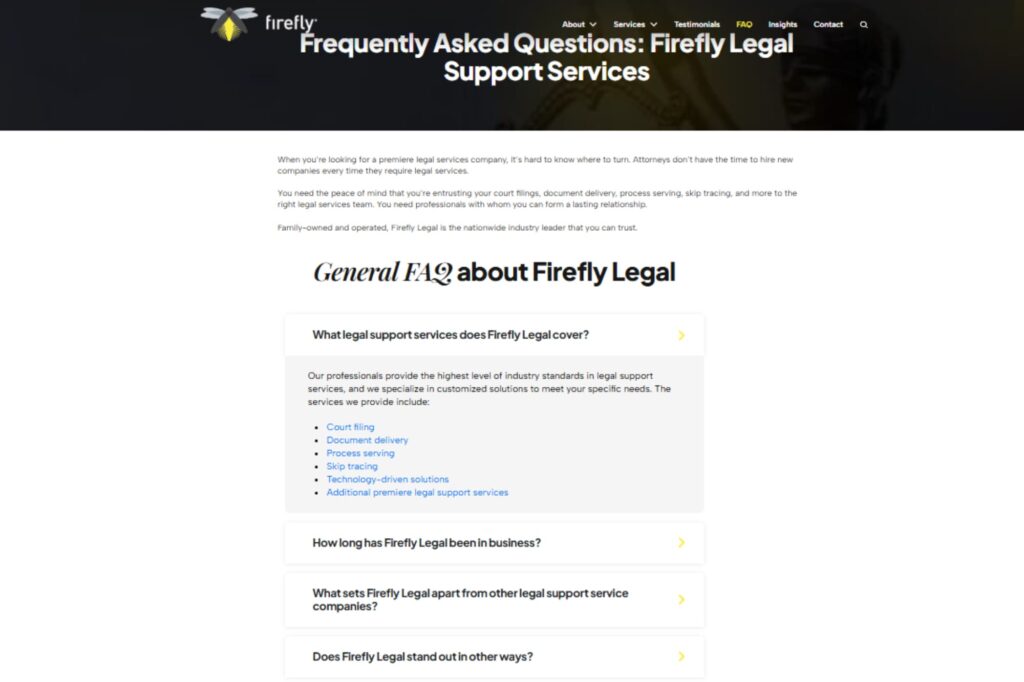
Yeah. So you have an FAQ page, which is a set of questions broken down into sections on pricing and other topics. You also have various services pages that each include FAQs at the bottom. So, for example, on the process serving page for just the general services page, you have, “Can a process server talk to my neighbors? Can a process server walk around your property? Do you have to answer process servers’ questions? What happens if a process server can’t find you? How do process servers find people?”
Questions like that, which help with SEO, help with, you know, showing up and people also. Asked a section of the search results in Google. It also helps with AEO answer engine optimization, so that you show up in ChatGPT as a recommendation and other LLMs, Perplexity, etc. So having that just as Questions and Answers is a good thing. But on top of that, we also add FAQ schema markup, which makes it very clear to all these engines that this is a question, this is an answer, then this is a question, and then this is an answer.
People have objections or concerns that need to be addressed, and that’s where a Frequently Asked Questions page comes into play.
And so that increases the likelihood that the LLM will utilize those FAQs, or in the case of Google, that it will be potentially not just an answer in Google AI mode or an AI overview, but also in the people also ask section where people can expand on those questions and then see the answers, and then more questions get populated into that section as you expand some of the questions. So that’s a great little strategy there for FAQs.
Another strategy I want to bring up that I’m really proud of is having these service pages like process serving, for example, or skip tracing or court filing, having multiple locations that you’re in many different cities and states, some states are more important than others, some cities more important than others, as far as your market, but having a page for process serving In, let’s say, Arizona, versus just having one single services page for process serving and that’s it. And hoping that ranks for everything from process servers in Arizona to process servers in Ohio to process servers in Chicago or Chicago process servers, etc, that’s not likely to happen if you just have a single page trying to target all of those location-focused keywords. So we have a range of pages that cover these markets, combining location and service. Do you want to expand on that, or say anything about the results?
Well, I would say that, starting in the early 2000s, we expanded by opening offices in Tampa, Miami, Cleveland, and Cincinnati. So we had offices. We had, I think, 18 different offices at one point, and you were listed in the Yellow Pages or in the local Google Maps listings. But as time has moved on and technology’s changed, we’ve actually shut down those offices, because everything can be localized, especially since the pandemic.
We’ve been able to really use the technologies that became available to reduce our office size. Still, we’ve expanded our footprint because we can be in Wisconsin, Pennsylvania, Philadelphia, Chicago, or wherever a person’s looking, and when a person goes to look, they’re not looking in the yellow pages. They’re probably not looking on Google Maps; they’re probably going to type in “Chicago Process Server.”
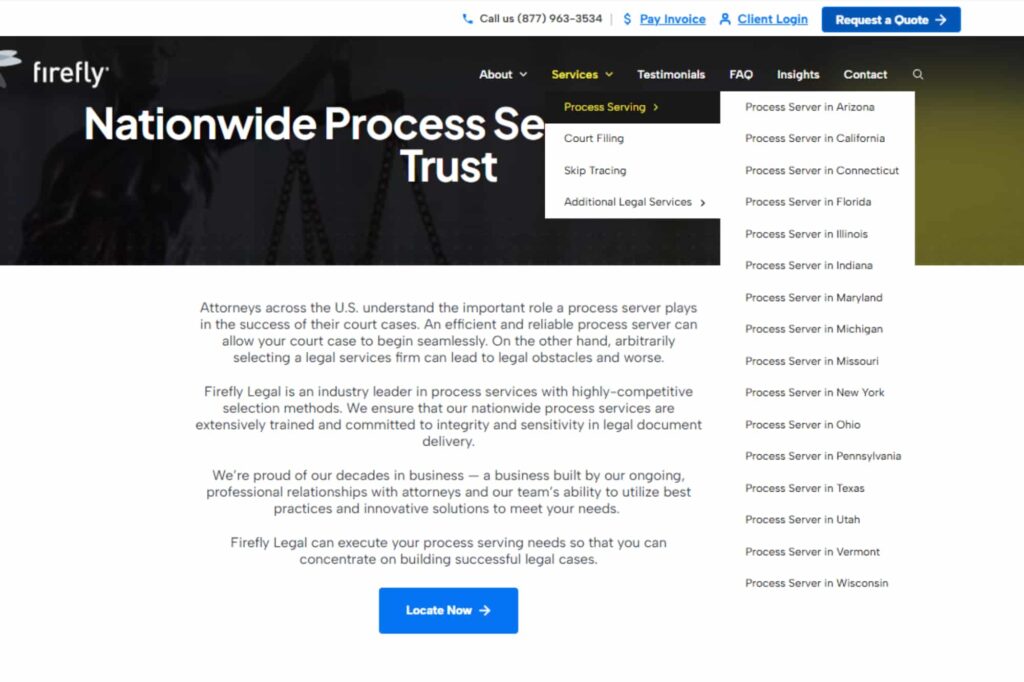
So you’d better have a way to make sure your web page comes up in the top results on Google, or in Illinois. We need a person in all of Illinois, or we need Florida, or we need, hey, there could be Jacksonville in Florida, so that those different ways expand your footprint without having to expand your square footage. You can serve a much larger area and more people with a centralized product. So it’s been great.
Yeah, awesome. So let’s talk a little bit about the results. What have you seen over the couple of years we’ve been working together so far? What are you getting in terms of leads and signed clients and rankings, traffic, improvements, all that sort of stuff? What’s been the result for you?
So it’s scary to think, but before we started working together, I don’t think we were tracking where any results came from, how they came about, or anything like that. So we would get a call, and it was generally a referral, which is a great way, but there are so many more ways. Again, what we were looking for was something out there selling for us that we couldn’t be, and what we did was implement a tracking system. Where did it come from? How did it come from? And then we implemented a way on our web page to schedule appointments, so we’d have them scheduled.
What you ask for from an AI is what it gives you back. If you're going to be basic with it, it will be basic back with you. If you want to be advanced and comprehensive, it will be that. Share on XAll of a sudden, our tracking went from, you know, we got a couple of leads when we started working, to a couple more as the SEO took off and the website got built out. And so I think Jay Abraham always talks about doubling, then redoubling, then redoubling. Well, that’s what we were doing. And then you started seeing the results just up to the right every month, right? And so it became a thing where we were converting.
One client, maybe a month to two clients, a month to four clients. And then I think we started converting over a client a day. So when you think about that, a client a day, and you don’t know what the lifetime value of that client is going to be. It could be a one-time client or multiple clients over time.
And what’s really cool is that, and I wanted to mention this earlier, as you were speaking to the OEM and LLMs, we actually had one come in the other day that said, “Hey, found you on ChatGPT,” oh, that’s cool. So that’s a brand new way, right? Whereas people generally say, “Oh, I found you on the internet.” I found you on Google and ChatGPT, which was kind of fun and encouraging.
The better you can provide answers to questions they’re not even thinking of, the better you relate to the client.
Well, hopefully that’s one of many to come. One thing about ChatGPT leads is that they are pre-suaded. They believe the LLM has already done much of the due diligence for them, and they can just go ahead and hire you. So perfect. Pretty cool. It’s kind of taking a referral strategy and mixing it with technology to implement the best of both worlds. So awesome.
So if you want to share any specifics about the results, I know we have a case study right up on my site that you approved for publication. It’s got some good stats there, like an 850% increase in top three position keyword rankings in less than two years, which is pretty cool, just insane. And that’s, I mean, I really want to find those conversions, because I think that’s an insane number as well. I believe it was something like 400% in conversion.
So, yeah, 400% increase, yep, and qualified leads. You just can’t go out and get that at any conference or by cold calling; you’re just not going to get it right. Most people aren’t answering the phone, most people aren’t looking at your flyer, most people aren’t looking you up, unless, unless they are prompted to look at you. So that’s a huge increase, and it would not have happened without the SEO, the AEO and all the work that we put in, all the hard work, so to do it in two years is fantastic, and we’re not done yet. We’re still working our way up.
So yep, my website’s never finished, and SEO and AEOs never finished either. So yeah, hopefully we’ll be working together for a long time, right? So let’s talk a little bit about social media, or, as Gary Vaynerchuk now calls it, interest media. He says it’s not social media anymore. It’s not about the social network.
It’s about interests, because people who are not in your network, who have something very interesting, likely interesting according to your interest graph that will get shown to you on most of the social platforms, if it’s LinkedIn or it’s Facebook or whatever, you’ll see those shorts or those reels, if they’re likely to be interesting to you, Regardless of whether that person is in your network or even a friend of a friend of a friend. So we’re working on some interesting media, posts, videos and stuff. Do you want to talk a bit about that?

Well, it’s kind of cool. Some of the little shorts that we’ve just begun and just started, we’re using my own again to go back to us being a personal brand and going off our website, we’re using my voice to voice over some of those cool shorts, and then we’re hitting quick with quick just grabs right? And I’m the same way, like if I get caught in the death scroll, if it doesn’t grab my attention, it just goes past. But we think that the little shorts that we’re putting together are just long enough to keep a person’s interest, not too long, to where they just don’t want to listen to it, and then memorable enough to where they’ll remember your brand later on, or maybe it’s one of those touches that you need along the way to remember your brand.
So yeah. YouTube short. I don’t know if the listener is aware, but a YouTube short can be up to 3 minutes long. Now this has been the case for well over a year, and our shorts are significantly less than that. It’s more like a minute or a minute and a half. That’s the limit, you have a minute and a half for an Instagram reel.
But this is really about storytelling and a story arc in a very short period of time, and not losing them. The most critical time that you’re most likely to lose them is in those first three seconds. So you have to deliver a strong hook and powerful foreshadowing in those first three seconds, or they’re out of there. They swiped to the next one.
Right. And the whole thing is the hook, right? Just a quick hook, but you’ve got to keep it interesting if you’re going to go 45 seconds, 90 seconds again. Probably why we wouldn’t go three minutes, because after about 30 seconds, people are probably swiping.
Clients want results and answers given back to them, and that's what we need to provide. Share on XThat’s the thing, too: people who are in a position to educate me, or I’m ready to. Potentially buy, and I need to do my due diligence or my research. They’re in a different mode, and they’re likely to be watching landscape, longer form videos, whereas the portrait mode, short form content, reels and shorts, those are for people who are kind of bored, or they have a minute or two where normally they would just be kind of zoning out, looking into the distance.
Still, now they can whip out their phone while they’re sitting and waiting in the grocery aisle or a grocery register line for their turn at the register. So this is where creating shorts and reels is a different strategy than creating long-form video, and you have to really keep them engaged, because the average attention span of a reel or shorts watcher is probably much less than that of a goldfish.
Yes, and I, myself, included, get it and understand it.
So, we went with you as the voiceover. We played around with using ElevenLabs to clone your voice, and it turned out more authentic. ElevenLabs is incredibly good, but it’s just more real when you can get the person, in this case, you, Keith, the client, to give us the voiceover directly, rather than us having to rely on ElevenLabs. Now we’re creating hundreds of shorts for you. We’re not going to bury you in a bunch of voiceover creation. We’re going to use ElevenLabs, but in this case, you did such a great job, got such a great radio voice, we wanted to utilize that, and you were game to do it.
When I read those scripts that you guys are trying to portray to clients, I’m trying to also give my own inflection, right? And 11 labs will do a great job, but I may want to emphasize something a little more than they would, or where they would. So, a couple of takes, and you guys figured out how to put that all together and make it look so pretty like it was. It’s gorgeous.
Yeah, yeah, we used a lot of AI, of course, along with stock video, stock photography, various effects, graphics, transitions, and all sorts of cool stuff. So yeah, it’s really amazing what you can accomplish with video editing and with AI these days.
Yeah, it’s a little bit more fun to do it yourself, too. So it doesn’t take much time, and it’s a little bit more fun. And then when you see it all put together, it’s impressive.
Cool. All right, so I know we’re getting close to time. I want to cover a couple of other topics. One is your personal brand. So why make a personal brand website?
So things that I believe in in life are helping other people, right, whether it’s being a football coach, whether it’s being a business person, whether it’s serving people out on the street, like it’s to help people. And so it took me 30 years to figure out so many of these shortcuts, right? And if I can help another entrepreneur, another businessperson, or another employee advance their journey in business, my goal is to help them.

And so not everybody can afford a Jay Abraham, not everybody can afford Tony Robbins, not everybody can afford a lot of the experts out there. So maybe I can be a conduit to help them get to that point, fast-track them there, or point them in the right direction. There are a lot of cool things. And so, even when coaching football, my whole goal is to teach life skills through the game. Right? And how do you have teamwork, success, discipline, consistency, and dedication?
So all those life skills are things that I teach, and my conduit is football with kids. So I feel like football taught me a lot of life skills that I took into business, and now I’m taking that back into the football world, but I also want businesses to give me a lot, so I can give back to the business world. So that’s my goal. And if I can help others, that kind of drives me to help.
Yeah, so Coach Mac coaching in business, not just in football. Love it. So you recently got acquired.
I did. It’s funny, the industry goes through its cyclical, and it goes through changes about every 10/15 years. There are some changes, some consolidation, some things that happen. And because I was able to grow my company and do a lot of cool things with our website, marketing, and operations while staying scalable and efficient, people have been knocking on our door a lot.
And so this one company has a very good outlook on how they like to treat clients and people. Their culture aligns well with ours, and they like helping others. So that’s one of the reasons we felt it might be a good fit. The other reason is that they offered some other things that we can’t offer. Won’t be able to offer, but we can put together a more comprehensive package for law firms and lawyers. And so what you’re getting is not only the front-end trial court services from our firm, but also appellate work.
The work that goes all the way can go all the way up to the United States Supreme Court through this acquisition, and we’re also able to grow our footprint across different industries and geographies. So the acquisition is, and the coming together of these companies really creates something great to go forward with. It’s an exciting time, and it’s just the next step in our journey as a company to where we’re headed. So it’s fun, and it’s fun to find a team that you think can work together. So
Yep, awesome. And they acquired multiple companies over the course of this year, seven, I think, right?
Yeah, they’ve acquired six in our industry, and I think three or four in the appellate industry, and so, yeah, there’s a lot of great stuff going on, and we’re going through a complete rebrand, so we’re going to see how that all works out, but it’s going to be fun. So now Firefly is actually a proceed service, so Proceed is the parent company of Firefly.
Yeah, proceedlegal.com, correct?
Yeah.
Best of luck with that integration, rebranding, and expansion process. We’ll be here to help you make it more successful and impactful. And yeah, make things as easy and painless as possible.
Yeah, and I’ve given the highest recommendation I can to everyone at the company, and I’m hopeful that things will move forward.
Yeah. So thank you for that, and thank you for all the kind words you’ve said to the powers that be at Proceed, and for being such a great client. We’re just really so delighted to work with you. You’re just a joy to work with, and you’ve got such a great heart, a really purpose-driven mission, and a drive to succeed and to help people. So thank you for being you and for choosing us.
The feeling is completely mutual. I think we’ve been working together for three or five years, something like that, or we met along the way five years ago, and we couldn’t have gotten to this point without the tutelage of everything that you’ve taught me. And it isn’t just the website or just SEO; it’s a lot more like we have a good conversation just about life. So it’s been fantastic, and I appreciate everything you’ve done for our company along the way. So I would give anybody, anybody that’s listening or watching, the highest recommendations to Stephan and his team.
So thank you very much, very much. Thank you. And thank you, listener. Thank you for listening to this case study episode. So now I hope you take some action from what you learned and apply it in your business. Apply it in your life. Make the world a better place. We’ll catch you in the next episode. I’m your host. Stephan Spencer, signing off.
Important Links
Connect with Keith McMaster
Apps/Tools
Books
Businesses/Organizations
People
Previous Marketing Speak Episode
Building Trust Through Design: A Case Study with Greg Merrilees
Case Study: Firefly Legal’s Digital Transformation
Crafting An Expert Facebook Ad with Taki Moore
Digital Course Website Overhaul: A Case Study with Greg Merrilees
Don’t Just Speak, Perform! with Michael Port
E-commerce Redesign Secrets: A Case Study with Greg Merrilees
High Converting Landing Pages with Greg Merrilees
Local Services Website Teardown: A Case Study with Greg Merrilees
Secrets to a Persuasive Website with Greg Merrilees
The Real ROI of Good Design: A Law Firm Case Study with Greg Merrilees
The Enlightened Marketer with Jay Abraham
Wisdom That Transcends Marketing with the Legendary Jay Abraham
Previous Get Yourself Optimized Episodes
YouTube Videos
Your Checklist of Actions to Take
- Fish where the big fish are to scale my business. Identify and pursue volume clients instead of chasing individual small accounts. This allows me to expand from a local operation into a national service provider.
- Leverage technology as my competitive advantage. Integrate emerging technology into my legacy business model to differentiate and scale. Immediately identify opportunities to automate and systematize my process-serving business.
- Build my website as an automatic marketing funnel. Create a digital presence that works as a 24/7 sales tool without requiring additional staff or cold calling. Invest in comprehensive SEO, keyword research, content creation, technical optimization, and link building to ensure prospects can find my brand in key markets without having to actively pursue them.
- Seek honest feedback, not validation. Volunteer for a critical review of my business assets even when it feels uncomfortable.
- Invest in a comprehensive content strategy. Transform a thin website into a robust resource through strategic content development.
- Prioritize cultural alignment in business partnerships. Evaluate potential partners and acquirers based on shared values and how they treat people, not just financial terms. Choose the acquisition partner whose culture aligns with ours.
- Create systems that allow me to scale without proportional staff growth. Design operations that can handle increased volume through efficiency and automation rather than headcount.
- Build a personal brand that gives back and helps others. Launch a platform to share my 30 years of shortcuts and lessons with entrepreneurs who can’t afford expensive consultants.
- Use my core business learnings to expand my impact. Take the principles that worked in one domain and apply them to help others in different contexts.
 About the Host
STEPHAN SPENCER
Since coming into his own power and having a life-changing spiritual awakening, Stephan is on a mission. He is devoted to curiosity, reason, wonder, and most importantly, a connection with God and the unseen world. He has one agenda: revealing light in everything he does. A self-proclaimed geek who went on to pioneer the world of SEO and make a name for himself in the top echelons of marketing circles, Stephan’s journey has taken him from one of career ambition to soul searching and spiritual awakening.
Stephan has created and sold businesses, gone on spiritual quests, and explored the world with Tony Robbins as a part of Tony’s “Platinum Partnership.” He went through a radical personal transformation – from an introverted outlier to a leader in business and personal development.
 About the Guest
Keith McMaster
Keith McMaster is a veteran CEO and football coach known for simplifying chaos. He blends business strategy, tech-driven innovation, and real-world problem-solving with a high-performance mindset—helping organizations build disciplined systems, operate with clarity, and perform at championship levels.






Leave a Reply